
Women in Sarkaghat Moving Towards Self-Reliance
Munish Sood
Mandi
The state government in Himachal Pradesh is continuing its focused efforts to strengthen the rural economy through a range of livelihood-oriented initiatives aimed at enhancing income generation and promoting self-employment in rural areas. Among these, the sericulture programme implemented by the Industries Department’s Sericulture Wing is emerging as a significant intervention for women’s economic empowerment and sustainable income generation.
Women in Sarkaghat Adopting Sericulture as a Livelihood Option
Women in the Sarkaghat region of Mandi district are increasingly adopting silkworm rearing as an additional source of income, contributing to improved household financial stability and gradual economic self-reliance.
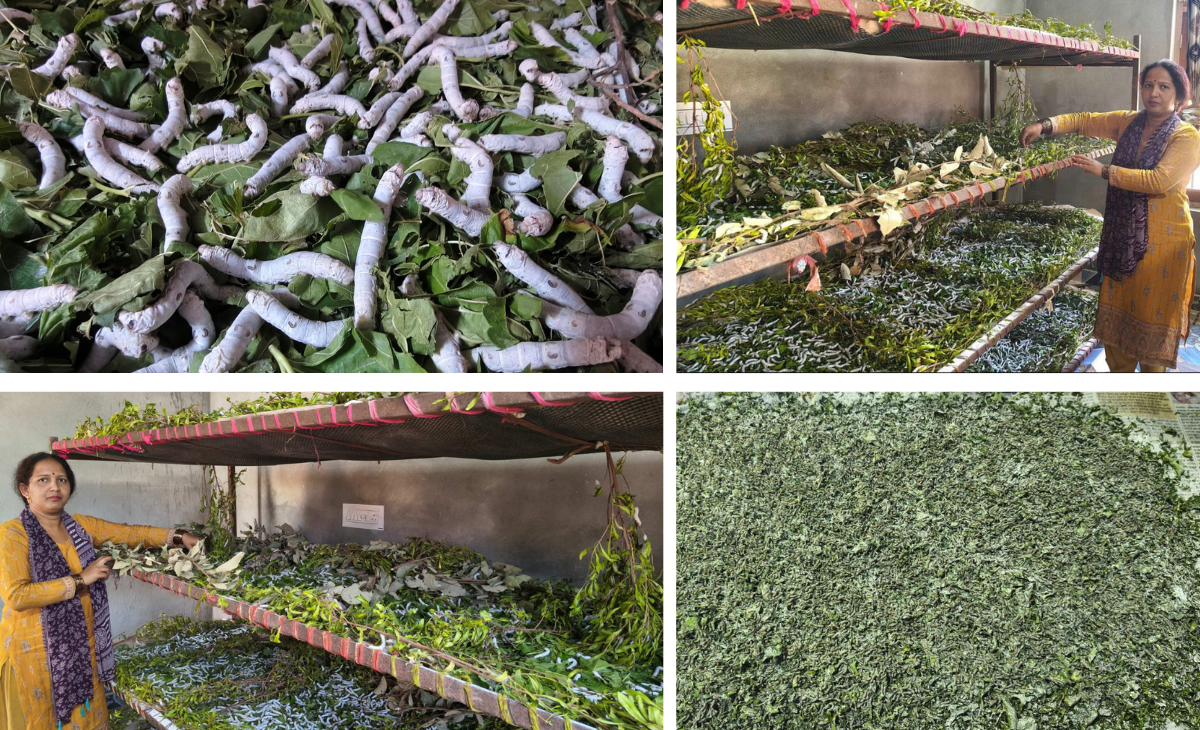
Madhu, a resident of Sinharn village in Sarkaghat tehsil, has become an example of successful adoption of the initiative at the grassroots level. She stated that she was introduced to sericulture through an awareness programme conducted by the department, after which she received technical guidance and support under government schemes to begin production at the household level.
Structured Government Support Enabling Income Generation
Madhu is currently engaged in home-based silk production, which has led to a noticeable improvement in her economic condition. Cocoons produced under the programme are fetching approximately ₹1,000 to ₹1,200 per kilogram in the market. She earns around ₹12,000 per production cycle, with two cycles annually, resulting in an average income of ₹24,000 to ₹25,000 per year.
She further informed that the state government has facilitated the initiative through provision of essential infrastructure, including rearing stands, plastic trays, nets, and a dedicated rearing shed for systematic production. In addition, mulberry saplings have been supplied along with financial assistance for plantation activities, while silkworm seed is provided twice a year. Field-level departmental staff regularly monitor operations and provide technical guidance to ensure quality output.
Expanding Participation in Rural Areas
Madhu noted that the initiative has significantly contributed to strengthening rural livelihoods and enhancing women’s participation in income-generating activities. She expressed appreciation for the support extended by the state government, stating that the programme has enabled families to access a reliable source of income within their immediate surroundings.
Her experience has encouraged several other women in the region to take up sericulture as a livelihood activity. At present, around 40 to 50 women in the area are engaged in silkworm rearing, reflecting a gradual expansion of the initiative and its impact on rural economic participation.
Institutional Support and Implementation Framework
Under the sericulture programme, the state government fully bears the cost of mulberry plantation. Beneficiaries are provided with essential rearing infrastructure, including stands, trays, and nets under various schemes. For larger-scale production, a 20×20 feet rearing shed is also constructed with full financial support.
The scheme is implemented through a shared funding model involving central and state government support, under which beneficiaries contribute approximately 10% of the total cost. The silkworm rearing cycle is completed within 15 to 18 days, enabling beneficiaries to generate income within a short production period.
Expansion of Sericulture Activities in the Region
According to Sericulture Inspector Arun Kumar at the Government Sericulture Centre, Mouhi, the operational jurisdiction includes Sajao-Piplu, Baldwara, and Samahela areas under the Sericulture Division Sandhol. During the current year, approximately 250 beneficiaries have been allotted silkworm seed, while 50 to 55 new rearing sheds are under construction, aimed at extending direct benefits to an equal number of families.
He further stated that with two production cycles annually (March and August), individual beneficiaries have the potential to earn between ₹35,000 and ₹50,000 per year, making sericulture a viable supplementary rural livelihood option in the region.