
Munish sood
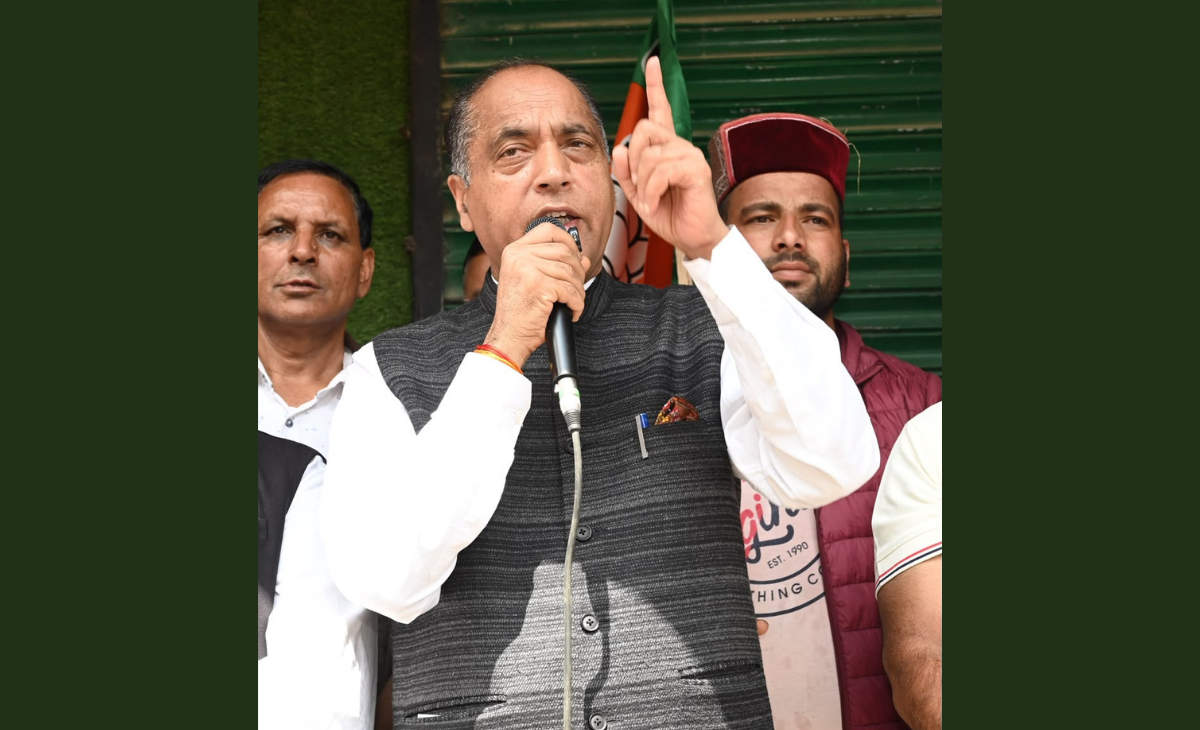
Shimla: A fresh political confrontation has erupted in Himachal Pradesh over the government’s move to prune the IAS, IPS and IFS cadres, with Leader of Opposition Jairam Thakur turning Chief Minister Sukhvinder Singh Sukhu’s cost-cutting argument back on the government.
Thakur questioned the rationale behind reducing the sanctioned strength of senior officers in the name of fiscal prudence while, he alleged, the government was simultaneously retaining favoured officials through repeated extensions and creating a network of positions carrying Cabinet-rank benefits.
His attack came a day after Sukhu said the state had more senior officers than it could effectively utilise and that rationalising their numbers could substantially reduce the government’s revenue expenditure.
Taking a pointed swipe at the Chief Minister, Thakur alleged that the government was reluctant to induct newly selected officers through the UPSC even as extensions were being granted repeatedly to serving or retired officials. Without naming the officer, he referred to a former IAS officer who, he claimed, had faced corruption allegations from Sukhu when the Congress was in opposition but was now being repeatedly given extensions.
Thakur questioned the timing of what he described as a two-year extension, arguing that the government itself had only about a year left in office. The BJP leader sought to turn the government’s own expenditure argument into a political question: if every rupee spent on the bureaucracy is being scrutinised, he asked, why should expenditure on politically appointed positions and associated privileges be treated differently?
He particularly targeted the appointments of chairpersons and vice-chairpersons allegedly enjoying Cabinet rank, accusing the government of creating a sizeable establishment around itself while simultaneously preaching austerity in the administrative machinery.
Thakur also revived the controversy surrounding the appointment of Chief Parliamentary Secretaries, alleging that the government had used public money on appointments that had been challenged on legal and constitutional grounds.
The counterattack came after Sukhu announced that his government was seeking to reduce Himachal’s IAS cadre from 153 to 130. The Chief Minister said he personally favoured bringing the number down further to 110, arguing that several officers were posted in relatively small departments where their capabilities were not being fully utilised.
The government has also reduced the sanctioned IFS strength from 118 to 83 and is working on rationalising the IPS cadre. Sukhu has estimated that the exercise could save the state between Rs 100 crore and Rs 150 crore, as the government grapples with mounting revenue expenditure and the withdrawal of the Revenue Deficit Grant.
Sukhu has framed the move as part of a larger fiscal restructuring exercise, arguing that Himachal can no longer sustain an administrative structure that carries a high recurring cost. He has also said that officers seeking central deputation are being relieved more readily, rather than being retained in the state despite a lack of suitable assignments.
But the BJP has seized on the issue to question the consistency of the government’s austerity policy.
The numbers themselves add another dimension to the debate. As many as 25 Himachal-cadre IAS officers and 24 IPS officers are currently on central deputation, while 17 IFS officers are serving outside the state. The government’s argument, therefore, is not merely about the number of officers on paper but about how efficiently the available cadre is deployed.
What began as an administrative exercise to rationalise the state’s senior bureaucracy has thus quickly acquired a political edge—with the Opposition challenging the government to apply its cost-cutting formula across the board, rather than selectively to the permanent administrative establishment.