
An Editorial on Youth, Workforce Readiness, and the Education Imperative of Our Time
Dr. Amrik Singh Thakur
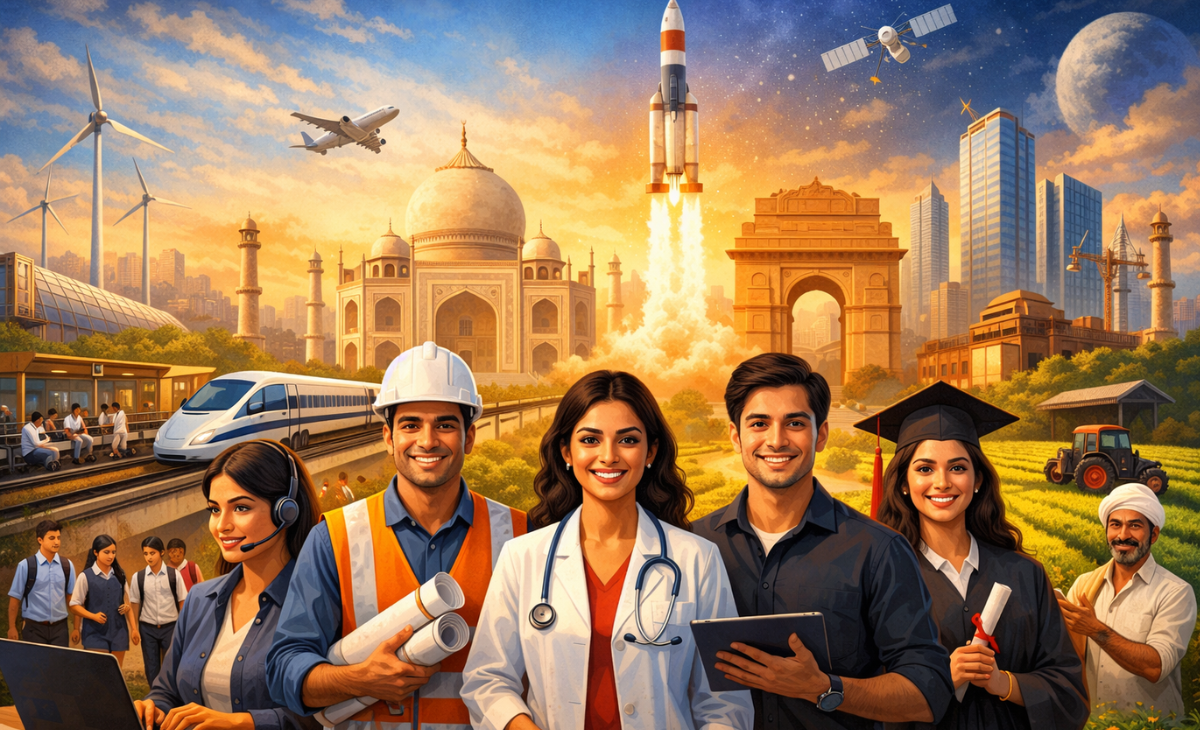
There is a number that India carries into every room it enters on the world stage. Not its GDP. Not its space programme. Not even its ancient civilizational depth. The number is this: by 2030, one in every five working-age people on earth will be Indian. That single demographic fact — stark, irreversible, and ticking with the urgency of a countdown — is simultaneously the greatest opportunity this country has ever been handed and the most demanding responsibility any generation of policymakers, educators, and institutions has ever faced.
We are living inside the demographic dividend right now. Sixty-five per cent of India’s 1.4 billion citizens are under the age of 35. The median age of an Indian is 28, younger than China, the United States, and younger than every major European economy. Demographers call this a dividend because a nation whose population is concentrated in its working years enjoys a structural economic advantage — more producers, more consumers, more innovators, more taxpayers, fewer dependents. But here is what the economic textbooks rarely say with sufficient directness: a demographic dividend is not self-executing. It does not arrive automatically simply because a country has a lot of young people. A young population without education, without skills, without employment, and without opportunity is not a dividend. It is a deferred crisis.
India is at the precise inflection point where the dividend either gets cashed or gets squandered.
The good news is that India has never been more conscious of this moment. The National Education Policy 2020 is the most ambitious reimagining of India’s educational architecture since Independence. It dismantles the rigid disciplinary silos that have separated sciences from humanities, vocational training from academic degrees, and Indian knowledge traditions from global intellectual engagement. It introduces multiple entry and exit points, credit transfers, and flexible learning pathways that treat students as complete human beings with evolving interests rather than as candidates to be sorted into predetermined grooves. The vision embedded in NEP 2020 is genuinely bold, and those who drafted it understood something important — that the education system India built for the industrial age cannot produce the workforce that the knowledge economy demands.
But here is where the honest discomfort begins. The distance between what NEP 2020 envisions and what a student sitting in a government college in a tier-three town actually experiences every day remains vast enough to be described, without exaggeration, as a civilisational gap. Thirty to forty percent of faculty positions in central and state universities remain vacant. An enormous proportion of teaching is delivered by contractual and ad hoc staff whose own professional development and security are precarious. Laboratories are underfunded. Libraries are thin. Internet connectivity is inconsistent. And in too many institutions, the examination system still rewards the student who memorises over the student who thinks, the one who reproduces over the one who questions.
This is the reality into which India’s 600 million young people are walking every morning. And the world they are walking toward has never been more unforgiving of educational inadequacy. Artificial intelligence is not a future technology — it is already restructuring hiring pipelines, displacing routine cognitive tasks, and raising the baseline competency threshold that employers across every sector now require. The graduate who cannot think critically, communicate clearly, collaborate across cultures, and adapt continuously is not merely disadvantaged in this labour market. That graduate is, with increasing speed, unemployable in the formal economy entirely.
India’s workforce readiness crisis is not a secret. The employability surveys conducted by bodies like NASSCOM and the Aspiring Minds National Employability Report have for years documented the same uncomfortable finding — that a majority of India’s engineering graduates, management graduates, and general degree holders do not meet the minimum competency standards that industry requires at the point of hiring. This is not because Indian young people lack intelligence or aspiration. They have both in extraordinary abundance. It is because the system that was supposed to prepare them has been systematically underfunded, under-reformed, and operationally disconnected from the world it is meant to serve.
The solution is not simply more technology or more policy documents. It requires three things that are harder to deliver than either. The first is honest accountability — a willingness to measure educational outcomes with rigour and transparency, to publish institutional performance data, and to hold universities accountable for what their graduates can actually do rather than merely for how many of them graduated. The second is sustained investment — India currently spends approximately 1.3 percent of its GDP on higher education, compared to two and a half to three percent in OECD countries. That gap is not a funding footnote.
It is a structural constraint on everything the system is trying to achieve. A nation that wants to lead the world’s knowledge economy cannot build it on a budget designed for a developing country’s administrative overhead. The third is institutional courage — the willingness of university leaders, faculty communities, and regulatory bodies to genuinely redesign the learning experience rather than merely redesign the curriculum document. Changing what is written in a syllabus is not reform. Reform is what happens in the classroom, in the laboratory, in the interaction between a teacher who has been given time and support to grow and a student who has been given a reason to believe that effort leads somewhere.
India’s young people are not asking for sympathy. They are asking for a system that takes them seriously. They are asking for teachers who are present, equipped, and motivated. They are asking for degrees that mean something to an employer in Bengaluru, in Dubai, in Berlin, and in Boston. They are asking for a connection between what they are learning and the world they can see around them — a world that is changing faster than any previous generation has had to navigate.
The demographic window does not stay open indefinitely. By 2047 — the year India has set as its horizon for becoming a developed nation — the median age will have risen, the dependency ratio will have shifted, and the exceptional concentration of young energy that defines this moment will have passed. What remains will be the consequence of what we choose to do with it. History will not be gentle with a generation of leaders who had access to the world’s greatest demographic dividend and treated it primarily as a statistic to cite in speeches. India’s one billion opportunity is real. The question is whether the education system is real enough to match it.
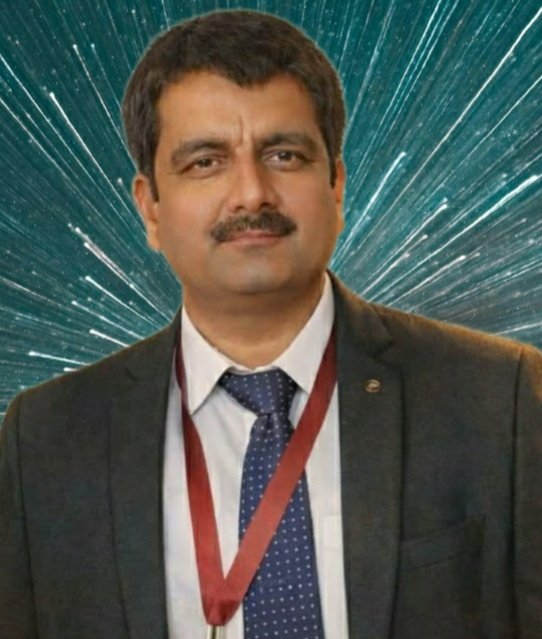
Dr. Amrik Singh Thakur is Director at the Centre for Tibetan Studies, Central University of Himachal Pradesh, Dharamshala. Views expressed are personal.