
Munish sood
Shimla
The political standoff over Vande Mataram and Jana Gana Mana continued to cast a shadow over the Himachal Pradesh Legislative Assembly for the second consecutive day on Saturday, raising an uncomfortable question: how long can the state’s legislative business be allowed to take a back seat to a political battle over national symbols?
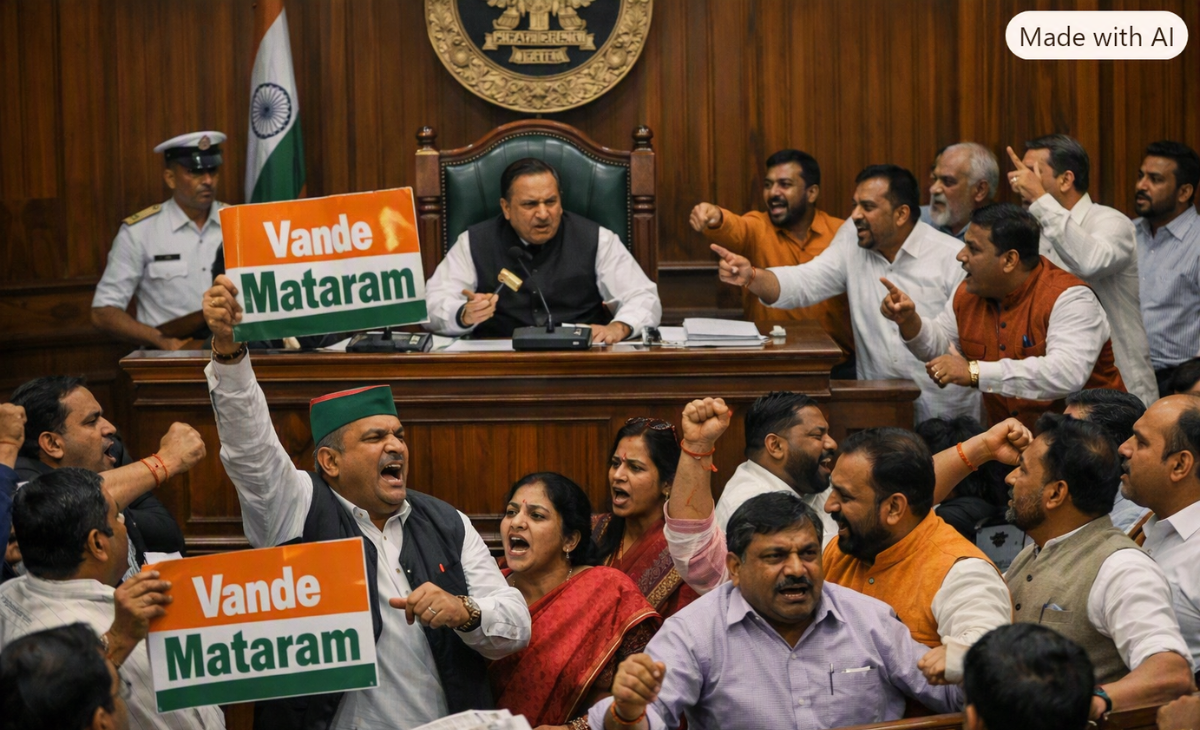
The first day of the monsoon session ended after barely 11 minutes amid an uproar over Vande Mataram. On the second day too, the confrontation continued, with the issue once again dominating the political discourse instead of allowing the House to focus on the problems confronting the people of Himachal Pradesh.
There is no question that Vande Mataram and Jana Gana Mana deserve the highest respect. They are national symbols and should never be reduced to ordinary political slogans. But the Legislative Assembly is meant to be the forum where elected representatives debate laws, question the government and raise issues affecting millions of people. When proceedings are disrupted, public resources continue to be spent on the machinery of the House while valuable legislative time is lost.
There is no publicly established official figure putting an exact price on every minute of an Assembly sitting. However, the cost of running the legislature is substantial, involving legislators’ salaries and allowances, the Assembly Secretariat, security, technical infrastructure, electricity, documentation and a large administrative workforce. The bigger cost, however, is the work that remains undone when the House is repeatedly disrupted.
Congress has questions to answer. If the Congress Working Committee’s decision to restrict its party programmes to the first two stanzas of Vande Mataram concerns its own organisational functions, why should that political decision become a source of confrontation inside a constitutional legislature? The Assembly is not a Congress meeting, and its functioning cannot be determined by a resolution of a political party.
But the BJP cannot escape scrutiny either. The Opposition has every right—and indeed a responsibility—to hold the government accountable. It has a long list of issues available to challenge the government, including unemployment, recruitment, election guarantees, the state’s financial position, roads, healthcare, education, agriculture and development. If the BJP believes the government has failed, the Assembly is precisely where it should put the facts on record and demand answers.
Likewise, if BJP leaders believe that vigilance investigations involving opposition leaders are politically motivated, those allegations too can be raised through facts, documents and constitutional mechanisms. Turning every issue into a confrontation, however, does little to serve the public interest.
The political benefits for both sides are obvious. For the Congress, a controversy over national symbols can divert attention from uncomfortable questions surrounding governance, finances and unfulfilled promises. For the BJP, the issue provides an emotionally charged political weapon with which to attack the government and mobilise public sentiment.
But the question is: who pays for this politics?
The ordinary taxpayer. The unemployed youth waiting for recruitment. The farmer seeking better support and markets. The patient looking for better healthcare. The family struggling with poor roads. The citizen waiting for an election promise to become reality.
They are not interested in which party wins the day’s political headline. They want the Assembly to work.
National symbols should unite the country, not become instruments of partisan confrontation. Congress cannot claim ownership over Vande Mataram. BJP cannot claim ownership over patriotism. Neither party owns the national symbols, and neither party owns the Legislative Assembly.
The Assembly belongs to the people. The people pay for it, and they have every right to expect their elected representatives to use every sitting to make laws, question the government and address public problems.
After two days of confrontation, therefore, the issue is no longer merely about Vande Mataram or Jana Gana Mana. The larger question is whether Himachal Pradesh can afford to lose precious legislative time—and public money—to political theatre.
Congress and BJP may gain political mileage from the confrontation, but if the Assembly does not do the work for which it exists, it is the people of Himachal Pradesh who ultimately pay the price.