
Munish Sood
Mandi
One of Himachal Pradesh’s most revered yet physically demanding pilgrimages could be called off this year after an expert committee concluded that key sections of the Shri Khand Mahadev route have become too dangerous for public movement.
A final decision is yet to be taken, but the recommendation has put the proposed Shri Khand Mahadev Yatra 2026 under serious scrutiny, with the district administration making pilgrim safety its overriding concern.
The issue came up for discussion at a meeting of the Shri Khand Mahadev Yatra Trust chaired by Kullu Deputy Commissioner Anurag Chandra Sharma, where members reviewed the findings of a detailed field assessment conducted by technical experts.
The survey, carried out by a joint team from the Revenue and Forest Departments along with specialists from the Atal Bihari Vajpayee Institute of Mountaineering and Allied Sports (ABVIMAS), found that the most critical stretch of the trek—from Bhim Dwari to Parvati Bagh—has become increasingly unstable.
According to the assessment, the terrain is marked by fragile mountain slopes, loose rocks, eroded pathways and multiple seasonal streams, all of which are expected to become significantly more hazardous with the arrival of the monsoon. Experts warned that landslides, rockfalls, flash floods and sudden water surges could pose a serious threat to thousands of pilgrims undertaking the high-altitude trek.
Significantly, the expert panel concluded that the pilgrimage cannot be recommended under the existing conditions, describing the risk level as unacceptably high.
The report also ruled out the proposed alternate alignment, observing that it offers no substantial safety advantage over the existing route. The committee further noted that any emergency evacuation or rescue operation in the vulnerable stretch would be extremely difficult because of the inaccessible terrain and unstable landscape.
Adding to the concerns, the camping site at Bhim Dwari has also been identified as a potential flash-flood zone. Experts said the geological condition of the area—dominated by loose boulders and unstable soil—makes even temporary protective infrastructure such as rope bridges or makeshift crossings unsafe and technically unviable.
To arrive at a long-term solution, the panel has recommended a comprehensive geological investigation by the Geological Survey of India (GSI) or another specialised scientific institution before future pilgrimages are considered.
Chairing the meeting, Deputy Commissioner Anurag Chandra Sharma said the administration would not compromise on the safety of devotees under any circumstances. He invited Trust members to submit written observations on the expert report before the administration takes a final call on the pilgrimage.
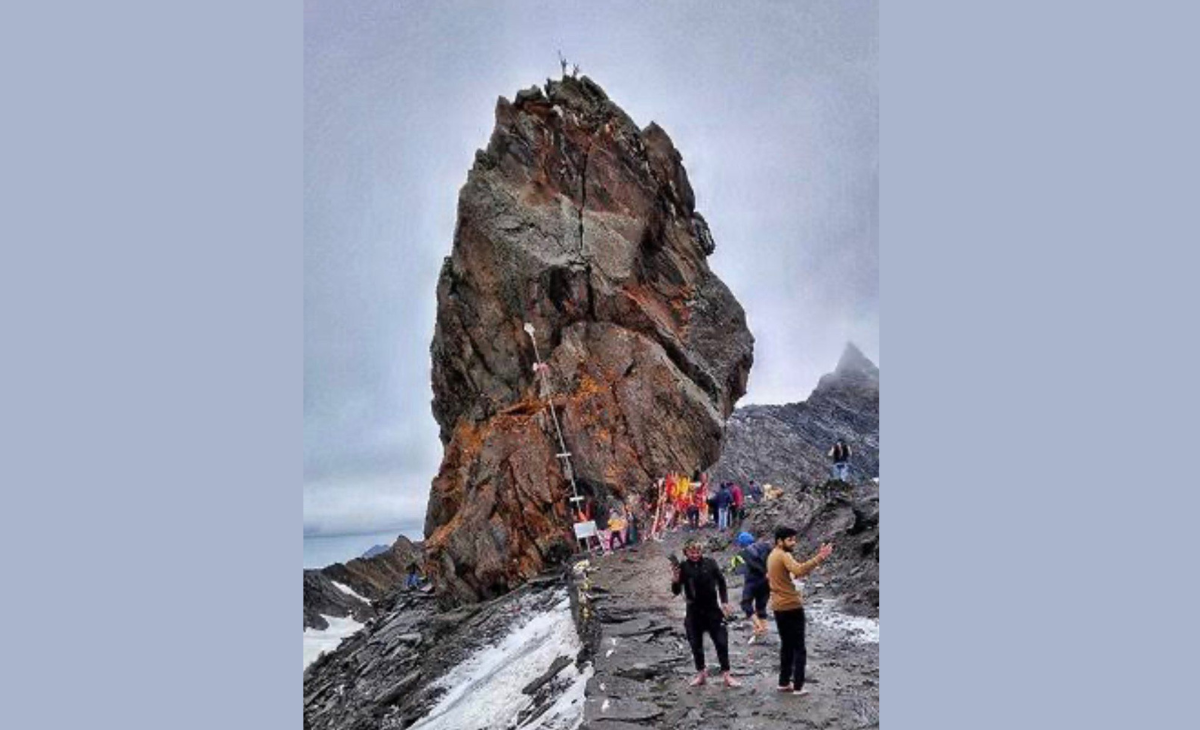
The Shri Khand Mahadev Yatra is regarded as one of the country’s toughest religious treks. Beginning from Nirmand in Kullu district, pilgrims cover nearly 32 kilometres through steep mountain terrain to reach the naturally formed 75-foot Shivling, located at an altitude of around 19,000 feet. The pilgrimage traditionally attracts thousands of devotees every July, but its challenging geography has also made it one of the most risk-prone religious journeys in the Himalayas.