
Dr. Aman Kumar Bhardwaj
Dr. Shikha Sharma
The Himalayas, which are famously known as “the roof of the world,” are considered some of the most remarkable natural phenomena in the world. These mountains stretch across India, Nepal, Bhutan, China, and Pakistan. They are a significant geographical feature, water source, biodiversity hotspot, and spiritual and cultural treasure. In the past few decades, the Himalayan region has turned into a major international tourism destination. It receives many tourists every year, who come to hike, worship, explore, and enjoy nature. While the tourism industry brings in revenue and helps the economy, there are many challenges related to it. The rapid expansion of tourism activities in the region has made it unsustainable and harmful for the fragile environment, local population, and other factors. The situation has become so bad that tourism, which was initially an advantage, is now turning into a disadvantage. The present situation requires tourism activities to be reconsidered and redesigned so that the economic benefits can be maximized without causing any harm.
Rise of Tourism in the Himalayas
In recent years, there has been an immense increase in tourism within the Himalayas. Even the most remote destinations are now easily reachable owing to better connectivity, social media presence, and increased disposable income levels. Currently, tourist numbers are increasing towards destinations such as Shimla, Manali, Leh-Ladakh, and hill stations within Uttarakhand during peak season. Adventure tourism activities like trekking, mountaineering, river rafting, and skiing have further contributed to the popularity of the area. Each year, millions of tourists come towards pilgrimage destinations like Kedarnath, Badrinath, Amarnath, and Vaishno Devi, adding to another dimension in terms of tourism. While such an influx has positive economic impacts and job opportunities, the extent of tourist inflows has surpassed the carrying capacity of the area.
Environmental Degradation: A Growing Threat
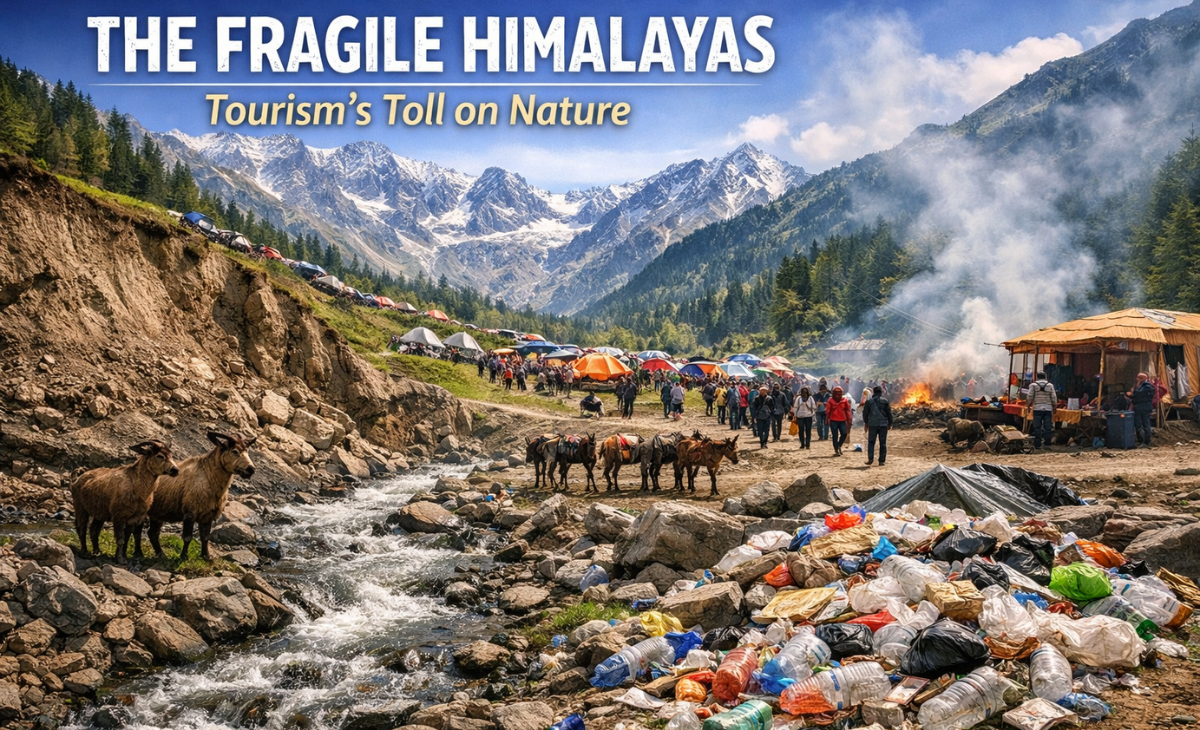
One of the most apparent and alarming consequences of mass tourism in the Himalayas is environmental degradation. Due to the high level of ecosystem vulnerability, even small disturbances can lead to long-term consequences. Regrettably, these ecological limitations are often overlooked in the course of tourism activity. Waste generation is a particularly serious issue. Plastic bottles, packaging materials, and other non-degradable substances are accumulating on trekking trails, along rivers, and at altitude campsites. There is no proper infrastructure for waste disposal in many areas. Contamination of soil and water occurs when waste is burned, buried, or accumulated.
Deforestation is yet another environmental problem that has emerged. Forests are cut down in order to make way for hotels, resorts, roads, and car parks for tourists. Apart from the fact that forests are home to several species of wildlife, it should be mentioned that this process makes the mountainside unstable, hence making landslides more probable. Another factor that is on the rise is that of air and noise pollution. Vehicle emissions have grown because of the rising number of vehicles in alpine areas, hence causing air pollution.
Resource Constraints and Water Scarcity
Water shortage is a serious issue in many tourist spots in the Himalayas. Despite the area being well-known for having plenty of rivers and glaciers, there is significant water scarcity. Overconsumption, mismanagement, and inequitable distribution are some of the key reasons behind such water scarcity. A large amount of water is needed by hotels, resorts, and home stays for activities like bathing, cleaning, and gardening. In peak tourist seasons, more water may be needed than available, leading to constraints imposed by the local administration. At times, water has to be transported from afar, leading to increased costs and detrimental effects on the environment.
People residing in these areas suffer the most. Though businesses related to tourism keep operating, they have little water for themselves. Conflicts arise between the people and the businesses due to this disparity. Another problem is that of energy consumption. Most remote places depend upon diesel-based generators for energy, thus resulting in pollution.
Climate Change Effects on Tourism
One of the most vulnerable regions due to the effect of climate change is the Himalayas. Melting glaciers due to increased temperature have caused a change in water levels in rivers and an increase in risk to GLOF. Alterations in snow patterns are affecting the lives of people and winter tourism in the region. Climate change is caused by tourism. Increased transportation activities cause increased greenhouse gases, especially in flights and road travel. The region’s ability to take carbon dioxide decreases due to deforestation and constructions in the region.
In addition, tourism and climate change can lead to a cycle of their own. As environmental destruction makes places less scenic for tourists, new tourist attractions emerge, thus extending impacts to previously unexplored regions.
Overcrowding and Infrastructure Stress
One thing that makes the Himalayan regions special is over tourism. Places where tourists like to go and trek are usually packed during the holidays and other periods when there is heavy traffic. This results in long queues and traffic jams. It is also possible to note that the infrastructure of the Himalayan region is not always designed for such high volumes of tourists. There are limited transport networks, roads that can be quickly damaged, and often inadequate emergency services. Disasters and accidents become more likely due to the stress placed on the infrastructure. Unplanned urbanization is another factor. Structures are often constructed without following all the necessary rules regarding the environment and safety.
Impact on Culture and Local Communities
The villages located in the Himalayas have definitely seen some economic advantages due to tourism, which has helped generate employment opportunities in crafts, transport, tourism, and hospitality industries. However, all such benefits are not necessarily evenly distributed. The earnings that the locals receive are minimal since most hotels and tourism companies are owned by foreigners. Moreover, the benefits associated with tourism are not only temporary but also undermined due to low salaries and part-time work.
Another matter of concern is cultural degradation. As tourists’ needs continue to influence the culture, traditions, languages, and lifestyles, everything becomes commercialized. The purpose of craft, festivals, and other rituals may get diluted. Locals will also suffer from increasing living costs associated with becoming a tourist attraction. The prices for various goods, including food, real estate, and services, will be higher than before.
Disaster Risks and Travelling
Because of their young geological age, the Himalayas are highly susceptible to earthquakes, floods, and landslides. Tourism activities may increase these risks. Landslides might be triggered due to constructions on sloping regions, felling down trees, and insufficient drainage facilities. Flood risks might be increased by encroachments around rivers. The disasters which have occurred in Himachal Pradesh recently and in Uttarakhand in 2013 illustrate the disastrous consequences that could occur from such growth patterns. The tourists themselves might venture into such risky areas without the appropriate help since they might not be aware of the dangers there.
Issues in Policy and Governance
Poor policy implementation and poor governance constitute the main reasons for the problems in the tourism industry in the Himalayas. Policies exist; however, these are not usually implemented properly. The process of carrying capacity assessment is seldom conducted. The EIA procedure might not have been conducted at all or conducted inadequately. Coordination among the various government agencies is usually lacking. Sustainable development projects may also be compromised because of political influence and corruption. Decision making processes may also not involve local people, resulting in an ineffective policy making process.
The Future: Stepping towards Environmentally Sustainable Tourism
Though challenging, the challenges of Himalayan tourism are certainly not impossible to overcome. First of all, it is extremely important to ensure that sustainable tourism is followed. Firstly, the number of tourists should be controlled based on carrying capacity. One way in which pressure could be reduced would be through the establishment of a system allowing access and encouraging people to visit during off-peak seasons. Secondly, effective waste management systems must be improved immediately.
Third, green infrastructure needs to receive prime attention. This includes construction of green buildings, use of alternative energy sources, and water management techniques. To ensure that the benefits accrue to the local populace, initiatives like home stays and community tourism are to be encouraged. Fourth, education and awareness become critical at this point. Local people are supposed to be taught the ways of sustainability, whereas tourists need to be made aware of proper behavior. Fifth, proper implementation of policies and their monitoring becomes vital.
Preserving the World’s Heritage
The Himalayan range is much more than just a range of mountains. It signifies one of the most valuable parts of the natural and cultural heritage of the world. The biodiversity of these ranges, along with the provision of water and climate, serves purposes beyond their territory. If used correctly, the concept of tourism can serve as an important means of conservation and progress. Otherwise, it can prove disastrous for this precious site if neglected. In any case, everyone involved—governments, businesses, locals, and tourists alike—must shoulder responsibility in this regard. It is incumbent upon all to ensure that this fragile site remains safe and sound. Otherwise, future generations will inherit an inferior version of the Himalayas. It will have lost its uniqueness, balance, and purity.


Dr. Aman Kumar Bhardwaj
Dr. Shikha Sharma
Apex Institute of Management-Chandigarh University