

Munish Sood
Mandi
Professor Emeritus Gautam R. Desiraju of the Indian Institute of Technology (IIT) Mandi has been awarded the prestigious 14th Ewald Prize by the International Union of Crystallography (IUCr) for his pioneering contributions to crystal engineering and his transformative work on the molecular interactions that determine the structure and properties of crystals.
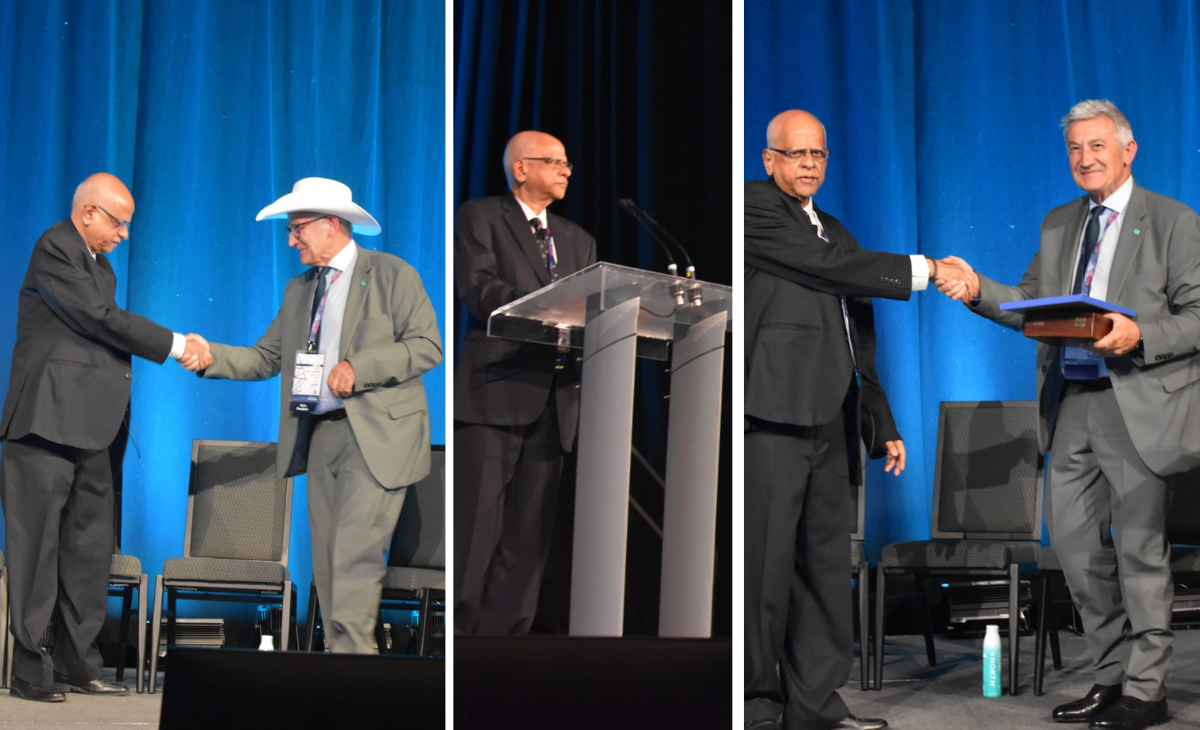
The award, one of the most distinguished international honours in crystallography, was presented to Professor Desiraju on August 11 in Calgary, Canada, during the International Congress of Crystallography.
The Ewald Prize is awarded every three years at the International Congress of Crystallography to recognise outstanding contributions to the field. Professor Desiraju has been honoured particularly for establishing the concept of supramolecular synthons and for demonstrating the structural importance of weak hydrogen and halogen bonds in molecular crystals and biological systems.
His work has helped transform crystal engineering from a largely descriptive discipline into a predictive and design-oriented science, with applications ranging from pharmaceuticals to advanced functional materials.
Professor Desiraju is also Professor Emeritus at the Indian Institute of Science, Bengaluru, and Distinguished Professor at IIT Mandi’s IKS MHA. Over several decades, his research has focused on understanding how molecules interact and organise themselves into crystalline structures—and, importantly, how those interactions can be used to deliberately design materials with desired properties.
Reacting to the honour, Professor Desiraju said the Ewald Prize is widely regarded as one of the highest distinctions a structural chemist or biologist can receive. He also highlighted the rigorous and confidential selection process associated with the award.
Congratulating Professor Desiraju, IIT Mandi Director Professor Laxmidhar Behera said the recognition was a matter of immense pride for IIT Mandi and Indian science. He noted that Professor Desiraju’s pioneering research had significantly advanced the understanding of molecular interactions and created new possibilities in pharmaceuticals and advanced materials.
From “unusual” crystals to a new science
Professor Desiraju’s scientific journey was driven by a deceptively simple question: Why do crystals adopt the structures they do?
During his research at the University of Illinois, the prevailing view was that the structures of organic crystals were largely governed by close molecular packing. Desiraju instead began investigating the exceptions—crystals whose structures could not be adequately explained by conventional packing principles.
His attention turned to weak intermolecular forces, particularly the C—H···O interaction, which at the time was often regarded as too weak to have major structural significance. His research, including work with Thomas Steiner, helped establish such interactions as genuine weak hydrogen bonds with important structural roles.
Today, these interactions are recognised not only in molecular crystals but also in biological systems, where subtle molecular forces can have significant functional consequences.
The idea that changed crystal engineering
Perhaps Professor Desiraju’s most influential conceptual contribution is the supramolecular synthon, introduced in a landmark review published in 1995.
Inspired by Nobel laureate E.J. Corey’s concept of retrosynthetic analysis, Desiraju proposed that scientists could approach a crystal in much the same way a synthetic chemist approaches a molecule—as something that can be designed.
The supramolecular synthon concept identifies recurring structural units that are held together through predictable intermolecular interactions. This provided researchers with a framework for anticipating how molecules might assemble into crystals and opened the way for the deliberate design of crystalline materials.
The approach subsequently evolved from relatively simple binary and ternary co-crystals to increasingly complex four-, five- and six-component molecular crystals. Desiraju has described such multicomponent systems as the “Mount Everest of supramolecular solid-state synthesis.”
From the laboratory to medicines
The importance of crystal engineering is increasingly visible in real-world applications, particularly in pharmaceuticals.
Pharmaceutical co-crystals can improve the solubility, stability and bioavailability of poorly soluble drugs while leaving the active pharmaceutical molecule itself unchanged. Several medicines based on crystal-engineering approaches have already reached the market.
The field is also addressing major scientific challenges such as polymorphism and crystal structure prediction. Professor Desiraju believes artificial intelligence could make a decisive breakthrough in crystal structure prediction over the next five to ten years.
His recent research has also explored mechanically responsive crystals—materials capable of bending, slipping or recovering their shape—pointing towards new possibilities in smart and functional materials.
A scientist shaping the future of crystallography
Professor Desiraju has published more than 475 research papers, which have collectively received over 80,000 citations. He served as President of the International Union of Crystallography from 2011 to 2014 and remains an influential figure in structural chemistry and crystallography worldwide.
Coinciding with the Ewald Prize, a special first-person article by Professor Desiraju has been published in the September 2026 issue of the International Union of Crystallography Journal. Titled “Crystal Clear. Engineering Complexity,” the article traces his scientific journey and the evolution of crystal engineering, a field to which he has made foundational contributions.
The article also reflects his broader view of crystals as complex, interconnected systems in which strong molecular bonds provide stability while weaker interactions provide flexibility and adaptability.
The Ewald Prize therefore represents more than recognition for a distinguished body of research. It acknowledges Professor Desiraju’s central role in changing how scientists think about crystals—from structures that are merely observed and analysed to materials whose properties can increasingly be predicted, engineered and designed.