
Munish Sood
Mandi
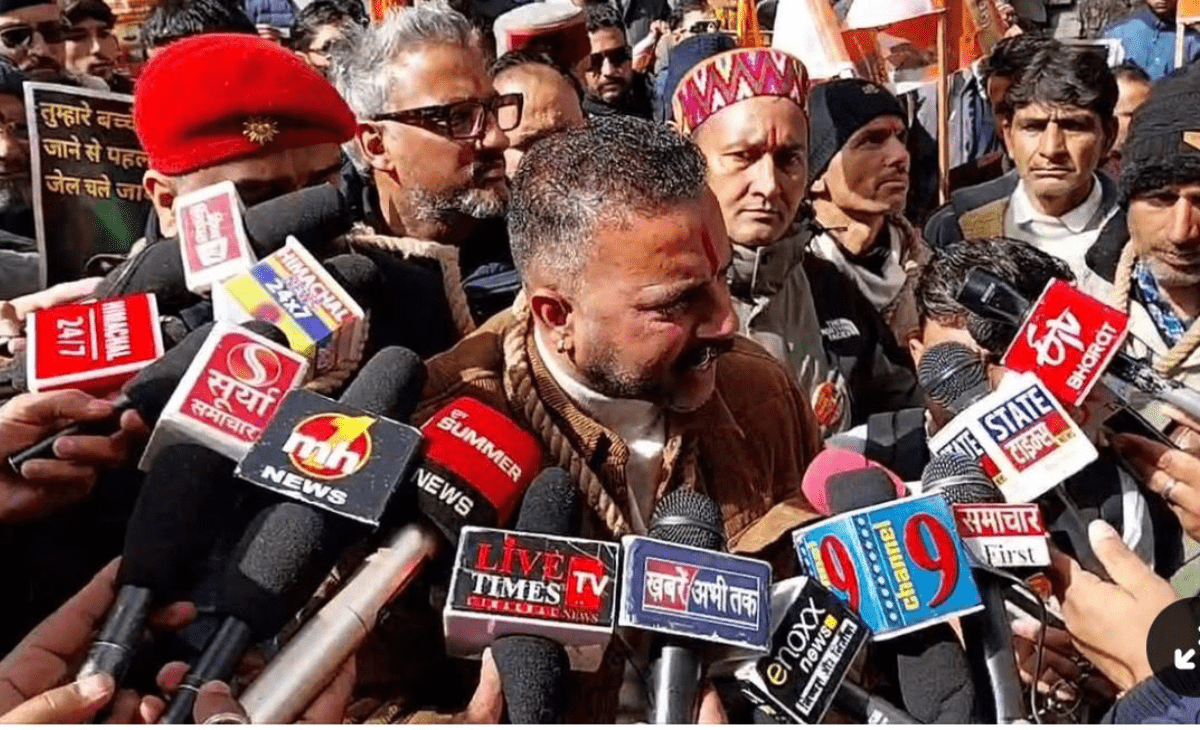
The University Grants Commission’s newly notified equity regulations have ignited a sharp nationwide backlash, with Shimla emerging as a flashpoint of resistance against what protesters describe as a “dangerous and divisive policy” imposed by the Centre. On Tuesday, the Devbhoomi Kshatriya Organisation launched a fierce protest outside the BJP office in Shimla, accusing the Union government of pushing higher education towards caste-based surveillance and institutional bias.
In a striking show of anger, protesters symbolically placed nooses around their necks and raised slogans against the Narendra Modi-led government, warning that the UGC’s rules threaten social harmony, academic freedom and the constitutional principle of equality. The Shimla protest, sharply worded and politically charged, has put Himachal Pradesh at the centre of a growing national revolt against the new framework.
Tight Security in Delhi, Fire on the Streets
The intensity of the opposition forced authorities to step up security outside the UGC headquarters in New Delhi, where heavy barricading was put in place to prevent demonstrators from entering the campus. The unrest has spread rapidly across Uttar Pradesh, with protests reported from Lucknow, Raebareli, Varanasi, Meerut, Prayagraj and Sitapur.
In Raebareli, BJP farmer leader Ramesh Bahadur Singh and Gau Raksha Dal president Mahendra Pandey courted controversy by sending bangles to upper-caste MPs, accusing them of “cowardly silence” on an issue affecting millions of students. In Bareilly, the resignation of City Magistrate Alankar Agnihotri in protest against the UGC rules has further deepened the crisis, raising uncomfortable questions for the Centre.
What the UGC Has Mandated
Notified on January 13 as the ‘Promotion of Equity in Higher Education Institutions Regulations, 2026’, the rules make it compulsory for every college and university to establish an extensive monitoring and reporting structure:
• Equal Opportunity Centres (EOC) to address academic, financial and discrimination-related complaints.
• Equality Committees, chaired by institutional heads, with mandatory representation from SC, ST, OBC groups, women and persons with disabilities.
• Equality Squads to keep round-the-clock watch on alleged discrimination.
• Complaints to be taken up within 24 hours, reports submitted within 15 days, and action initiated within 7 days.
• Mandatory six-monthly reports to institutions and annual caste-discrimination reports to the UGC.
• A national-level monitoring committee with sweeping oversight powers.
Non-compliance invites harsh penalties—freezing of grants, suspension of degree, online and distance-learning programmes, and in extreme cases, cancellation of UGC recognition.
‘Institutionalising Suspicion’: Critics Lash Out
Opponents argue that the regulations effectively paint general category and upper-caste students as “presumed offenders,” institutionalising suspicion and opening the door to selective targeting and misuse. Student groups and social organisations warn that the rules could paralyse campuses, fuel false complaints and replace academic autonomy with fear-driven administration.
Poet and commentator Kumar Vishwas echoed this sentiment in a widely shared post on X, using biting satire to highlight what he called the systematic humiliation of the ‘savarna’ identity. Meanwhile, advocate Vineet Jindal has moved the Supreme Court, seeking an immediate stay on the regulations and demanding truly equal opportunity mechanisms applicable to all students, without caste-based presumptions.
Government on the Defensive
Union Education Minister Dharmendra Pradhan has sought to downplay the outrage, stating that the rules would not be allowed to be misused and that no student would face injustice. However, protests on the ground suggest the assurance has failed to convince critics, who see the framework as punitive rather than reformative.
Tragedies, Courts and Policy Pressure
The UGC maintains that the regulations are rooted in Supreme Court observations and tragic cases such as the suicides of Rohith Vemula (University of Hyderabad, 2016) and Dr Payal Tadvi (Mumbai, 2019), where allegations of institutional caste discrimination shook the nation. Similar cases—from AIIMS Delhi and JNU to Himachal Pradesh Medical College—have repeatedly come under judicial scrutiny.
A parliamentary standing committee on education, chaired by Congress leader Digvijaya Singh, had earlier recommended mandatory equity committees across higher education institutions. Critics, however, argue that the UGC has gone far beyond recommendations, creating a regime of coercive compliance rather than balanced reform.
Shimla Sends a Clear Warning
From the streets of Shimla, protesters have issued a blunt message to the Centre: withdraw or substantially amend the regulations, or face an intensifying national movement. With resignations, court challenges and street protests converging, the controversy has transformed into a serious political test for the Union government.
What began as a regulatory reform has now become a credibility battle—one that could redefine the future of higher education governance and the Centre’s relationship with students across India.