

Himani Sharma
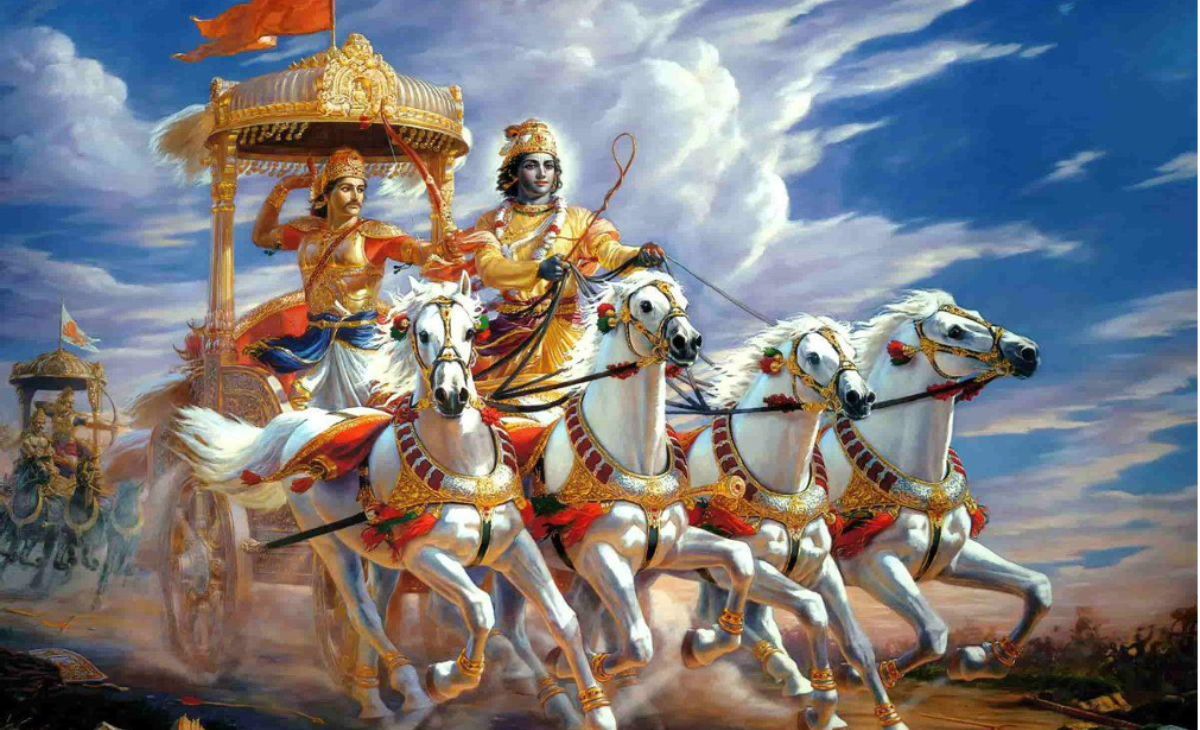
The Bhagavad Gita is one of the most profound spiritual and philosophical texts ever written. Presented as a dialogue between Lord Krishna and Arjuna on the battlefield of Kurukshetra, it unfolds as a gradual journey from emotional confusion to spiritual clarity. Its eighteen chapters are not isolated teachings but a continuous progression in which each lesson prepares the ground for the next.
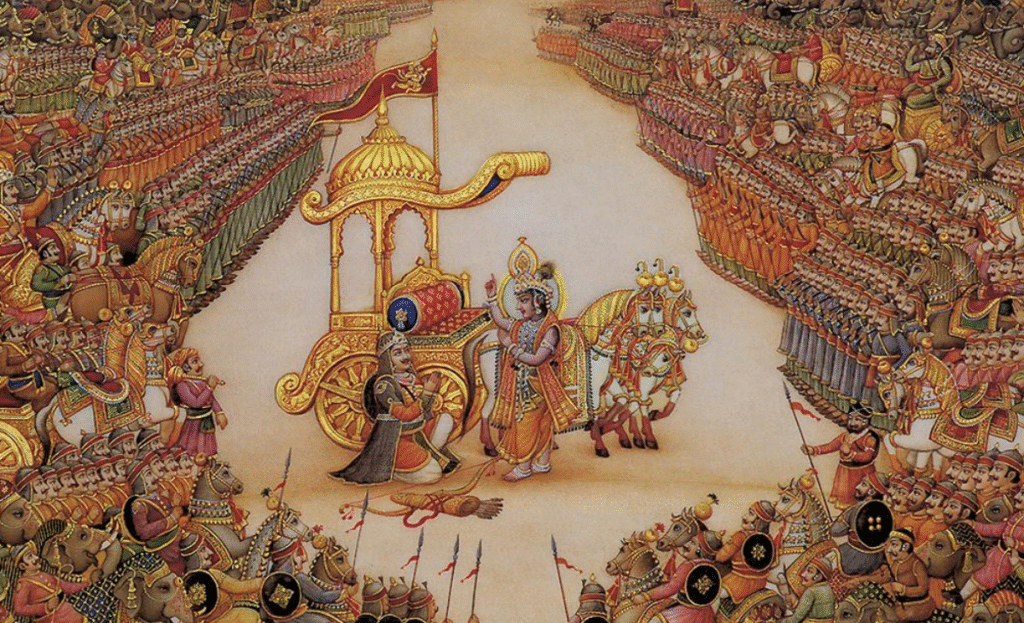
Through its verses, the Gita guides the individual from despair to wisdom, from action to devotion and from self knowledge to liberation. The Gita begins in Chapter One, Arjuna Vishada Yoga, with Arjuna’s despair. In verses 1.28 to 1.47, Arjuna looks upon the battlefield and sees teachers, relatives and friends standing on both sides. Overcome by grief, fear and moral confusion, he loses his will to fight. His body weakens, his mind trembles and he declares that he would rather abandon battle than kill those he loves. This opening reveals a central truth: transformation often begins in crisis.
Human beings usually seek wisdom only when certainty collapses. Arjuna’s breakdown becomes the doorway through which spiritual knowledge enters. In Chapter Two, Sankhya Yoga, Krishna begins His teachings by addressing Arjuna’s sorrow. In verses 2.11 to 2.30, Krishna explains the immortality of the soul. Verse 2.13 teaches that just as the body moves from childhood to youth and old age, the soul moves beyond bodily death. Krishna declares that the Self cannot be destroyed, cut, burned or diminished.
This teaching shifts identity away from the physical body toward eternal consciousness. Krishna then moves to the idea of duty in verses 2.31 to 2.38, teaching Arjuna that one must not abandon righteous responsibility because of emotional attachment. The chapter reaches one of its most important teachings in verse 2.47, where Krishna states that a person has the right to action but never to the fruits of action. This becomes the foundation of selfless work.
The chapter concludes in verses 2.55 to 2.72 by describing the Sthitaprajna, the person of steady wisdom, who remains calm amid desire, success and loss. Verse 2.70 compares such a person to the ocean, full and unmoved despite rivers flowing into it. Chapter Three, Karma Yoga, expands the philosophy of action. Arjuna wonders why action is necessary if wisdom is superior. Krishna answers in verses 3.4 to 3.9 that no person can remain without action, because life itself is movement. What matters is not the avoidance of action but freedom from selfish attachment. Verse 3.19 teaches that one should perform duty without attachment to results. Verse 3.21 explains that society follows the conduct of influential individuals, meaning personal action shapes collective morality.
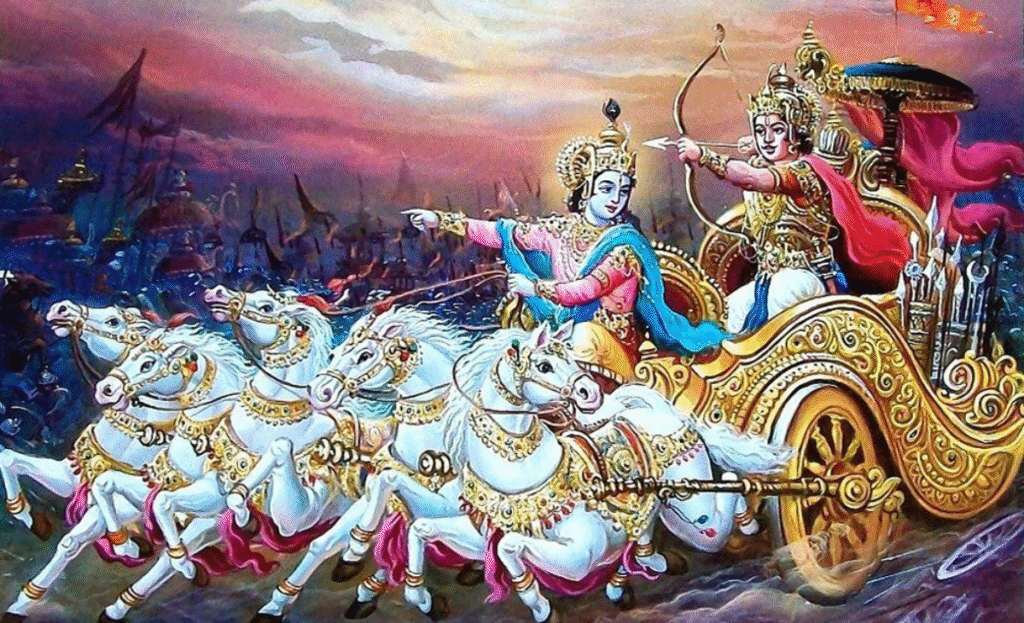
In verse 3.30, Krishna instructs Arjuna to dedicate all actions to the Divine, acting without ego, fear or selfish desire. This chapter teaches that action becomes sacred when performed in the spirit of service. In Chapter Four, Jnana Karma Sanyasa Yoga, Krishna reveals the deeper relationship between knowledge and action. In verses 4.7 and 4.8, He declares that whenever righteousness declines and disorder rises, He manifests to restore balance.
This establishes divine involvement in moral order. Verse 4.13 explains that social roles arise from qualities and actions rather than superficial labels. Verse 4.18 introduces a profound spiritual paradox, saying that the wise see action in stillness and stillness in action, meaning inner detachment can exist even amid intense activity. Verse 4.34 advises seekers to approach knowledge with humility, inquiry and guidance. Krishna teaches that true knowledge destroys ignorance and frees the individual from bondage.
Chapter Five, Karma Sanyasa Yoga, compares renunciation and action. Krishna explains in verse 5.2 that selfless action is superior for most individuals because it allows growth without withdrawal from life. Verse 5.10 compares the detached worker to a lotus leaf untouched by water, showing how action need not create bondage. Verse 5.18 teaches equality, saying the wise see all beings with equal vision. This chapter presents spiritual maturity as detachment, peace and universal respect. Chapter Six, Dhyana Yoga, introduces meditation and mastery of the mind. Verse 6.5 teaches that a person must elevate oneself through one’s own mind, because the mind can act as either friend or enemy.
Krishna describes the practice of meditation in verses 6.10 to 6.15, emphasising discipline, posture, moderation and concentration. In verse 6.26, He teaches that whenever the mind wanders, it must be brought back repeatedly. Verse 6.35 states that the mind can be controlled through practice and detachment. The chapter concludes in verse 6.47 by declaring that the highest yogi is one who lives with faith and devotion. In Chapters Seven through Twelve, Krishna reveals His divine nature and the path of devotion. Chapter Seven explains that all material and spiritual reality originates from the Divine. Verse 7.14 teaches that illusion binds individuals to worldly confusion. Chapter Eight teaches that one’s consciousness at life’s end reflects one’s lifelong inner state.
Chapter Nine introduces devotion as the highest wisdom. Verse 9.26 teaches that even a leaf, flower, fruit or water offered with devotion is accepted by the Divine, proving that sincerity matters more than wealth. Chapter Ten reveals divine presence throughout creation, with verse 10.20 stating that Krishna is the Self within all beings. Chapter Eleven presents the cosmic vision where Krishna reveals His universal form. Verse 11.32 identifies Him as Time itself, containing creation and destruction.
Chapter Twelve defines devotion through character, describing the true devotee as compassionate, humble, peaceful and free of hatred. Chapters Thirteen to Seventeen focus on deeper self understanding and moral development. Chapter Thirteen distinguishes the body from the knower of the body, teaching that awareness is greater than physical existence. Chapter Fourteen introduces the three gunas that shape nature: purity, passion and ignorance. Verse 14.20 teaches that liberation comes by rising beyond these qualities. Chapter Fifteen compares worldly life to an inverted tree, whose roots lie beyond visible existence. Chapter Sixteen contrasts divine qualities such as truth, compassion and fearlessness with destructive qualities such as pride, anger and cruelty. Chapter Seventeen explains that faith reflects one’s inner nature. Verses 17.14 to 17.16 teach purity in body, speech and mind, showing that spiritual growth requires disciplined conduct.
The Gita reaches its culmination in Chapter Eighteen, Moksha Sanyasa Yoga, where Krishna unifies all previous teachings. Verse 18.5 teaches that duty, discipline and sacrifice must not be abandoned. Verse 18.46 states that individuals attain fulfilment by serving through their own work. The most famous conclusion appears in verse 18.66, where Krishna asks Arjuna to surrender all limited dependence and take refuge in the Divine alone. This is not a rejection of action, but the highest expression of trust, wisdom and spiritual surrender.
In verse 18.73, Arjuna declares that his confusion has vanished and he is ready to act. The Bhagavad Gita therefore unfolds in a clear spiritual sequence. It begins with despair, moves into self knowledge, teaches duty and selfless action, introduces meditation and wisdom, reveals divine reality, develops devotion, refines character and concludes with liberation.
Its teachings remain timeless because they address universal human struggles: fear, desire, identity, duty and peace. The central message of the Bhagavad Gita is simple yet profound. Know your true self beyond the body. Perform your duty without attachment. Control the mind through discipline. Live with truth and compassion. Offer actions without ego. Develop devotion and transcend selfish desire. Through these teachings, the Gita transforms life from confusion into clarity and from temporary success into lasting inner freedom.