

Munish Sood
Mandi
A quirky internet campaign born out of political satire has rapidly snowballed into one of the most talked-about social media movements in India, with the so-called “Cockroach Janta Party” (CJP) emerging as an unexpected symbol of youth frustration, online dissent and meme-driven political engagement.
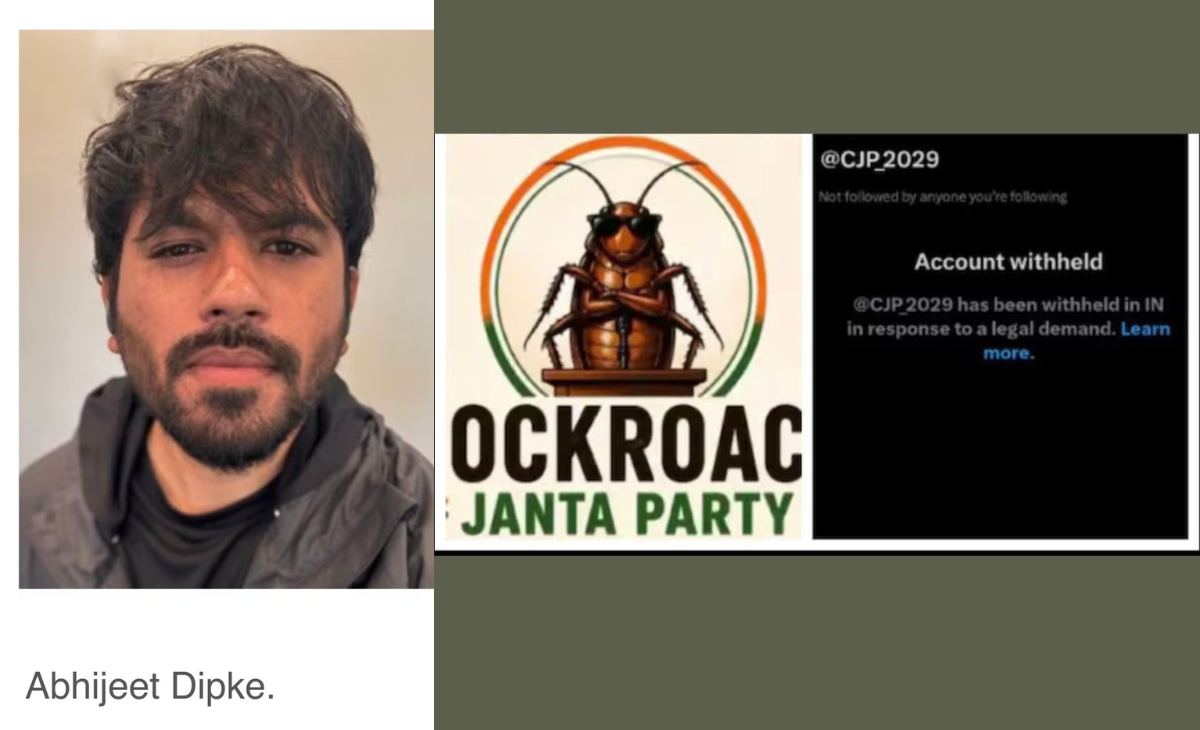
The controversy intensified on Thursday after the movement’s account on X was reportedly withheld in India following a legal request. The action came only hours after the group’s Instagram page surged past the follower count of the official account of the Bharatiya Janata Party, triggering a fresh wave of debate across digital platforms.
The satirical collective, which describes itself as a youth-led political front operating with the slogan “Secular, Socialist, Democratic, Lazy,” has attracted millions of followers within days of its emergence. What initially appeared to be an online joke has now evolved into a wider expression of discontent among young Indians over unemployment, exam paper leaks, shrinking opportunities, political fatigue and questions surrounding institutional accountability.
Origin of the ‘Cockroach’ Symbol
The unusual name traces its roots to remarks linked to Surya Kant during a recent court hearing. Comments allegedly comparing certain unemployed youth and online activists to “cockroaches” and “parasites” triggered outrage on social media, particularly among younger users.
Although the Chief Justice later clarified that his remarks were directed only at individuals using fake educational qualifications to enter professions, the explanation failed to contain the backlash already building online.
Within hours, the cockroach — often viewed as resilient and impossible to eliminate — was reclaimed by users as a sarcastic badge of identity. Memes, hashtags and parody content flooded platforms, eventually giving birth to the Cockroach Janta Party.
The Man Behind the Movement
The campaign was launched by Abhijeet Dipke, a former social media campaign worker associated with the Aam Aadmi Party and currently a student at Boston University.
Dipke later said the movement was initially conceived as satire but quickly transformed into something much larger after receiving overwhelming support from young people online.
According to him, the remarks attributed to the Chief Justice resonated deeply because they were perceived as dismissive of an entire generation struggling with economic uncertainty and limited opportunities.
The CJP’s digital strategy — built around memes, humour, sarcasm and self-deprecating commentary — struck a chord with Gen Z audiences who increasingly consume politics through internet culture rather than conventional political messaging.
A Viral Political Experiment
In less than a week, the movement reportedly attracted lakhs of supporters through online sign-up forms and built a massive social media presence.
Its Instagram page crossed more than 10 million followers, overtaking the BJP’s official Instagram account, which currently has around 8.7 million followers. The Indian National Congress continues to maintain a larger presence on the platform, while the Aam Aadmi Party trails significantly behind.
The movement’s X account, however, became inaccessible to users in India on Thursday. A message displayed on the platform stated that the account had been withheld “in response to a legal demand.”
Reacting to the development, Dipke claimed the move had been anticipated and argued that attempts to restrict the account would only increase public curiosity around the campaign.
Opposition Leaders Join the Buzz
The online movement has also attracted reactions from several prominent public figures. Senior advocate Prashant Bhushan, activist Anjali Bhardwaj and Mahua Moitra were among those who engaged with the campaign online. Kirti Azad also jokingly expressed willingness to “join” the satirical outfit.
Supporters describe the movement as a refreshing alternative in an increasingly polarised political environment, while critics argue it is little more than a carefully packaged digital campaign with indirect opposition backing due to Dipke’s earlier association with the AAP.
A Reflection of India’s Youth Frustration
Beyond the memes and humour, analysts believe the movement reflects growing unease among India’s younger population. Despite India having one of the world’s youngest demographics, many young people increasingly feel disconnected from formal political structures.
Economic growth has not fully eased concerns surrounding unemployment, rising living costs, inequality and uncertain career prospects. For many students and young professionals, academic qualifications no longer guarantee financial stability or upward mobility.
The Cockroach Janta Party appears to have tapped into this frustration through an unconventional language of satire and internet culture rather than traditional political rhetoric.
Its website mixes absurd humour with serious political messaging, advocating accountability, electoral transparency, media reform and greater representation, while simultaneously mocking doomscrolling, political burnout and unemployment.
What began as a sarcastic online reaction has now evolved into a larger digital conversation about how India’s younger generation views politics, power and representation in the age of social media.