
Munish Sood
Mandi
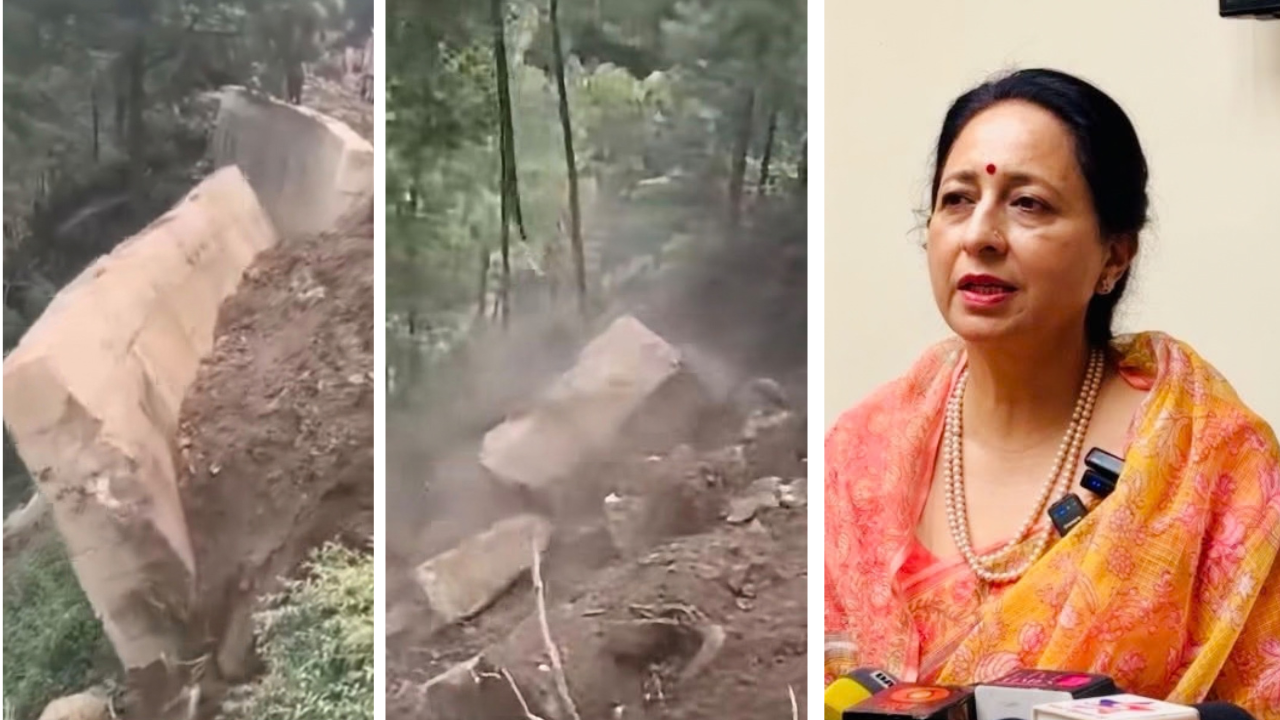
The collapse of a massive supporting/retaining wall along the Mandi–Kotli National Highway has once again brought the quality, safety and accountability of ongoing highway construction under scrutiny, with social activist and academic Prof. Anupama Singh demanding an independent technical audit and public disclosure of inspection reports.
The wall, reportedly ranging between around 30 and 52.5 feet in height, collapsed during ongoing construction, raising concerns among local residents about the safety of highway structures and the impact of large-scale hill cutting.
Prof. Singh, who has been raising issues related to highway construction in the area, said the incident should not be treated merely as the failure of a single structure. She questioned whether construction is being executed strictly in accordance with the approved DPR, design specifications, safety norms and prescribed technical standards.
She has sought details of quality audits, structural inspections and technical assessments carried out on the existing road and safety structures, besides demanding that such reports be made available in the public domain.
“The incident raises fundamental questions about whether adequate technical safeguards are being followed during construction and whether the quality of work is being independently monitored,” Prof. Singh said.
She also drew attention to the manner in which hill slopes are being cut for highway expansion, alleging that adequate slope stabilisation, drainage arrangements and retaining structures are not always visible at construction sites. She said the safety of houses, agricultural land and natural water sources affected by construction must also be treated as a priority.
Seeks answers from NHAI and agencies
Prof. Singh has raised a series of questions for the National Highways Authority of India and other agencies associated with the project.
Among other things, she has sought clarification on the agency responsible for quality and structural audits, whether construction conforms to the approved design and specifications, and what technical assessment has been made to determine the reason behind the wall collapse.
She has also sought clarity on the responsibility for damage to private property, agricultural land and water sources allegedly affected by construction activity, as well as the mechanism available to affected residents for seeking compensation and redressal.
The issue of muck disposal has also figured prominently in her concerns. Prof. Singh said complaints regarding what she described as improper disposal of construction debris and its possible impact on the environment had been raised earlier as well. She referred to proceedings and records relating to environmental concerns and muck dumping associated with highway construction, and called for greater transparency in the handling of excavated material.
Says issue was raised with Gadkari
Prof. Singh said the concerns were not being raised for the first time. According to her, she had discussed the issue with Union Minister for Road Transport and Highways Nitin Gadkari during her meeting with him on September 28, besides raising the matter with NHAI and other officials.
She said assurances alone would not be sufficient and called for a transparent system under which quality inspection reports for major structures are made available, independent technical and structural audits are conducted, and safety assessments before and after construction are documented.
She also sought clarity on the contractual and technical eligibility of agencies executing major works, particularly in cases where allegations or regulatory proceedings have previously been raised against them.
“Development must be safe and accountable”
Prof. Singh maintained that the demand was not against infrastructure development but for construction that is scientifically planned, technically sound and accountable.
She said public money must result in infrastructure that is safe, durable and capable of serving people over the long term.
The immediate cause of the wall collapse has yet to be established through an independent technical assessment. While observations circulating locally have pointed to the possible role of soil and water pressure behind the structure, such explanations would need to be established through a formal engineering investigation.
The incident has nevertheless renewed the larger debate over highway construction in the fragile Himalayan terrain, where extensive hill cutting, slope stability, drainage and retaining structures remain critical components of road safety.
For Prof. Singh, the central issue is accountability: if a structure constructed with public money fails, there must be a clear mechanism to determine what went wrong, who was responsible and what corrective measures are required to prevent a recurrence.
“Roads must be built, but not at the cost of people’s safety. Development must go hand in hand with quality, transparency and accountability,” she said.