
Centre to study impact of altitude, low oxygen and extreme cold on human health; Jai Ram Thakur and Kangana Ranaut highlight its significance for Himalayan healthcare
Munish Sood
KEYLONG
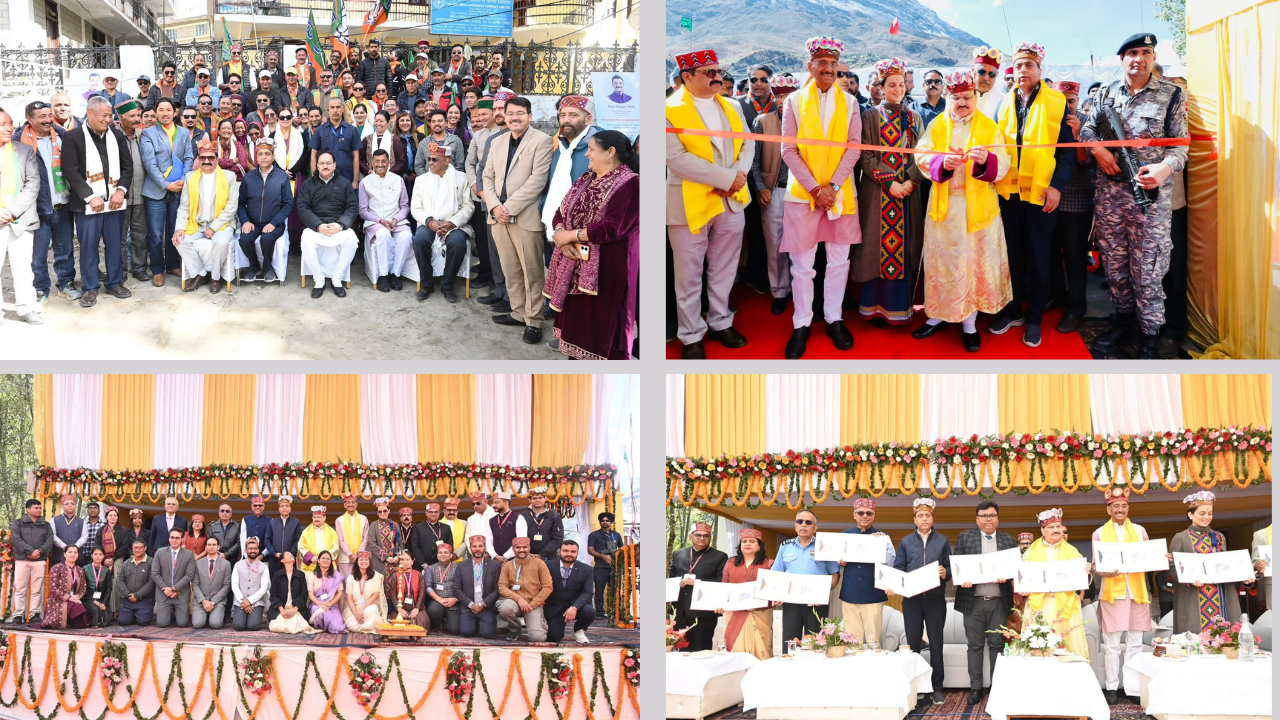
Union Health and Family Welfare Minister Jagat Prakash Nadda on Monday laid the foundation stone of the Indian Council of Medical Research’s (ICMR) Centre for High-Altitude Medicine and Public Health Research at Keylong in Himachal Pradesh’s Lahaul-Spiti district, marking a significant step towards advancing medical research and strengthening healthcare in the Himalayan region.
Nadda, who was the chief guest at the ceremony, received a traditional Lahauli welcome on his arrival. Union Minister of State for Defence Sanjay Seth, Leader of the Opposition and former Chief Minister Jai Ram Thakur, and Mandi MP Kangana Ranaut were among the prominent dignitaries present.
Following the foundation stone-laying ceremony, Nadda planted Himalayan saplings. A scientific exhibition was subsequently inaugurated at the Keylong Police Ground. The programme also featured the launch of the centre’s website and the release of a special commemorative postal cover.
Research to address unique high-altitude health challenges
Addressing the gathering, Nadda highlighted the distinctive geographical and climatic conditions of Lahaul-Spiti, pointing out that high altitude, reduced oxygen availability and extreme cold pose specific challenges to human health.
He said the centre would study the effects of these conditions on people living in the region, as well as personnel arriving from other parts of the country to work in high-altitude environments. The research would help improve understanding of mountain-related health conditions and support the development of better treatment approaches and public health interventions.
The proposed facility is expected to generate scientific evidence relevant to healthcare planning in remote Himalayan areas, where difficult terrain, harsh winters and geographical isolation can complicate access to medical services.
The research could also benefit other high-altitude regions of the country by providing insights into the prevention, diagnosis and management of health conditions associated with mountainous environments.
Jai Ram Thakur welcomes Centre’s establishment
Leader of the Opposition and former Chief Minister Jai Ram Thakur welcomed the initiative, describing it as an important contribution towards strengthening healthcare and medical research in Himachal Pradesh. In a Facebook post, he said the Central government, under Prime Minister Narendra Modi’s leadership, was continuously supporting efforts to improve healthcare facilities in the state. He expressed gratitude to Nadda, adding that the centre would play an important role in researching diseases prevalent in high Himalayan areas, improving treatment and developing public health services.
Kangana Ranaut highlights importance for Himalayan regions
Mandi MP Kangana Ranaut also attended the ceremony and highlighted the significance of the project for Lahaul-Spiti and the wider Himalayan region. She described the initiative as a step towards advancing healthcare, promoting scientific research and addressing the distinctive needs of tribal communities and people living in remote mountain areas. The project is aligned with the broader objective of strengthening healthcare infrastructure in geographically challenging regions.
A step towards specialised mountain medicine
The establishment of the ICMR research centre is expected to strengthen India’s scientific capacity in high-altitude medicine and public health. Its long-term impact will depend on the research infrastructure developed and the translation of scientific findings into practical healthcare solutions.
For Lahaul-Spiti, the initiative offers an opportunity to place Himalayan health challenges at the centre of specialised medical research and contribute to better-informed healthcare strategies for mountain communities.