
While auto operators seek action against bike-taxi services, commuters and young riders see Rapido as an affordable mobility and livelihood option; government now faces the task of framing clear rules
Munish Sood
Mandi: The protest against Rapido bike-taxi services in Mandi has opened up a larger debate over the future of affordable urban mobility in the town. While auto-rickshaw operators have raised objections to the operation of app-based bike taxis, the service has also found support among commuters and young people who see it as a cheaper and more flexible way of travelling.
The issue has essentially brought two concerns face to face—the livelihood interests of traditional auto operators and the growing demand for affordable transport and new employment opportunities.
Auto operators have approached the administration seeking action against Rapido, arguing that private two-wheelers are being used for commercial passenger services without the same regulatory obligations that apply to commercial vehicles. The Transport Department has also maintained that private motorcycles, scooters and mopeds do not currently have formal permission in Mandi to carry passengers for hire through Rapido or other online platforms, and enforcement action has been taken in cases of alleged violations.
But the other side of the debate is equally significant.
A social media post highlighting a passenger’s experience with Rapido described the first ride as being with a student who was using the platform to earn an income. The passenger was reportedly so pleased with the service that he gave the Rapido captain four apples brought from his village for friends. The post appealed to the government to formulate rules at the earliest, arguing that the service has created a new employment option for the youth of Mandi.
The incident may appear small, but it reflects why the bike-taxi model has attracted users—affordability, convenience and the possibility of earning through an existing two-wheeler.
Gadkari’s employment argument
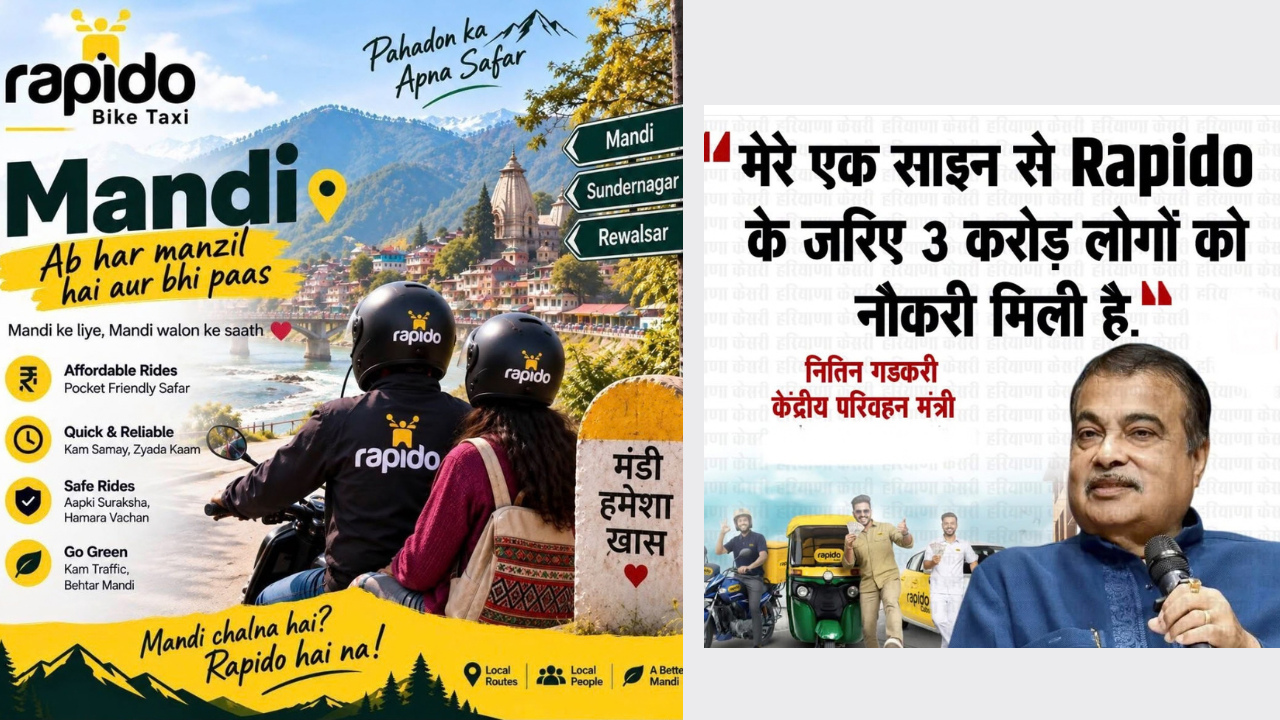
The debate in Mandi also assumes significance in the light of comments made by Union Road Transport and Highways Minister Nitin Gadkari, who has publicly advocated the use of private two-wheelers and four-wheelers as a source of self-employment through regulated taxi and aggregator models.
Gadkari recently said that a policy decision taken through his ministry had helped create employment opportunities on a massive scale. Referring specifically to the emergence of companies such as Rapido, he said:
“I have written on the file that if someone has their own two-wheeler or four-wheeler, they can run a taxi even now. After one signature from me, Bengaluru’s Rapido company gave employment to 3.5 crore people.”
He has also argued that bike taxis can provide an economical mode of transport for short-distance journeys while creating livelihood opportunities for people who already own two-wheelers.
Regulate it, rather than leave a policy vacuum?
The Mandi controversy therefore raises a more fundamental question: if bike taxis are not presently covered by a clear state-level framework, should the response be simply to oppose the service—or should a transparent regulatory mechanism be created first?
There are legitimate issues that any such framework would have to address, including passenger safety, insurance, driver verification, vehicle registration, permits, taxation, fare regulation and accountability of aggregators.
At the same time, the concerns of auto-rickshaw operators cannot simply be ignored. They operate under an established commercial transport system and have financial and regulatory obligations that app-based services would also need to meet if they are permitted to operate commercially.
For commuters, however, the attraction of Rapido is straightforward: a quick ride at a relatively lower cost, particularly for short distances and congested urban routes. For young riders, it can potentially provide an additional source of income without requiring them to purchase a separate commercial vehicle.
The Mandi debate, therefore, is bigger than Rapido versus autos. It is about how a changing transport ecosystem should be regulated without unnecessarily shutting the door on affordable mobility and emerging livelihood opportunities.
The immediate question before the Himachal Pradesh government is whether it will formulate clear rules governing bike taxis and aggregators, balancing the interests of existing transport operators with the needs of commuters and the employment aspirations of the state’s youth.