
From personalised meal plans to early detection of nutritional deficiencies, AI is becoming a powerful ally in the pursuit of better health
Dr. Radhna Gupta
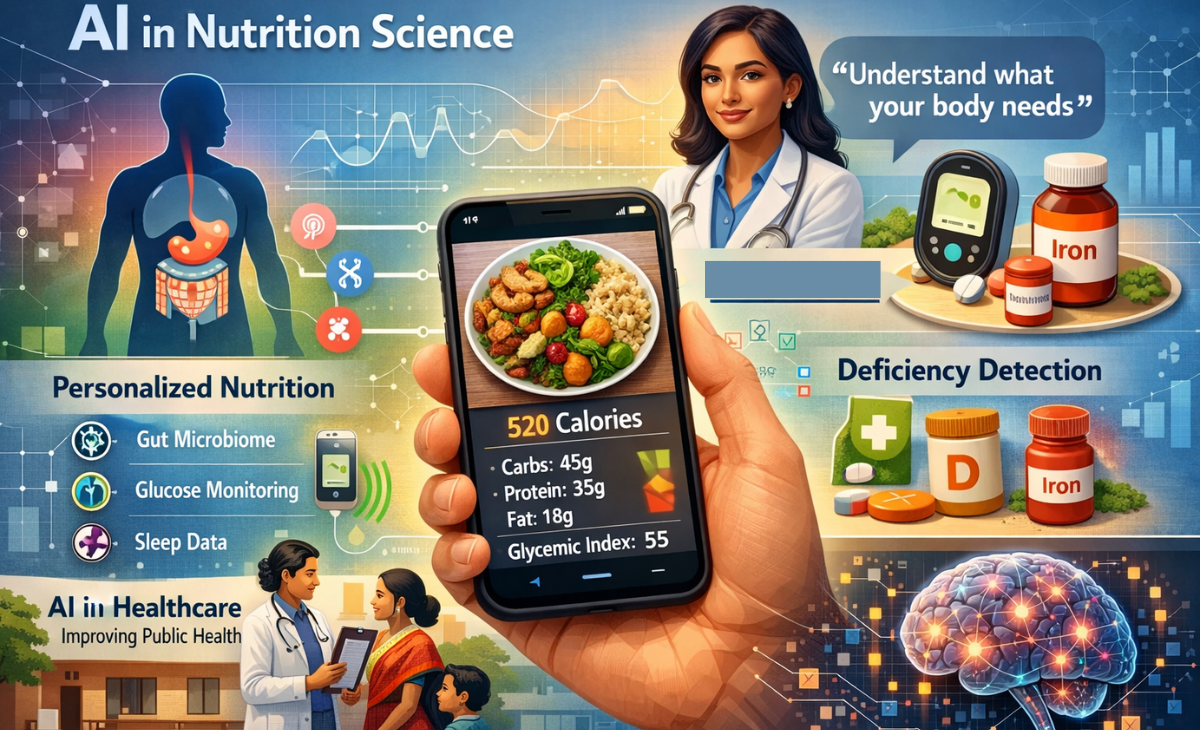
Artificial intelligence is quietly rewriting the rules of nutrition science. AI-powered apps can now analyse a photograph of a meal and estimate its calorie content, macronutrient breakdown, and glycaemic index within seconds doing in a moment what once required a trained dietitian and a reference book.
The technology runs far deeper than calorie counting. Researchers at Stanford University have demonstrated that blood sugar responses to identical foods vary dramatically between individuals, challenging the one-size-fits-all approach that has dominated dietary guidelines for decades. AI systems trained on gut microbiome data, sleep patterns, and continuous glucose readings can now predict how a specific person will respond to a specific meal. Truly personalised nutrition is no longer a distant ambition it is arriving.
“We have spent a century telling people what the average human body needs,” says Dr Amara Patel of King’s College London. “What AI allows us to do, for the first time, is understand what your body needs. Those are very different questions.”
The public health implications are significant. Iron deficiency affects 1.2 billion people worldwide, and vitamin D insufficiency is widespread across northern populations. AI tools trained on dietary and biomarker data are proving adept at flagging these deficiencies earlier than conventional clinical tests. In India, state governments are piloting AI-assisted nutrition monitoring in public clinics, with early results showing improved detection rates and better patient adherence to dietary advice.
Nutritional science is also benefiting from AI’s ability to process vast datasets. Machine learning models are being used to uncover previously hidden links between dietary patterns and chronic diseases such as type 2 diabetes, cardiovascular disease, and certain cancers. These insights are informing the next generation of public health guidelines, moving the field from broad population recommendations toward evidence-based, individual-level guidance.
Critics, however, caution that these tools are only as good as their training data, which has historically skewed towards Western populations. A system built on American dietary patterns may perform poorly for someone whose meals centre on dal or ugali. “If we are not deliberate about diversity in our data, we risk deepening existing health inequalities,” warns Dr Emmanuel Nkosi of the University of Cape Town.
Most clinicians view AI as a complement to human expertise, not a replacement. An algorithm can flag low omega-3 levels; it cannot address the emotional and cultural dimensions of why someone is not eating well. As regulators in the US and EU begin classifying AI dietary tools as medical devices, the demand for evidence, transparency, and human oversight will only grow. Nutrition has always been personal. Making it intelligent is only the beginning.

Dr. Radhna Gupta
Professor, Department of Food Science,
Nutrition and Technology, COCS,
CKHPKV, Palampur, 176062
Contact: 8219287051