
Dr. Amrik Singh
India’s tourism sector stands today at a decisive crossroads. Over the past two decades, the sector has witnessed remarkable expansion, with a continuous rise in both domestic and international visitor numbers. Tourism has been viewed as a primary instrument of economic growth, employment generation, and global image-building. However, the fundamental approach driving this rapid expansion has remained largely marketing-based rather than design-based.
This imbalance has created a situation where visitor numbers have grown, but serious pressure has been generated on the carrying capacity of destinations, the participation of local communities, and environmental equilibrium. It has therefore become necessary for India to re-evaluate its current tourism model and transform it into a more systematic, balanced, and long-term approach.
The greatest limitation of the current tourism model is that its success is measured exclusively through numerical indicators, total visitor numbers, foreign exchange earnings, and hotel occupancy rates. This approach treats tourism as a consumer product, where the objective is to attract as many people as possible.
In this process, the question of what kind of experience visitors actually have when they arrive at a destination, and what impact their arrival has on local ecology, culture, and economy, frequently goes unanswered. As a result, numerous popular destinations today grapple with the problem of over-tourism, where congestion, excessive resource consumption, and environmental degradation have become normal conditions. Alongside this, the role of local communities has also remained limited within this model. A large share of the economic benefit generated by tourism does not remain at the local level but flows outward to external agencies, international hotel chains, and large tour operators.
This process known as economic leakage is emerging as a serious challenge in developing tourism destinations. Additionally, cultural traditions are frequently presented merely as performance, which affects their authenticity and depth. In this manner, the current model is not only environmentally imbalanced but also socially and culturally unsustainable.
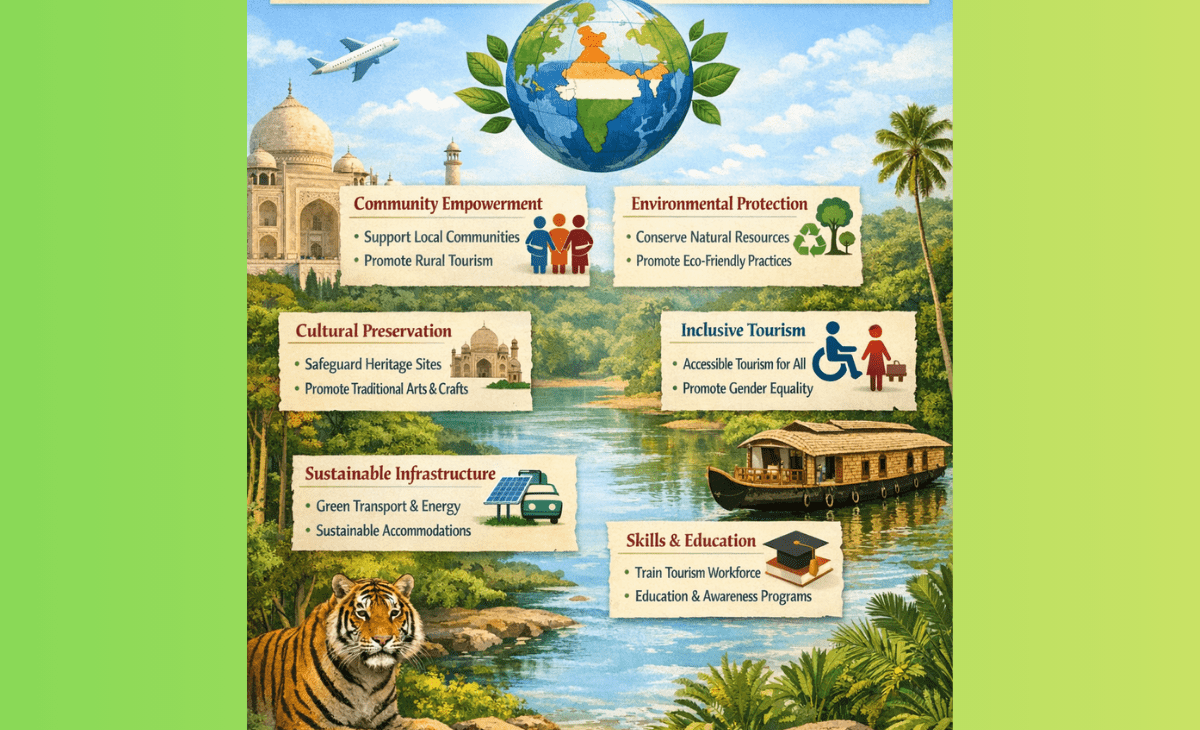
To address these challenges, a new approach is required, one that may be termed design-based tourism. This approach does not view tourism merely as an activity but as a system, where every element whether it is the travel route, accommodation arrangement, or cultural experience is pre-planned and structured. The objective of design-based tourism is to ensure that visitors’ experiences are balanced, meaningful, and responsible, while local communities receive direct benefit and environmental impact remains minimal.
This approach does not focus only on external appearance but also addresses the internal processes that shape the tourism experience. In this context, the role of travel routes and experience structure becomes critically important. The movement of visitors at each destination must be designed in such a manner that it is not merely convenient but also environmentally and culturally appropriate.
For example, the construction of controlled pathways in protected areas, the setting of limits on visitor numbers, and the planning of seasonal distribution are measures that can balance the impact of tourism. Similarly, cultural experiences must be presented in such a way that they do not become merely a means of entertainment, but provide genuine understanding of local traditions and ways of life.
From an economic perspective as well, significant change is required in the design of tourism. It is necessary to ensure that expenditure made by visitor’s remains within the local economy and that its benefit reaches local communities to the maximum possible extent. For this purpose, it is essential to strengthen local supply chains, encourage small and medium enterprises, and give priority to local products and services. Such an approach will not only promote economic growth but will also ensure social inclusion. Maintaining environmental balance must also be a primary objective of this policy.
In a country like India with such diverse ecosystems, the impact of tourism can be extremely wide-ranging. Tourism activities in mountainous regions, coastal areas, and forest zones must be regulated in such a manner that they place minimum pressure on natural resources. For this purpose, the scientific determination of carrying capacity, effective arrangements for waste management, and the promotion of environmental education are essential. Additionally, the use of digital technology can make the monitoring and management of environmental impact even more effective.
In the context of cultural preservation too, it is necessary to adopt a balanced approach. Presenting culture merely as a product not only diminishes its dignity but also affects its original character. It is therefore necessary that the design of cultural experiences be carried out with the participation of local communities, and that they are given the opportunity to present their traditions in their own way. In this process, traditional knowledge and skills can also be preserved, which will transform tourism into a deeper and richer experience.
For the effective implementation of this policy, a robust institutional framework will be required. At the national level, a dedicated authority can be established to coordinate the design and planning of tourism in an integrated manner. At the state and local levels too, such bodies must be constituted that can implement plans according to regional requirements. In addition, establishing coordination among the various stakeholder’s government, private sector, and local communities will also be necessary.
For monitoring and evaluation, new indicators will also be required, indicators that are not limited merely to numerical data but can also measure quality, balance, and sustainability. For example, indicators such as local income per visitor, environmental impact index, and community satisfaction level can provide a better assessment of tourism’s real impact. Based on these indicators, necessary improvements and amendments can be made to policies.
Ultimately, it is clear that the future of tourism for India lies not in attracting more visitors, but in making their experience better and more balanced. The design-based approach can be an important step in this direction, which will establish tourism as a responsible and inclusive activity.
This will not only encourage economic growth but will also ensure social and environmental balance. In this manner, if India redefines tourism through a systemic and design-based approach, it will be able not only to improve the quality of its destinations but also to present an ideal tourism model at the global level. This transformation demands change not only at the policy level but also in the approach where tourism is seen not as a product but as an experience and a responsibility. This is the direction that can establish India as a sustainable, inclusive, and globally competitive tourism nation.