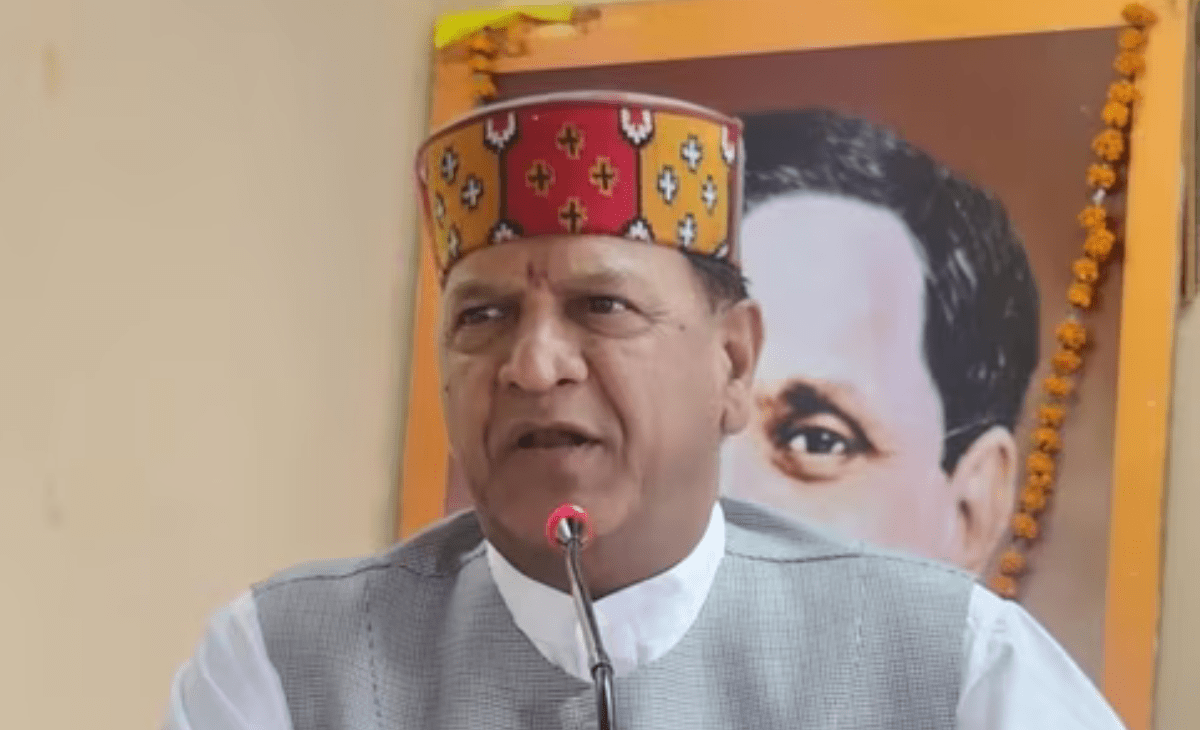

Dr Rakesh Kapoor
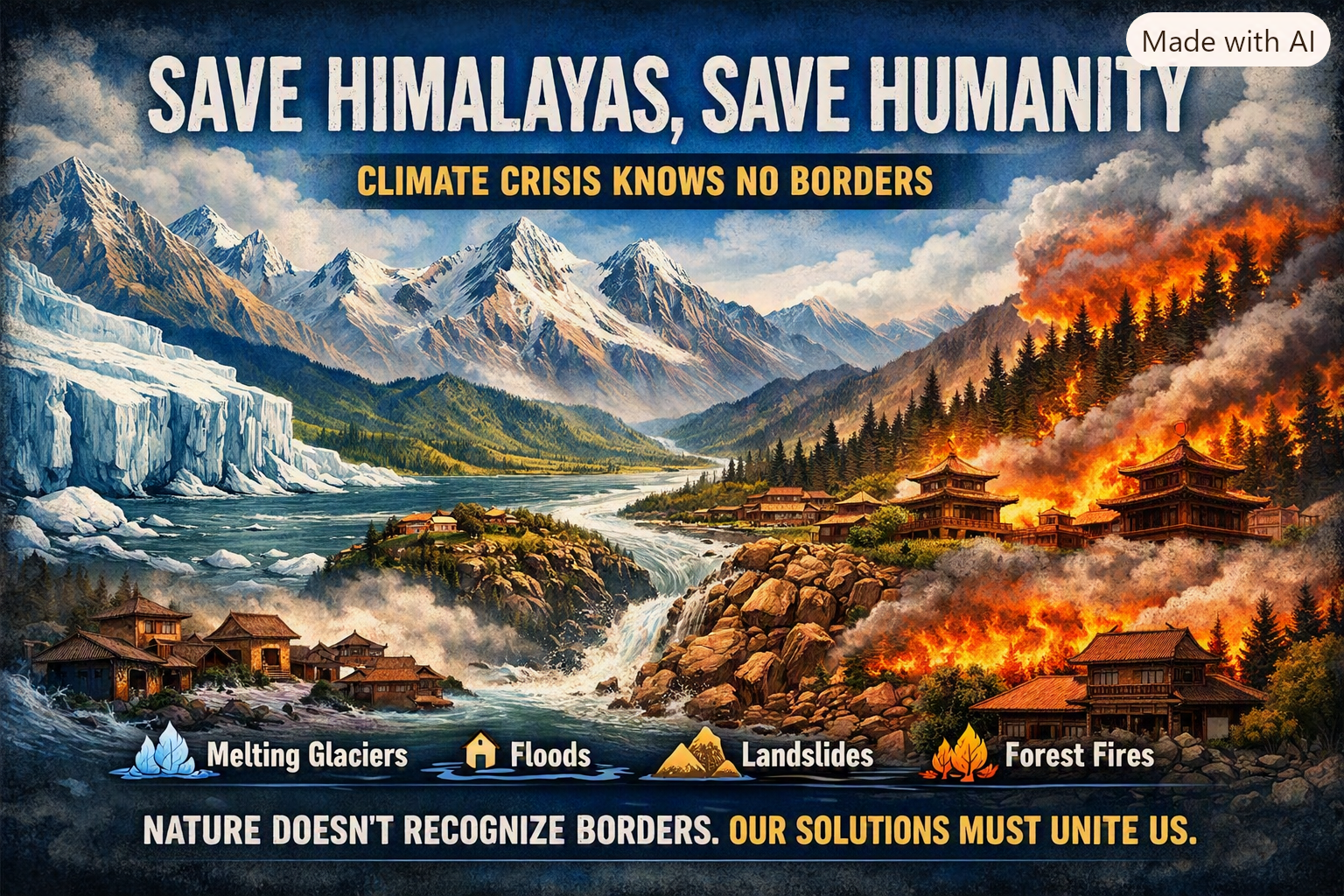
A glacier does not know where the boundary between Uttarakhand and Nepal lies. A river does not recognise state boundaries.A flood does not respect an international border. And climate change recognises no political jurisdiction.
The Himalaya demands that our planning, governance and disaster-management systems rise above administrative boundaries and recognise the mountains as one living, interconnected ecological system
The Himalayas are often described as the “Third Pole”, the “Water Tower of Asia” or the young and fragile mountain system that sustains some of the great rivers of the world. But these descriptions can make the Himalayas sound like a distant geographical entity. They are not. Saving the Himalayas is ultimately about saving human civilisation from one of the most dangerous consequences of climate change.
The urgency has become impossible to ignore. The Hindu Kush Himalaya is warming, its glaciers are losing ice at an accelerating rate, and the consequences extend far beyond mountain communities. The latest ICIMOD assessment says that the region’s glaciers are losing ice at roughly twice the rate observed around 2000, with up to 27 metres of ice thickness lost since 1975. Nearly two billion people downstream depend upon the region’s snow and ice for water.
Save the Himalayas to Save Humanity:- The Himalayas are not merely mountains belonging to India, Nepal, Bhutan, Pakistan, China or Afghanistan. Their glaciers, rivers, monsoon systems, forests, biodiversity and atmospheric influence constitute a connected ecological system that does not recognise political boundaries.
Namaste Langtang Lirung. Namaste Bhote Koshi and Trishuli. Namaste Chorabari and Kedarnath. Namaste Gangotri, South Lhonak, Sikkim, Himachal, Ladakh and the glaciers of the great Himalayan arc.
These are not merely words of reverence for the mountains. They are a reminder that the Himalaya is no longer a distant, silent landscape. It is changing rapidly, and the changes taking place in its glaciers, snowfields, permafrost, rivers and slopes are beginning to speak to us in the language of landslides, glacial lake outburst floods, flash floods and cascading disasters.
When a glacier melts in the high Himalaya, its consequences may appear hundreds of kilometres downstream. When forests disappear, springs dry and slopes are destabilised, the consequences are felt in villages, cities, agriculture, hydropower systems and river basins. When warming alters the cryosphere, it affects water security, food security, energy security and ultimately human security.
This is why Himalayan conservation cannot remain the responsibility of forest departments, mountain states or individual governments. It has to become a community movement and a global climate priority.
The great contradiction:- The greatest tragedy is that the Himalayas are being asked to absorb two opposite pressures simultaneously.
On one side is global warming caused predominantly by the accumulated emissions of industrialisation, fossil-fuel consumption and unsustainable production and consumption. On the other is local development that increasingly treats fragile mountain ecosystems as commodities—roads, tunnels, hydropower projects, real estate, mass tourism and urban expansion.
The result is a dangerous combination: global climate change plus local ecological destruction.
We cannot stop climate change in the Himalayas merely by planting a few thousand trees or constructing another concrete flood wall. Nor can we protect the mountains by declaring another festival or campaign. The response must address the causes as well as the consequences.
Global policy paralysis :- The world does not suffer from a shortage of climate conferences, declarations or scientific warnings. It suffers from a shortage of implementation.
The Paris Agreement established an important framework, but global emissions remain dangerously high. At COP30 in Belém in 2025, countries increased commitments on adaptation finance, but failed to establish a sufficiently concrete and binding pathway for phasing out fossil fuels.
This is the central contradiction of international climate governance: the science demands speed, while geopolitics demands consensus; the planet needs transformation, while governments remain constrained by short electoral cycles and economic interests.
Climate finance remains inadequate. Technology and scientific knowledge exist, but access is unequal. Countries that contributed least to historical emissions often face the greatest climate losses. The Himalayas exemplify this injustice.
Consequently, we must move beyond the conventional North-South argument and beyond the narrow idea that every country can solve the problem within its own borders.
A Himalayan Climate Compact :- The Himalayas need a new model of governance—a Himalayan Climate Compact involving governments, scientific institutions, local communities, civil society, universities, businesses and international organisations. We must start talking about climate injustice and climate justice polluters to pay poors must not pay the price of better life more CFCs more cars more factories ‘more MNCs ‘ more CFGDs .
First, the Himalayas should be treated as one ecological system rather than a collection of national territories. India, Nepal, Bhutan, China, Pakistan and Afghanistan need mechanisms for scientific cooperation, glacier monitoring, hydrological data sharing, disaster forecasting and coordinated early-warning systems.
Recent Himalayan disasters have demonstrated how dangerous the absence of adequate cross-border data and preparedness can become. The demand for stronger regional cooperation and real-time information sharing is therefore not diplomatic idealism; it is a life-saving necessity.
Second, every major infrastructure project in the mountains must pass a climate-risk and carrying-capacity test, not merely a conventional environmental clearance. Roads, tunnels, dams, townships and tourism infrastructure must be designed for the Himalayas of 2050 and 2100—not for the climate of the twentieth century.
Third, mountain communities must become partners rather than spectators. Local people possess generations of knowledge about springs, forests, slopes, weather and traditional water systems. Community-based watershed restoration, spring rejuvenation, forest protection, disaster preparedness and responsible tourism should become the foundation of Himalayan policy.
Fourth, the international community must create a dedicated Mountain and Cryosphere Adaptation Fund, additional to conventional development assistance. Countries and corporations with the greatest historical contribution to greenhouse-gas emissions should bear a proportionately greater responsibility for adaptation, loss and damage.
Finally, citizens themselves must recognise that Himalayan protection is not an environmental luxury. Every litre of water saved, every natural forest protected, every unnecessary tree cutting prevented, every wetland conserved and every responsible travel choice contributes to climate resilience.
Beyond borders, beyond governments :-The Himalayas need a new social contract—one in which citizens do not wait for governments, governments do not wait for international agreements, and nations do not wait for one another.
The challenge is larger than India versus China, developed versus developing countries, or government versus civil society. The real contest is between a living planet and an economic model that continues to consume natural capital faster than nature can regenerate it.
We therefore need a global Himalayan movement—scientists sharing knowledge, communities protecting watersheds, young people demanding climate accountability, businesses adopting ecological limits, courts enforcing environmental principles and governments cooperating across borders.
The Himalayas can still be protected, but the window is narrowing. The United Nations itself has emphasised that rapid decarbonisation, adaptation, changing water management and early-warning systems are essential for protecting mountain and glacier-dependent communities.
The choice before humanity is ultimately simple:- We can continue treating the Himalayas as a resource to be exploited—or recognise them as a life-support system to be protected. If the Himalayas survive, they will continue to give us water, forests, biodiversity and climatic stability.
If we allow the Himalayas to collapse, we will
discover that we were never really saving the mountains. We were saving ourselves. The Himalaya cannot be conquered by engineering alone. It cannot be made safe through concrete. It cannot be protected by celebrating development while ignoring ecological limits. We have to learn to live with the mountains rather than constantly trying to overpower them.
The time has come for a Himalayan development model based on science, carrying capacity, ecological security, climate resilience and community participation.
Dr Rakesh Kapoor
‘Environmental Geologist’
MIGA ‘ FPSI ‘
Spl Sect Retd GOHP