
Munish Sood
Shimla
Sukhu Government projects Supreme Court ruling as a major achievement, but Congress minister recalls Virbhadra Singh’s role in initiating the battle, while BJP leader accuses Chief Minister of attempting to claim sole credit for a decades-old struggle
The Supreme Court’s landmark verdict in the long-pending Bhakra Beas Management Board (BBMB) power-sharing dispute has triggered a political battle over who deserves credit for securing Himachal Pradesh’s long-claimed rights. While the Sukhvinder Singh Sukhu-led Congress government is projecting the ruling as a major achievement of its legal and political efforts, Public Works Minister Vikramaditya Singh has traced the origins of the struggle to former Chief Minister Virbhadra Singh. Meanwhile, Leader of Opposition and former Chief Minister Jai Ram Thakur has credited the outcome to three decades of sustained efforts by successive governments and the intervention of the Central Government.
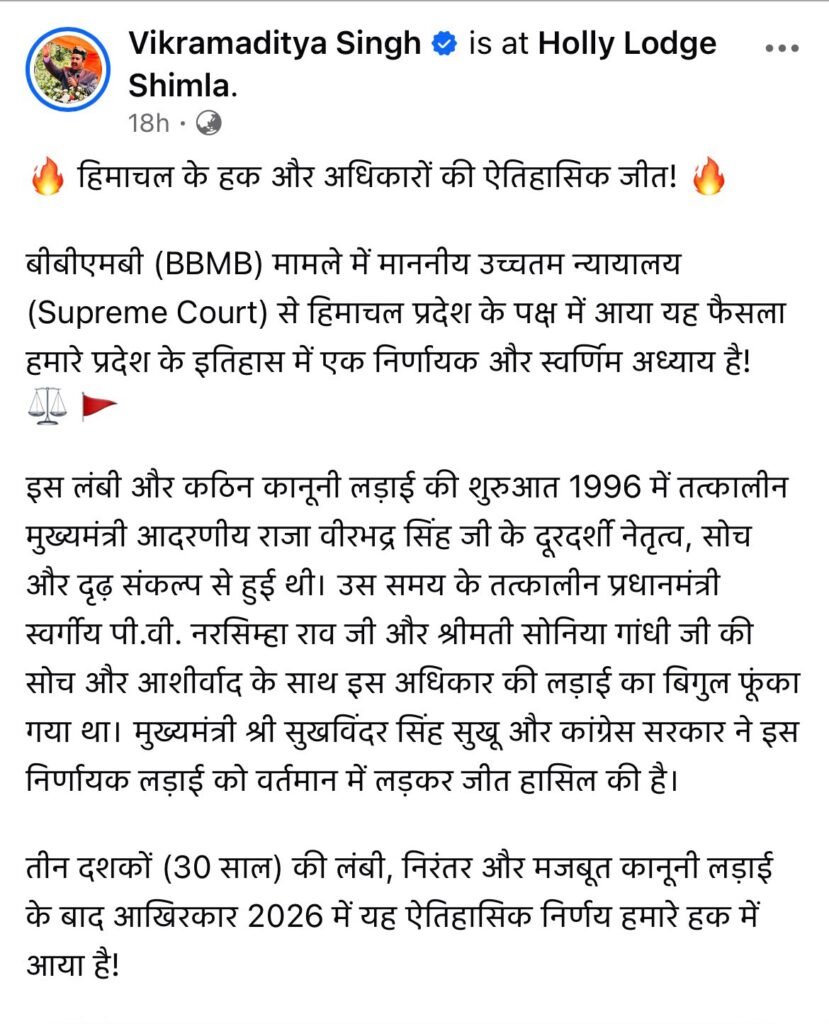
The competing claims have brought an interesting dimension to what is otherwise being celebrated across political lines as a significant victory for Himachal Pradesh. The debate is no longer limited to the outcome of the case but has shifted towards the political legacy of the struggle and the contribution of different governments in taking it to its logical conclusion.
Vikramaditya recalls Virbhadra’s initiative in 1996
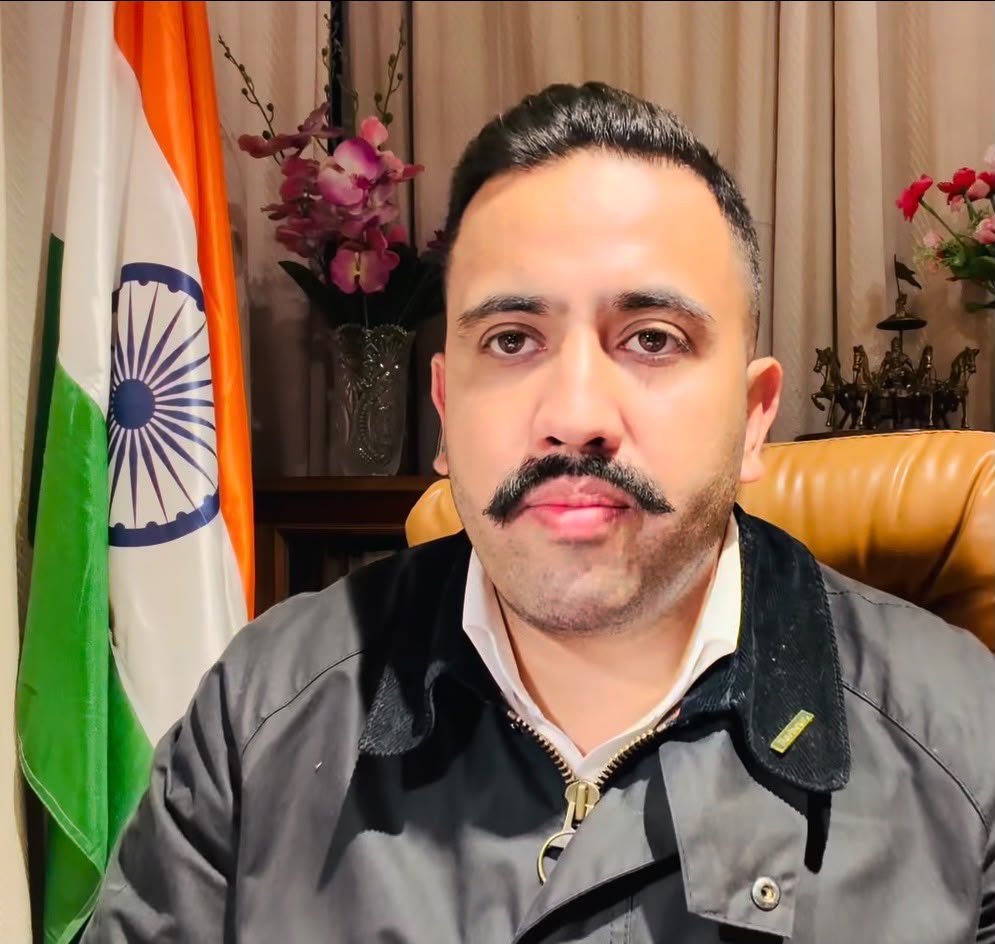
In a significant political intervention, Vikramaditya Singh underlined that the fight for Himachal Pradesh’s rightful share in BBMB projects was initiated in 1996 under the leadership of his father and former Chief Minister Virbhadra Singh.
He recalled that Virbhadra Singh had taken up the issue with the support of the then Prime Minister P.V. Narasimha Rao and senior Congress leader Sonia Gandhi, laying the foundation for the state’s long legal battle.
While acknowledging the efforts of the present Sukhu government in pursuing the case and putting forward Himachal’s position before the Supreme Court, Vikramaditya’s statement also highlighted that the roots of the achievement go back to the Virbhadra Singh era.
His remarks have added another layer to the credit debate, particularly as the present Congress government has been projecting the verdict as a result of its own determined efforts and strong legal representation.
Jairam credits Centre and three decades of struggle
Jai Ram Thakur welcomed the Supreme Court verdict but questioned the Congress government’s attempt to project it as the achievement of a single administration.
He maintained that the outcome was the result of nearly 30 years of legal and political efforts involving successive state governments. He also highlighted the role of the Central Government, particularly its cashless energy settlement formula presented during the proceedings in July 2026.
According to Thakur, the Centre’s intervention provided a practical way forward to resolve a dispute that had remained unresolved for decades. He thanked Prime Minister Narendra Modi and the Central Government for their contribution.
Targeting Chief Minister Sukhvinder Singh Sukhu, the BJP leader alleged that the Chief Minister was attempting to take political credit for an achievement that was the outcome of a prolonged collective struggle.
Thakur also urged the state government to ensure that the benefits of the additional power reach ordinary consumers through affordable electricity and improved public services.
From Virbhadra’s initiative to the 2026 verdict
The dispute traces its origins to the reorganisation of Punjab in 1966 and Himachal Pradesh’s claim to a 7.19 per cent share in BBMB projects.
In September 2011, the Supreme Court had recognised Himachal Pradesh’s entitlement to a 7.19 per cent share in the BBMB power projects. However, the actual settlement of accumulated energy dues and the mechanism for transferring the state’s entitlement remained contentious.
In its latest ruling, the Supreme Court has directed Punjab and Haryana to supply 11,973 million units (MUs) of electricity to Himachal Pradesh over a period of 20 years under the cashless energy settlement mechanism.
The decision is expected to provide substantial financial relief to the state. Chief Minister Sukhu has estimated that the additional power could generate annual revenue of around Rs 500 crore to Rs 1,000 crore, depending on its utilisation and market value.
A victory for Himachal, but a contest over political legacy
The BBMB verdict has given Himachal Pradesh an important opportunity to secure the benefits of its long-pending power entitlement. However, the political reactions have exposed competing narratives over the credit for the achievement.
For the Congress government, the verdict represents the outcome of its current legal efforts. Vikramaditya Singh has placed the historical contribution of Virbhadra Singh at the centre of the narrative, while the BJP has emphasised the role of successive governments and the Centre’s settlement initiative.
Ultimately, the state stands to benefit from the verdict, but the political debate over who laid the foundation, who sustained the legal battle and whose intervention helped resolve the dispute is likely to continue.