
From the quiet roads of Jogindernagar to the marathon podium in Japan, Sawan Barwal’s silver has given Himachal Pradesh a sporting moment to savour
Munish Sood
MANDI: In the mountains, distance is measured differently. A kilometre uphill is not the same as a kilometre on a flat road. A morning run begins with cold air, climbs, bends and fatigue. You learn early that the only way to reach the destination is to keep moving. Perhaps that is why the story of Sawan Barwal feels so naturally connected to the land he comes from.
The 28-year-old Indian Army athlete from Jogindernagar in Mandi district has just run himself into Indian sporting history. And in doing so, he has given Himachal Pradesh one of its proudest sporting moments in recent years.
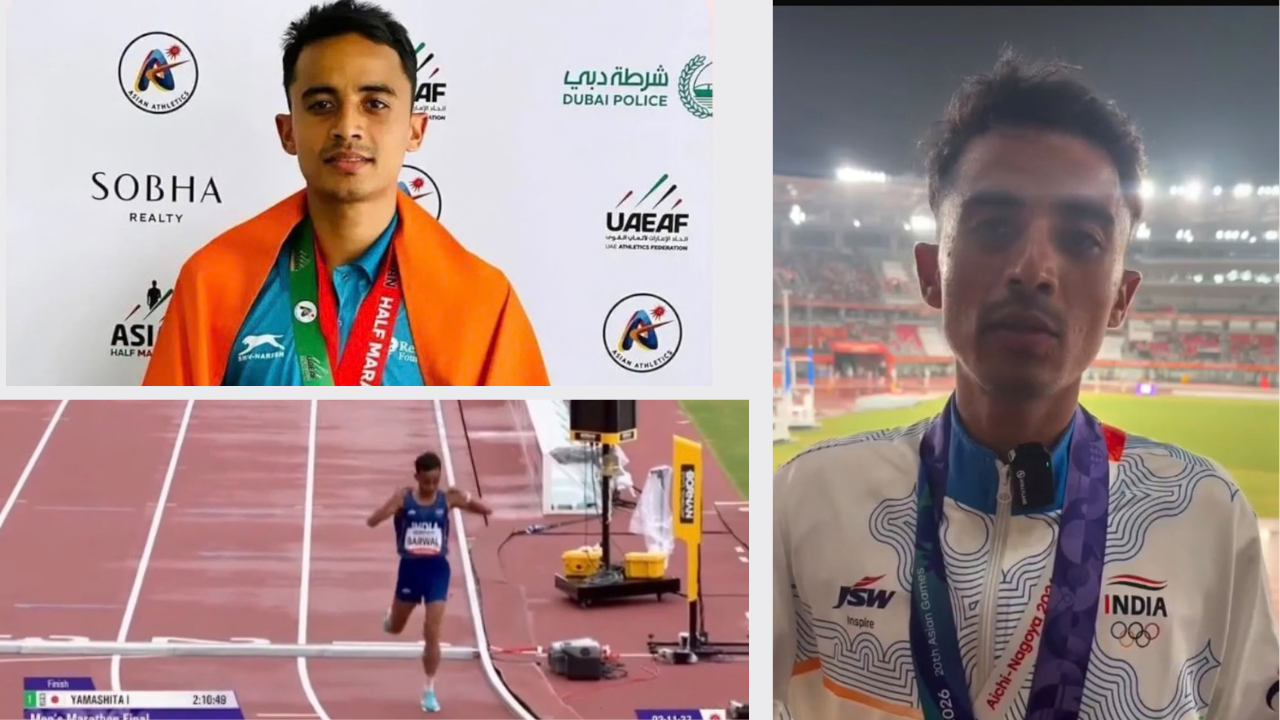
On Saturday in Nagoya, Japan, Sawan completed the 42.195-kilometre Asian Games marathon in 2 hours, 11 minutes and 37 seconds, winning the silver medal and improving his own national record.
But the stopwatch tells only part of the story. The bigger story is that a young runner from Mandi has ended India’s 44-year wait for a men’s marathon medal at the Asian Games.
For Himachal, the achievement carries an even more personal significance. This is not a champion produced by a metropolitan sporting academy. This is a Jogindernagar boy whose running journey began almost by chance. And now his name is written alongside some of the most significant marathon runners in Indian Asian Games history.
It began in Jogindernagar
There was no grand plan to make Sawan a marathon runner. He was just 14 when athletics entered his life.
His elder brother was associated with the school track team. Sawan went along, watched the training and was eventually asked to try running. He started with the 1,500 metres.
That first step, taken more than a decade ago in Jogindernagar, has now carried him to an Asian Games podium.
His coach Gopal Thakur remembers the beginning of that journey at the Sports Training Centre in Jogindernagar in 2012. At that stage, there was no talk of Asian Games medals or national records. There was simply a young boy discovering that he could run.
The medals began to come at district and state competitions. Then came the national level. Then the Army. Then the long distances. And finally, the marathon.
Mandi gave him the beginning; the Army gave him the platform
Sawan joined the Indian Army under the sports quota in 2019. By then, running had ceased to be a hobby. It had become his profession, his discipline and eventually his identity.
He built his reputation on the track, competing in the 5,000m and 10,000m. At the 2025 National Games in Dehradun, he won gold in both events.
Yet the biggest transformation was still ahead. The marathon was a completely different proposition.
Forty-two kilometres is not simply a longer race. It is another sport altogether. It demands pace, patience, nutrition, recovery and, above all, the ability to negotiate the final kilometres when the body is asking you to stop.
Sawan decided to take that challenge. It has turned out to be a remarkable one.
His first marathon already changed Indian athletics
The move to the marathon could easily have taken years to produce results. Instead, it took one race.
In April 2026, Sawan ran his first competitive marathon in Rotterdam. He finished in 2:11:58 and broke the Indian national record that had stood for 48 years.
Suddenly, the runner from Mandi was no longer simply a promising long-distance athlete. He was a national-record holder.
But even then, the biggest stage was still waiting.
Then came Nagoya
Sawan arrived at the Asian Games with just one marathon behind him. His preparation, however, had been serious.
The marathon in Nagoya was run in demanding conditions, with humidity, wind and intermittent rain adding to the challenge.
Sawan had one objective: stay with the leading group.
At halfway, he was second. Beyond 35 kilometres, the race had begun to become a test of survival as much as speed. Three runners remained at the front. Sawan was one of them.
The Japanese runner Ichitaka Yamashita eventually opened a gap. But Sawan held on. He did not panic. He did not abandon his pace. He ran his own race.
And when he crossed the finish line, the clock showed 2:11:37. Silver. A new national record. And a place in history.
Forty-four years later, India was back
The last time India had won a men’s marathon medal at the Asian Games was in 1982 in New Delhi, when Hosur Kukkappa Seetharan won bronze.
Sawan’s silver ended that 44-year wait. It also became India’s first medal in the Asian Games marathon on foreign soil.
Only a handful of Indian runners have previously stood on that podium. Now Sawan Barwal is one of them. And he has done it in only his second marathon.
That statistic alone tells the story of how extraordinary this breakthrough has been. His first marathon produced a national record. His second produced another national record and an Asian Games medal.
And in Mandi, the stopwatch suddenly became personal
Thousands of kilometres away, in Jogindernagar, Sawan’s family was following every kilometre. His father Kuldeep Barwal, who worked as a driver in Delhi, his mother Subhadra Devi, his elder brother and other family members watched with growing excitement.
When Sawan crossed the finish line, the celebration began. Neighbours started arriving. Messages poured in. The family celebrated with sweets and is planning a traditional dhaam for Sawan’s return home in October.
For a family from Jogindernagar, the Asian Games medal is not an abstract sporting achievement. It is their son’s achievement. The boy who started running at 14 has returned to the family story as a national hero.
Himachal has a new reason to be proud
The congratulatory messages have reflected the wider pride across Himachal Pradesh. Chief Minister Sukhvinder Singh Sukhu congratulated Sawan on the historic achievement.
Former Chief Minister and Leader of Opposition Jai Ram Thakur also congratulated the athlete from Jogindernagar, describing the achievement as a matter of pride and inspiration for the state’s youth.
The recognition is significant because Sawan’s achievement is not merely about one race. It reinforces something Himachal has repeatedly demonstrated in Indian sport: a small population and difficult terrain do not mean a small sporting ambition.
Sawan’s story adds another chapter. This time, the road leads through Mandi.
The hills may have taught him what the marathon demands
There is a certain poetry in a marathoner emerging from Himachal Pradesh. The sport demands endurance. The hills demand endurance too.
The sport demands patience. The mountains teach patience.
The sport asks you to keep moving when your legs become heavy. Anyone who has grown up negotiating Himachal’s roads knows something about that.
Sawan’s achievement should not be reduced to geography, of course. Elite marathon running is built on years of scientific training, coaching, nutrition, recovery and discipline. But the environment in which he first learned to run forms an important part of his story.
The boy from Jogindernagar learned to run before he learned how far that running could take him.
Two marathons. Two records. One historic medal.
Perhaps the most remarkable line in Sawan Barwal’s young marathon career is also the simplest: he has run only two competitive marathons.
The first gave him a national record. The second gave him another national record and an Asian Games silver.
And now the expectations will naturally grow. Sawan has already set his sights on improving towards the 2:07–2:08 range and competing at the highest international level.
The Asian Games medal may therefore be less a conclusion than an opening.
From a village in Mandi to the marathon history books
There are moments when sport becomes larger than sport. Sawan Barwal’s silver is one of them.
It is a moment for his family. A moment for Jogindernagar. A moment for Mandi. And a moment for Himachal Pradesh.
The image that will remain is not only that of Sawan standing on the Asian Games podium. It is also the image of a young boy on a track in Jogindernagar, more than a decade ago, taking his first serious steps into athletics without knowing where they would lead.
Those steps have now travelled 42.195 kilometres across Nagoya. They have crossed a 44-year wait. They have rewritten an Indian record. And they have carried the name of Mandi and Himachal Pradesh onto an Asian Games marathon podium.
For the people of Jogindernagar, Sawan’s story can now be told in one simple sentence: One of their boys ran all the way to history.