
Munish Sood
Mandi
Himachal CM says his fight is for the common man, accuses Centre of withholding funds and alleges BJP is putting politics ahead of state’s interests
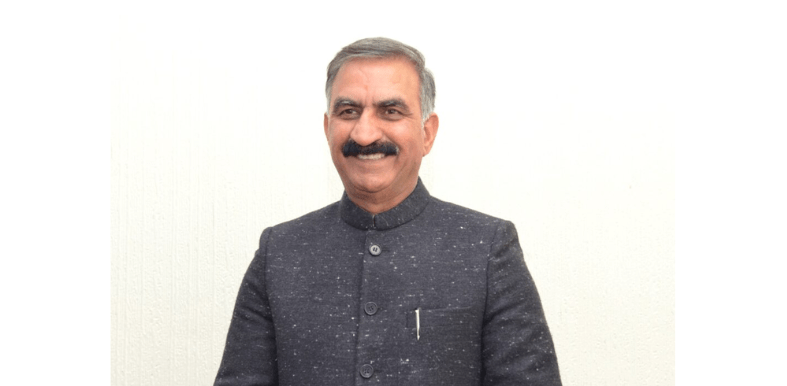
Himachal Pradesh Chief Minister Sukhvinder Singh Sukhu has mounted a sharp counterattack against Union Health Minister Jagat Prakash Nadda, turning the confrontation between the Congress government and the BJP into a wider political battle over central funding, disaster relief, tribal development and the treatment of an elected state government.
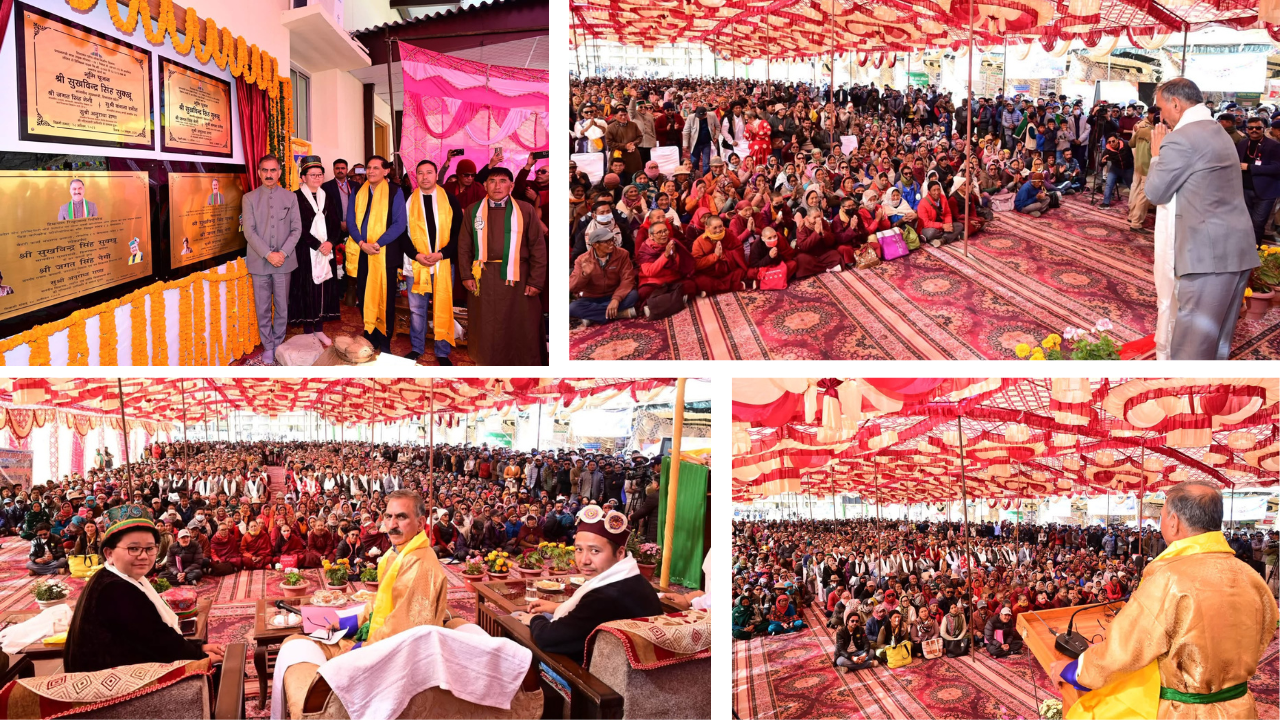
Addressing a gathering during his tribal tour of Kaza in Lahaul-Spiti under the Sarkar Gaon Ke Dwar initiative, Sukhu rejected the BJP’s allegations of financial mismanagement and administrative failures, asserting that his government was continuing its development and welfare agenda despite what he described as financial and political obstacles created by the Centre.
“My fight is not for the chair, but for the common man,” Sukhu said, seeking to frame the confrontation as a battle over public welfare rather than political power.
The chief minister’s remarks came after Nadda, during his recent visit to Kullu, accused the Congress government of misgovernance, poor financial management and failure to utilise central funds effectively. The Union minister also questioned delays in key infrastructure projects, including the strategically important Sumdo-Kaza road.
‘BJP must answer for its treatment of Himachal’
Countering Nadda’s criticism, Sukhu accused the BJP-led Centre of adopting a step-motherly approach towards Himachal Pradesh, particularly during natural disasters when the hill state faced widespread damage and mounting rehabilitation requirements.
The chief minister maintained that his government had enhanced relief and compensation from state resources to support affected families despite what he described as inadequate assistance from the Centre. He asserted that the administration had stood by disaster-hit people rather than leaving them to cope with the consequences on their own.
The dispute places the question of Centre-state financial relations at the heart of the political confrontation. While Nadda has argued that central assistance has not been utilised effectively, Sukhu’s counterargument is that pending funds and financial constraints have restricted the state’s ability to accelerate development.
The competing claims have brought renewed attention to the funding and implementation of welfare schemes, healthcare initiatives and infrastructure projects in the Himalayan state.
₹112 crore healthcare funding claim sharpens the confrontation
Healthcare funding has emerged as a major point of contention between the two sides. The Sukhu government has alleged that more than ₹112 crore in healthcare-related funds due to Himachal Pradesh remain pending, challenging Nadda’s criticism of the state’s handling of central assistance.
The Congress government’s position is that the Centre should release eligible funds instead of questioning the state’s financial management. The BJP, meanwhile, has maintained that the state administration must explain delays in implementing projects and effectively utilising the assistance already provided.
The figure of ₹112 crore and the precise status of the pending funds could not be independently established from the available reports. A detailed, scheme-wise account of releases, expenditure and outstanding claims would help clarify the dispute.
ICMR centre row brings cooperative federalism into focus
The political disagreement also intensified following Nadda’s visit to Keylong on October 12, when he laid the foundation stone of the ICMR Centre for High Altitude Medicine and Public Health Research.
The proposed centre is intended to advance research into high-altitude health challenges affecting Himalayan communities and armed forces personnel. The initiative is designed to support research into altitude-related illnesses, extreme weather conditions, maternal and child health, nutrition and improved healthcare delivery in remote areas.
However, the Sukhu government has objected to what it describes as the sidelining of elected state representatives during central government programmes, arguing that public events in Himachal Pradesh should reflect the principles of cooperative federalism rather than become platforms for partisan politics.
The dispute has therefore expanded beyond the merits of individual projects to the question of how the Centre and state governments should coordinate development initiatives while respecting each other’s institutional roles.
Sumdo-Kaza road becomes another flashpoint
The Sumdo-Kaza road has emerged as another contentious issue, with Nadda questioning delays in the strategically significant route and the state government disputing the suggestion that it was deliberately holding up development.
Sukhu’s camp has argued that the state is following the required statutory procedures and that delays in projects involving multiple departments and clearances cannot automatically be attributed to the state administration.
The road is particularly important for residents of the remote tribal region, where connectivity affects access to healthcare, education, markets, tourism and essential services. Its progress is also significant given Lahaul-Spiti’s strategic location and difficult geographical conditions.
The competing allegations underline the need for clarity on project timelines, pending approvals and the respective responsibilities of state and central agencies.
Attack on political defections
Sukhu also sharpened his political attack on leaders who switched parties, taking aim at what he described as opportunistic politics and the sale of political integrity.
In an apparent reference to former Lahaul-Spiti MLA Ravi Thakur, the chief minister criticised leaders who changed political allegiance and urged voters not to support what he called “bikaau vidhayaks” (leaders willing to be bought).
The remarks reflect the continuing political fallout from defections that reshaped the Congress government’s relationship with the opposition in Himachal Pradesh. By invoking the issue during a public programme in the tribal belt, Sukhu sought to connect the debate over party switching with questions of public trust and political accountability.
Welfare guarantees and rural economy at the centre of Sukhu’s defence
Defending his government’s record, Sukhu said it had continued to implement its welfare commitments despite financial pressures. He highlighted efforts to strengthen the rural economy, generate additional revenue and intensify the campaign against chitta, a term commonly used in Himachal Pradesh for heroin or heroin-like illicit drugs.
The chief minister presented these initiatives as evidence that his administration remained focused on household welfare, employment and the protection of young people.
However, a comprehensive assessment of the government’s performance would require scheme-wise expenditure, beneficiary figures and independently verifiable implementation data rather than political claims alone.
A political contest with wider implications
The Sukhu-Nadda confrontation reflects a broader struggle between the Congress government in Himachal Pradesh and the BJP leadership over governance, public finances and responsibility for delays in development.
For the BJP, the central issue is whether the state government has adequately utilised the resources available to it and delivered projects within stipulated timelines. For the Congress, the argument is that Himachal Pradesh faces financial constraints and pending central assistance while continuing to meet its welfare obligations.
The decisive questions are likely to be answered through official records: how much funding has been sanctioned and released, what amounts remain pending, which projects are delayed and why, and how effectively public money is reaching intended beneficiaries.
For the people of Lahaul-Spiti, the immediate stakes are practical rather than rhetorical — reliable road connectivity, accessible healthcare, disaster support and sustained development in one of the country’s most challenging geographical regions.
As the political exchange intensifies, the contest between the Centre and the state government is likely to remain focused on a central question: whether competing claims of financial responsibility will translate into measurable improvements in the lives of Himachal Pradesh’s people.