
Sudhanshu Sharma
Nurpur
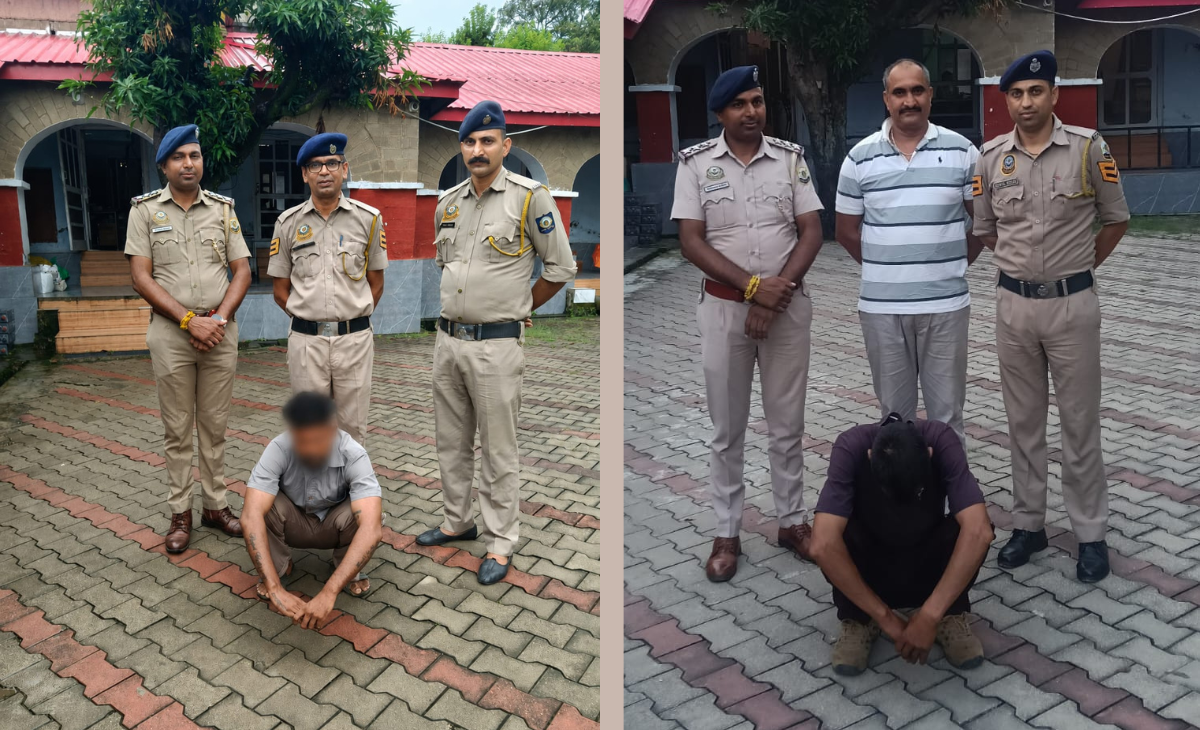
In a significant breakthrough against the illegal drug trade, Nurpur Police District has arrested two accused wanted in separate NDPS Act cases. The arrests were made on August 18, 2026, following intensive investigations that developed both backward and forward links to trace the supply chain and networks involved in narcotics distribution.
The Arrests
The first arrest was made in connection with FIR No. 171/2026, registered on June 28, 2026, under Sections 21 and 29 of the NDPS Act. The accused, Rajat (32 years), son of Rakesh Kumar and resident of Naushera Pattan, Tehsil Mukerian, District Hoshiarpur, Punjab, was apprehended from Police Station Shahpur Kandi, Pathankot (Punjab).
In the second case, linked to FIR No. 101/2026, registered on April 22, 2026, under Sections 20 and 29 of the NDPS Act, police arrested Rangila Ram (52 years), son of Tek Chand, resident of Village Bajot, Post Office Thaltukhod, Tehsil Padhar, District Mandi, Himachal Pradesh.
Both arrests were executed after investigators successfully established backward and forward links, connecting the accused to broader networks of drug supply and distribution.
Understanding Backward and Forward Link Investigation
Backward and forward link analysis is a critical investigative technique used in narcotics cases.
- Backward link refers to tracing the origin of the drugs—identifying suppliers, sources, and production points.
- Forward link focuses on tracking the distribution chain—identifying buyers, transporters, and networks that spread narcotics further into communities.
By combining both approaches, police can dismantle entire networks rather than just arresting individuals. In these cases, Nurpur Police emphasized that the arrests were not isolated but part of a larger strategy to uncover the roots of the drug trade.
The Broader Campaign Against Narcotics
Nurpur Police District has been running a sustained campaign against narcotics, targeting both small-scale peddlers and larger networks. Officials stated that the arrests of Rajat and Rangila Ram are part of ongoing efforts to eliminate the drug menace from the region.
“Drugs destroy lives and communities. Our mission is to uproot the networks that sustain this illegal trade. By developing backward and forward links, we are not only arresting individuals but also exposing the supply chains behind them,” said a senior police officer.
The Legal Framework
The Narcotic Drugs and Psychotropic Substances (NDPS) Act, 1985 is India’s primary legislation to combat drug trafficking and abuse.
- Section 20 deals with offenses related to cannabis.
- Section 21 pertains to manufactured drugs and preparations.
- Section 29 covers conspiracy and abetment in drug-related offenses.
Both accused face serious charges under these provisions, which carry stringent penalties including long-term imprisonment.
Court Proceedings
Police confirmed that both accused will be presented before the Honorable Court on August 19, 2026. The court will decide on their custody and further investigation. Legal experts note that such arrests often lead to extended investigations, as accused individuals may provide information about larger networks.
Community Impact and Concerns
Drug abuse has become a growing concern in Himachal Pradesh and neighboring Punjab. Communities often bear the brunt of addiction, with families suffering from social and economic consequences. The arrests have been welcomed by locals, who see them as a step toward safeguarding youth from the lure of narcotics.
“Every arrest matters. It shows that the police are serious about protecting our children from drugs. But the fight must continue until the entire network is destroyed,” said a resident of Nurpur.
Challenges in Combating Drug Networks
Despite regular arrests, dismantling drug networks remains challenging.
- Cross-border supply chains: Many drugs flow across state borders, making coordination between police forces essential.
- Hidden networks: Suppliers often operate through layers of intermediaries, making it difficult to trace the original source.
- Legal complexities: Proving conspiracy and abetment under Section 29 requires strong evidence, which can take time to gather.
Nurpur Police emphasized that backward and forward link analysis is helping overcome these challenges by systematically mapping connections.
A Pattern of Success
This is not the first time Nurpur Police has used link analysis to make arrests. In recent months, several cases have been cracked using similar methods, leading to multiple arrests and seizures of narcotics. The district police have built a reputation for innovative investigative strategies, combining technology with human intelligence.
Officials noted that the arrests of Rajat and Rangila Ram are part of a larger pattern of success, demonstrating the effectiveness of link-based investigations.
Looking Ahead
Police have assured that investigations will continue to identify other individuals connected to these cases. The focus remains on dismantling the supply chain, from source to consumer. “We will not stop until the drug networks are eliminated. Every link we uncover brings us closer to that goal,” said an investigating officer.
Authorities also urged the public to cooperate by reporting suspicious activities. Community participation, they said, is vital in the fight against narcotics.
Conclusion
The arrests of Rajat from Punjab and Rangila Ram from Himachal Pradesh mark another milestone in Nurpur Police District’s campaign against narcotics. By employing backward and forward link analysis, investigators have not only apprehended two wanted accused but also strengthened their strategy to dismantle drug networks at the root.
As the accused face court proceedings, the larger battle against narcotics continues. For the people of Nurpur and surrounding regions, these arrests bring hope that the menace of drugs can be curbed, ensuring a safer and healthier future for the community.