
Staff Reporter
Shimla: As Chief Minister Sukhvinder Singh Sukhu prepares to present his next state budget, the mountainous state finds itself at a critical crossroads.
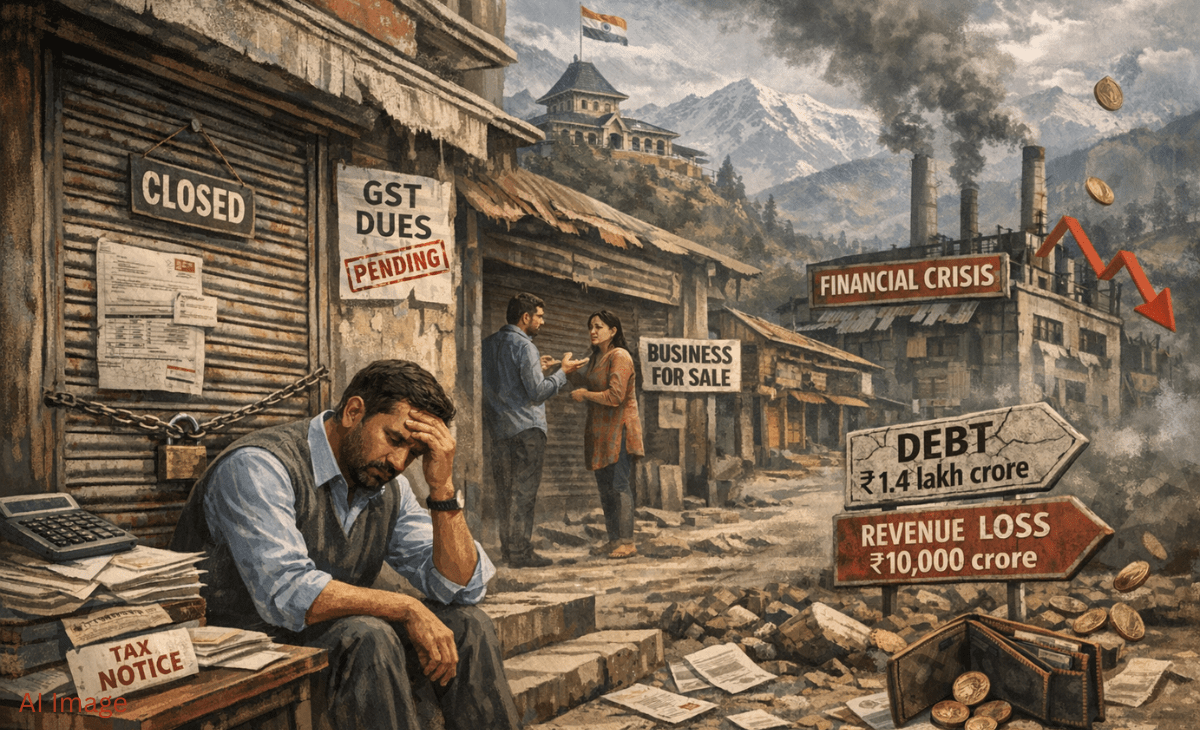
While the government battles a ballooning debt burden exceeding ₹1.40 lakh crore and a looming annual revenue loss of ₹10,000 crore following the discontinuation of the Central Revenue Deficit Grant, a segment of the local economy—small and medium businesses—is sounding an alarm over government apathy.
The COVID Hangover: A GST Deadlock
Despite the Chief Minister’s repeated calls for “financial self-reliance,” several businesses that were derailed by the COVID-19 pandemic claim they are being blocked from re-entering the mainstream economy. These enterprises, which failed to file their GST returns during the height of the crisis, now find themselves in a bureaucratic stalemate.
Yogesh Kumar, a prominent business consultant, highlighted the growing frustration among entrepreneurs who are eager to settle their dues but find the doors closed.
“A significant number of businesses could not maintain their filings during the pandemic due to health crises and shuttered operations,” Kumar stated. “Today, these business owners are ready to pay all outstanding penalties and fines to regularize their status. However, they are being met with silence or confusion from the department.”
According to Kumar, the only current recourse is filing long, drawn-out appeals. He noted that even after following this formal process, there is no certainty of relief. These businesses are essentially in a state of “taxation limbo,” unable to operate fully or contribute to the state’s revenue at a time when the treasury needs every rupee.
Departmental Confusion and Silence
The State Taxes and Excise Department appears equally adrift. Internal sources suggest that officials are unclear on how to handle these legacy COVID cases beyond the standard appeal process, as no specific amnesty or streamlining instructions have been issued from the top.
The lack of a clear policy framework has left mid-level officials hesitant to exercise discretion, fearing future audits.
Recent attempts to reach the department for clarification proved futile, as officials remained unavailable for comment.
This lack of communication comes even as the state government publicly emphasizes the importance of GST as a milestone for transparency—a sentiment that feels increasingly distant to those struggling with procedural hurdles.
CM Sukhu’s Balancing Act
The plight of these businesses adds another layer of complexity to CM Sukhu’s “harsh fiscal reality.” In recent months, the government has taken drastic measures to curb expenditure, including stripping Cabinet status from various board chairmen and deferring 20% of salaries for political appointees.
While the Chief Minister is lobbying New Delhi for a special financial package and pushing for a “self-reliance” budget that seeks to maximize internal revenue, critics argue that the state must first fix its internal machinery.
If the taxation department continues to ignore businesses willing to pay their way back into the system, the goal of reviving Himachal’s financial health may remain an uphill climb for the hill state.
For now, the business community looks toward the upcoming policy announcements, hoping for a clear roadmap that replaces “appeals and apathy” with “amnesty and action.”