

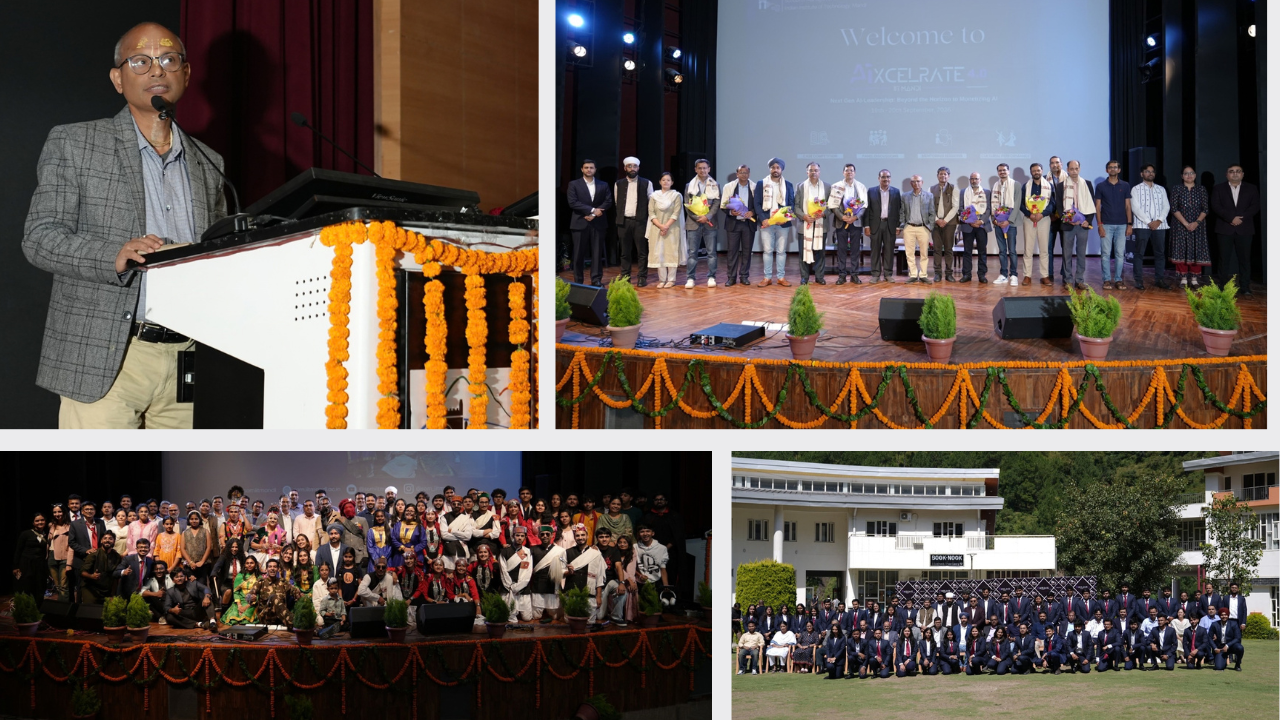
Two-day conclave examines responsible AI, strategic advantage and the challenge of scaling innovation
Munish Sood
Mandi
Turning artificial intelligence into sustainable business value will depend not only on technology, but also on leadership, organisational readiness and responsible decision-making, experts said at IIT Mandi’s fourth AI and leadership conclave, AiXcelrate 4.0.
Held on September 19 and 20 by the institute’s School of Management, the conclave was organised around the theme “Next Gen AI-Leadership: Beyond the Horizon to Monetizing AI.” It brought together industry leaders, professionals, faculty members and students to discuss the changing relationship between AI, leadership and business.
The discussions focused on three key shifts: moving from automation and productivity towards strategic advantage, converting AI adoption into business growth, and scaling successful pilots into sustainable organisational solutions.
IIT Mandi Director Prof. Laxmidhar Behera said the future of AI leadership must be rooted in responsibility and social impact. He stressed that rapid technology adoption alone could not define effective leadership and called for innovation to remain aligned with human values and meaningful outcomes.
The first day featured a panel on “Moving from Productivity and Automation to Strategic Advantage: The AI Value Shift.” Hindustan Coca-Cola Chief Data Officer Ashley D’Acouza cautioned that widespread access to AI would not automatically create competitive advantage. He said organisations were still largely experimenting with the technology and that its impact would depend on leadership, strategic vision and alignment with business needs.
The day also included mentoring sessions and industry-academia interactions, followed by HimTarang – Cultural Evening, featuring performances by the IIT Mandi community.
The second day focused on organisational AI maturity and measurable business outcomes. A panel on “Moving from AI Adoption to AI Advantage: Accelerating Growth” examined AI’s role in customer acquisition, personalisation, innovation, decision-making and revenue growth.
Rohit Kilam, Chief Technology Officer, HDFC Life, discussed the evolving division of work between humans and AI. He said AI would increasingly handle tasks that could be readily verified, while ambiguity, judgement and interpretation would continue to require human involvement.
Another panel, “Moving from Pilot to Profit: Scaling AI,” addressed data infrastructure, system integration, governance, workforce preparedness, costs and human oversight.
An Industry Case Competition, supported by 6D Technologies, challenged MBA and Integrated MBA students to develop solutions to a real-world business problem. Team Tactical Minds won the competition, while The Case Solvers and The InsightX were named first and second runners-up.
Prof. Anjan K. Swain said AI’s business impact could be understood through scope, speed and scale. The conclave concluded that future success would depend on how organisations lead, govern, integrate and scale AI, rather than simply how quickly they adopt it.