

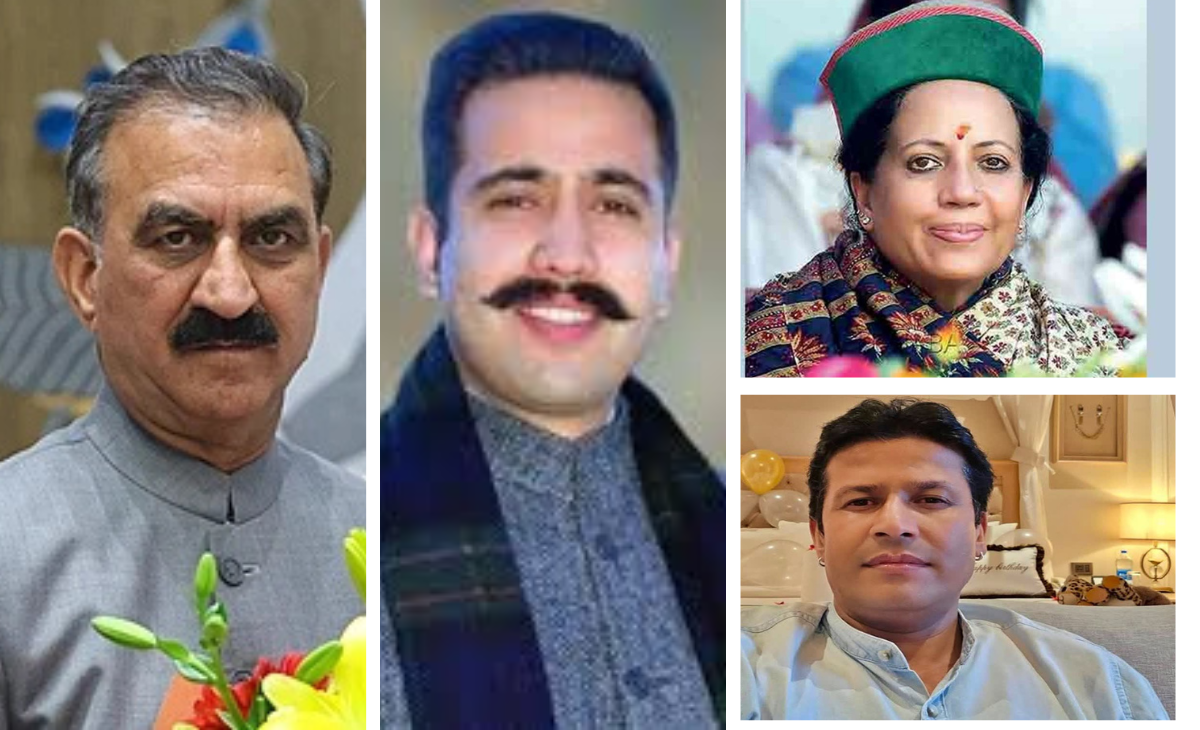
Munish Sood
Mandi
The resignation of former Congress vice-president Neeraj Bharti has once again brought into sharp focus the simmering internal fault lines within the Himachal Pradesh Congress, reviving the long-standing perception of a quiet but persistent power tussle between the current leadership and the political legacy of the Virbhadra Singh camp.
What began as Bharti’s resignation has now expanded into a wider narrative of factional positioning, with political observers reading the developments as an assertion of influence by leaders aligned with the Virbhadra Singh legacy, often referred to in political circles as the “Virbhadra camp.”
Chief Minister Sukhvinder Singh Sukhu, however, moved to firmly downplay the controversy, stating that the matter has been exaggerated beyond proportion and does not indicate any organisational crisis. His remarks—describing the episode as “not a major issue”—are being seen within party circles as an attempt to assert control over an increasingly vocal internal narrative.
Yet, behind this calibrated public stance, political interpretations suggest that the episode has provided an opening for competing internal voices to reassert themselves. The timing of Bharti’s resignation and his sharp social media attacks have added momentum to the perception that dormant tensions within the party are resurfacing.
Bharti, who has been critical of the state leadership, escalated his attack through a series of posts targeting the Chief Minister and the functioning of the organisation, further intensifying speculation of factional realignment. His statement that “the real issue will be seen in 2027” has only deepened the political undertone of the controversy.
Within this evolving landscape, the Congress organisational response has been swift. State Congress President Vinay Kumar accepted Bharti’s resignation from the post of vice-president, a move interpreted as an effort to quickly close the organisational chapter and prevent prolonged internal debate.
At the same time, senior leader Pratibha Singh—widely associated with the Virbhadra Singh political legacy—issued a nuanced but significant intervention. Emphasising the importance of grassroots workers, she stated that those who played a crucial role in bringing the party to power must be given full respect and recognition.
More importantly, she underlined that any dissatisfaction within the organisation should not be ignored. “If there is resentment or misunderstanding among workers, the leadership should sit together and resolve it through dialogue,” she said, indirectly highlighting the need for greater internal consultation and accommodation of differing voices.
Her remarks are being seen in political circles as a subtle reminder of the importance of balancing organisational control with ground-level sentiments—especially in a state unit where legacy influence continues to shape internal equations.
Cabinet Minister Vikramaditya Singh also sought to soften the perception of conflict, stating that differences within a political family are natural and should not be overstated, signalling an attempt to project unity amid growing speculation.
Meanwhile, the broader narrative being discussed in political corridors is that the Neeraj Bharti episode has once again activated underlying currents between the current administrative leadership and the influence networks associated with the Virbhadra Singh legacy. While no formal division is acknowledged within the party, the optics of repeated disagreements and public statements have added weight to the perception of an evolving internal contest.
Chief Minister Sukhu’s repeated dismissals of internal discord are being viewed by some observers as a strategy of firm centralisation, while critics interpret the current episode as evidence of periodic friction that surfaces whenever organisational balance shifts.
As the Congress attempts to maintain a united public posture, the Neeraj Bharti controversy has emerged as more than an isolated resignation—it now sits at the intersection of legacy politics, organisational control, and the ongoing recalibration of power within Himachal Pradesh’s ruling party.