

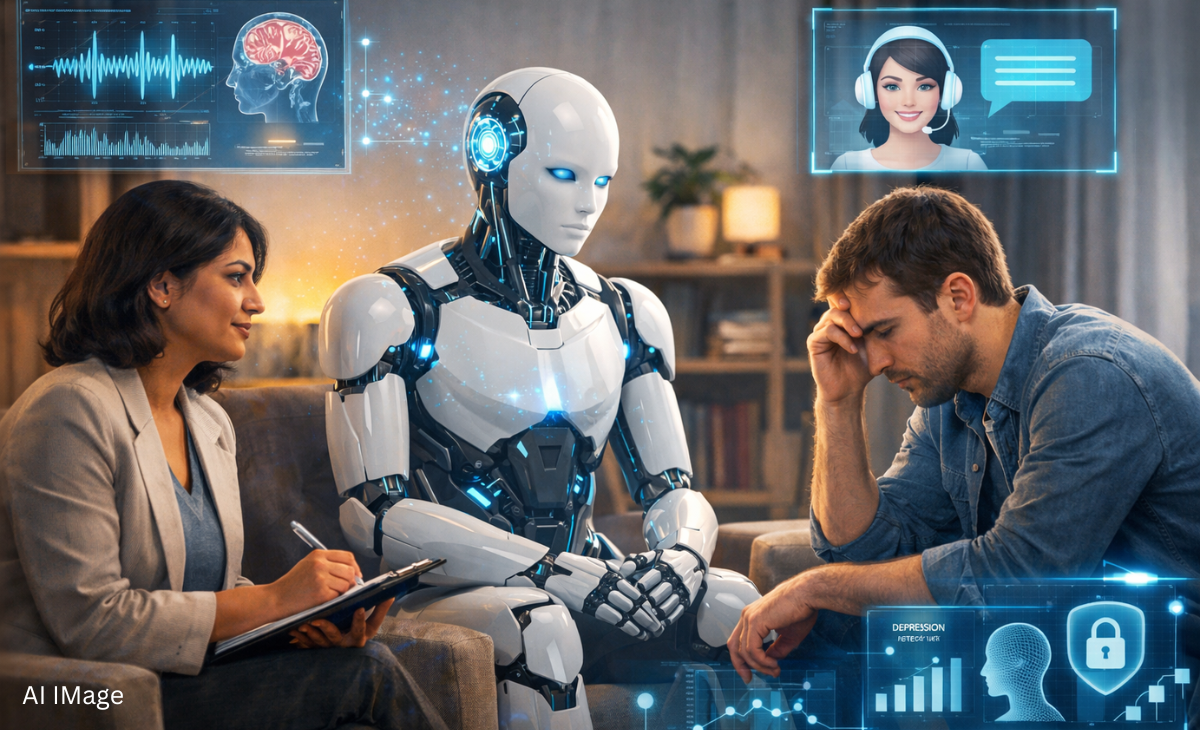
Artificial intelligence is reshaping psychology — expanding access to mental healthcare while raising urgent questions about what is lost when machines replace human therapists.
Anupriya
AI has entered the consulting room — not as a filing system, but as an active participant in psychological diagnosis and care. Machine learning systems now detect early signs of depression through speech patterns, predict therapy drop-out risk, and power chatbot apps used by tens of millions worldwide.
The most immediate gains are in diagnosis. A Harvard Medical School study found a machine learning model could identify PTSD with 89% accuracy using only a three-minute voice sample — no questionnaire, no clinical interview required. Yet critics warn that algorithmic labels risk flattening the complexity of mental experience. “Depression is not one thing,” argues Dr James Okonkwo of the Maudsley Institute. “A model accurate in aggregate may be catastrophically wrong in individual cases.”
“The machine doesn’t get tired or judge — but it cannot truly understand suffering, and that gap matters enormously.”
The deeper challenge arises when AI moves from diagnosing to treating. Studies show users disclose more openly to AI than to human therapists, partly because they fear no judgment. But this unsettles a core principle: the therapeutic alliance — the felt bond between therapist and client — is one of the strongest predictors of successful outcomes. Can an algorithm, however sophisticated, genuinely provide that? Or does it merely simulate care while leaving its substance untouched?
Regulatory frameworks have not kept pace. AI mental health tools occupy a legal grey zone in most jurisdictions, subject to neither medical device standards nor the ethical oversight governing human clinicians. Researchers are calling for enforceable rules on data privacy, algorithmic transparency, and mandatory professional oversight.
“Used carefully, as a complement to human care rather than a substitute, this technology could transform mental healthcare,” says Dr Priya Sharma of University College London. “The risk is that commercial pressures push us to deploy it before we have understood what we are doing.”
The questions AI raises for psychology are not only practical — does it work, is it safe, who is accountable — but profoundly human: What does it mean to truly care for another mind? There are no algorithms for that. At least not yet.
KEY FACTS
1 in 4 adults globally experience a mental health disorder each year
89% accuracy in voice-based PTSD detection (Harvard Medical School, 2026)
1.2 million+ global shortfalls in mental health workers (WHO)

Anupriya
Ph.D. Scholar, Department of
Human Development and Family Studies,
PAU, Ludhiana, 141004