
Munish Sood
Mandi
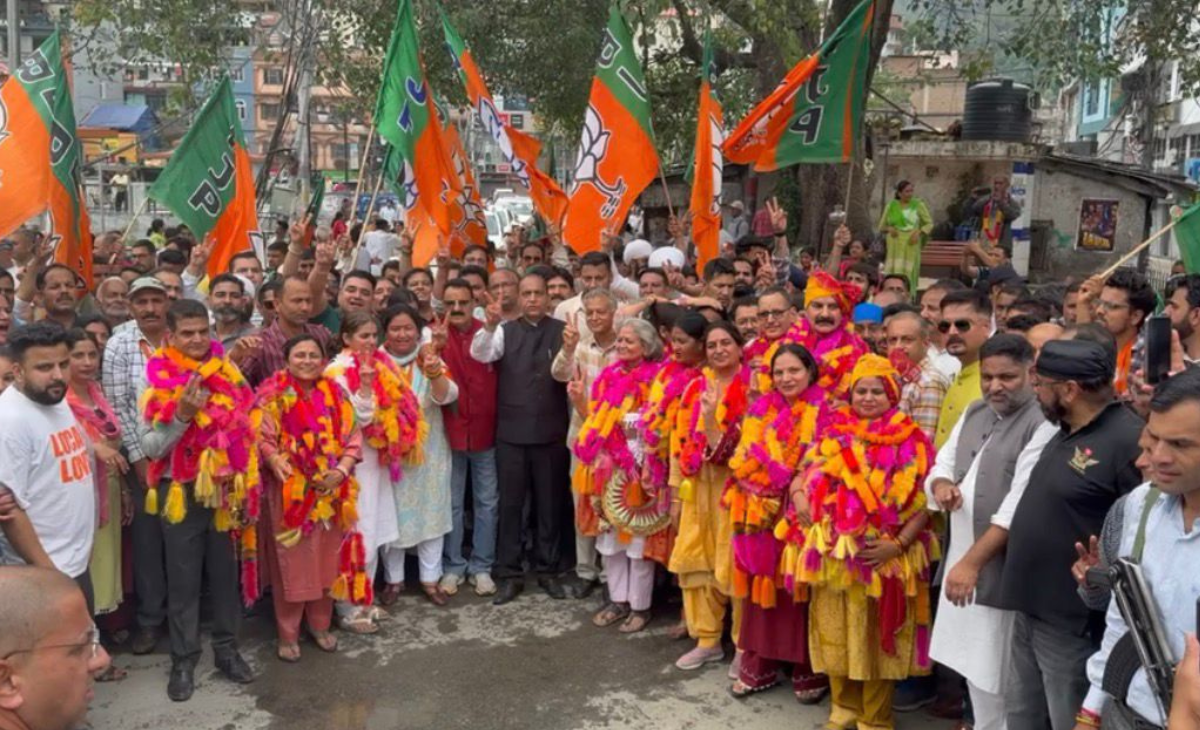
The results of the 2026 Mandi Municipal Corporation elections have delivered a significant political message from the heart of Himachal Pradesh, with the Bharatiya Janata Party (BJP) securing a commanding victory and retaining control of the civic body for a second consecutive term.
Out of the 15 wards in the Municipal Corporation, elections were held in 14 wards after residents of Behna Ward boycotted the polls over local developmental concerns. Of the 14 seats contested, the BJP emerged victorious in 12 wards, while the Congress managed to secure only one seat. The remaining seat was won by an Independent candidate.
The outcome is being viewed as far more than a local body election result. Political observers see it as a major endorsement of the BJP’s organisational strength in Mandi district and a reaffirmation of the party’s influence in a region long considered a crucial political centre in Himachal Pradesh.
The election was widely regarded as a test of political strength for former Chief Minister and Leader of Opposition Jai Ram Thakur, whose home district has traditionally served as one of the BJP’s strongest bastions. Despite an intensive campaign mounted by the ruling Congress government, including visits by Chief Minister Sukhvinder Singh Sukhu, senior ministers and state leadership, the party failed to make significant inroads into the BJP stronghold.
A key factor behind the BJP’s performance was the high-energy and strategically coordinated campaign led by local BJP MLA Anil Sharma. Considered one of the party’s most influential leaders in the region, Sharma personally campaigned across multiple wards alongside party candidates and played a pivotal role in mobilising grassroots support.
Political analysts believe Sharma’s extensive outreach, voter engagement efforts and ability to consolidate support across different sections of the electorate were instrumental in helping the BJP not only retain its traditional support base but also recover and secure seats that were considered vulnerable during the campaign. His visibility on the ground throughout the election period provided momentum to the party’s campaign and helped maintain organisational cohesion amid challenges posed by local anti-incumbency sentiments and rebel candidates.
The BJP’s victory is particularly significant as it improved upon its previous tally, increasing its representation from 11 seats in the last corporation election to 12 seats this year. The result reflects a consolidation of support rather than merely the retention of existing political ground.
The election also witnessed instances of rebellion and dissatisfaction over ticket distribution in both major parties. While some Congress rebels managed to influence local electoral equations, the BJP’s disciplined cadre network and booth-level management ensured that internal dissension did not translate into substantial electoral damage.
With a voter turnout of 68.78 percent, the election recorded robust public participation, indicating a high level of engagement among urban voters. The verdict suggests that a substantial section of the electorate endorsed continuity, local leadership and the BJP’s campaign narrative on governance and development.
However, the complete boycott of polling in Behna Ward has emerged as an important takeaway from the election. Residents’ refusal to participate over unresolved local issues has highlighted the growing importance of grassroots concerns and serves as a reminder to both political parties and the administration that local development remains central to democratic accountability.
Beyond the municipal limits of Mandi, the results carry broader political implications. For the BJP, the victory reinforces its organisational resilience and leadership strength in one of Himachal Pradesh’s most politically significant districts. For the Congress, the outcome is likely to trigger introspection over campaign strategy, local connect and organisational effectiveness despite the advantage of being the ruling party in the state.
As Himachal Pradesh gradually moves towards future electoral contests, the Mandi Municipal Corporation verdict is being interpreted as an early indicator of political sentiment in the region and a reaffirmation of the BJP’s continuing dominance in one of its most important strongholds.