

TNR News Network
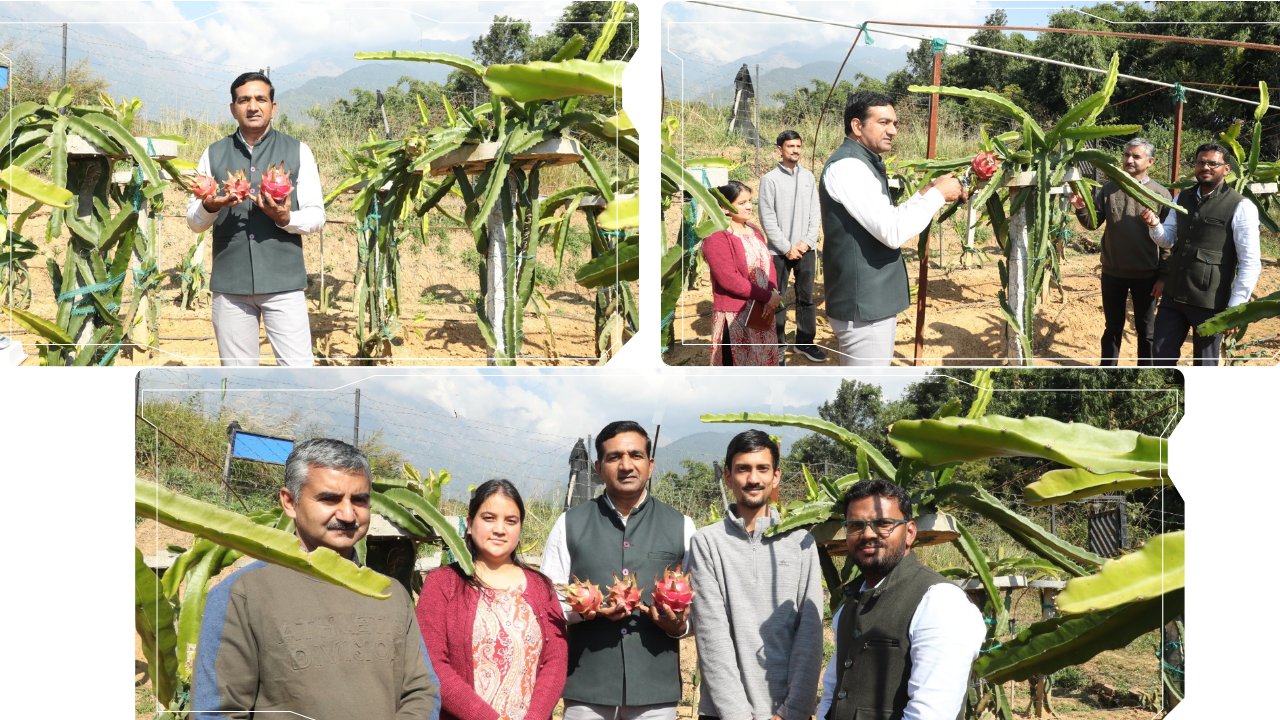
Palampur: In a significant breakthrough for Himachal Pradesh’s agricultural sector, the CSIR-Institute of Himalayan Bioresource Technology (CSIR-IHBT), Palampur, has successfully demonstrated the scientific cultivation and harvesting of dragon fruit for the first time in the mid-hill region of the state.
Traditionally considered a crop suited to warm and tropical climates, dragon fruit has now shown promising results under the cooler climatic conditions of the Himalayan region. The achievement is expected to open new avenues for high-value horticulture and provide additional income opportunities for farmers in the state.
The research initiative was undertaken by a team of scientists at CSIR-IHBT under the leadership of its Director, Dr. Sudesh Kumar Yadav. The trial was initiated on May 10, 2025, with a limited number of plant cuttings and a specially developed trellis support system to assess the crop’s adaptability to mid-hill conditions.
The research team closely monitored the plants through challenging winter conditions, including low temperatures and frost, as well as the monsoon season and high rainfall. Scientists systematically observed plant growth, conducted measurements and made necessary adjustments to evaluate the crop’s performance under Himalayan climatic conditions.
The efforts culminated in the first harvest on November 4, 2026, when the plants produced large, vibrant and high-quality fruits weighing up to 750 grams. According to the institute, the quality of the harvested fruits was comparable to those grown in tropical orchards.
This achievement demonstrates the potential of Himachal Pradesh’s mid-hill regions to support high-value fruit crops beyond traditional agricultural practices. Dragon fruit cultivation could provide farmers, particularly those with small and marginal landholdings, with an additional income-generating opportunity.
Benefits for Hill Farmers
Dragon fruit is considered a promising crop due to its potential for high economic returns and relatively low water requirements once established. Its successful cultivation in the mid-hills could help diversify agricultural activities, improve farm incomes and support sustainable horticultural development.
The successful trial also highlights the role of scientific research and innovation in identifying new crop opportunities suited to changing climatic conditions in the Himalayan region.
CSIR-IHBT will continue refining the cultivation package and developing appropriate scientific guidelines to enable more farmers to adopt dragon fruit cultivation with confidence.
The breakthrough marks an important step towards diversifying Himachal Pradesh’s agricultural economy and strengthening the state’s potential in high-value horticulture.