
‘Raseedi Ticket’ Brings Amrita Pritam’s Memories, Struggles and Unspoken Love to Life
Munish Sood
Satohal (Mandi)
The curtains came down on the five-day National Theatre Festival 2026 at Satohal in Mandi with an evocative staging of Raseedi Ticket, bringing alive the memories, struggles, relationships and unspoken love of celebrated writer Amrita Pritam.
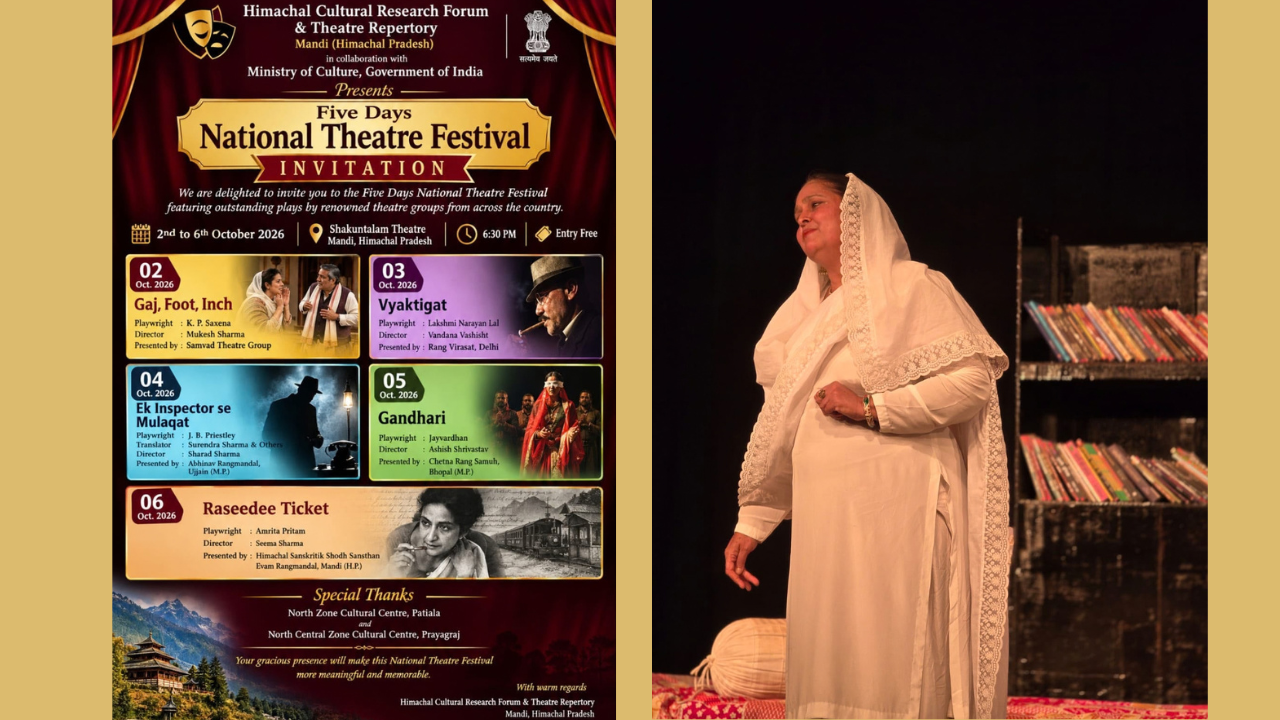
Organised by the Himachal Cultural Research Forum and Theatre Repertory, Mandi, in collaboration with the Ministry of Culture, Government of India, the festival, held from October 2 to 6 at the Shakuntalam Theatre, Satohal, brought together theatre groups and artists from different parts of the country. The festival offered audiences a diverse theatrical experience spanning social drama, literature, mythology and human relationships, with all performances open to the public free of charge.
The festival opened on October 2 with Gaj, Foot, Inch, written by noted playwright K.P. Saxena and directed by Mukesh Sharma, presented by the Samvad Theatre Group. On October 3, Ek Inspector Se Mulakat, based on J.B. Priestley’s An Inspector Calls, was staged. Adapted by Surendra Sharma and associates and directed by Sharad Sharma, the production was presented by Abhinav Rangmandal, Ujjain.
The October 4 presentation, Vyaktigat, written by Lakshmi Narayan Lal and directed by Vandana Vashishth, was presented by Rang Virasat, Delhi. The festival then turned to Indian mythology with Gandhari on October 5, written by Jayvardhan and directed by Ashish Shrivastava, presented by Chetna Rang Samuh, Bhopal.
The festival concluded on October 6 with Raseedi Ticket, based on the celebrated literary work of Amrita Pritam. The production was presented by the Himachal Cultural Research Forum and Theatre Repertory, Mandi, bringing the five-day celebration of Indian theatre to an emotionally powerful close.
The production was directed by Seema Sharma, who also portrayed Amrita Pritam in a demanding solo performance.
Amrita Pritam’s autobiography Raseedi Ticket is not merely an account of a writer’s life; it is the deeply personal self-expression of a woman who sought her independent voice amid the conventions, social restrictions and personal struggles of her time. Beginning with memories of childhood and moving through love, separation, struggle, literature, relationships and self-determination, the work presents her life journey with remarkable candour and intimacy.
The stage adaptation brought together several phases of Amrita’s life through a distinctive theatrical language. Her different identities—as a poet nurturing an inner world, a woman struggling with life, a sensitive soul immersed in love and a writer questioning the conventions of her times—were brought alive on stage.
The production also highlighted Amrita’s deep and largely unspoken relationship with Sahir Ludhianvi, where silence often spoke louder than words. Her attraction towards Sahir, the memories that found expression in her poetry and the lingering pain of an unfulfilled love added emotional depth to the performance.
The arrival of Imroz in her life emerged as another significant chapter—one in which love was portrayed not merely as the desire to possess, but as an acceptance of another person’s freedom and individuality.
The world of Raseedi Ticket is, in essence, a record of the small and defining experiences of Amrita’s life, which she transformed into literature through her words. Her pen gave universal resonance to personal pain and transformed individual love into a literary memory that continues to be read and felt by generations.
The most striking feature of Seema Sharma’s solo performance was her effort not merely to portray Amrita on stage, but to enter the emotional world of the writer herself. At one moment, she appeared as Amrita lost in memories; at another, as a woman waiting in love; elsewhere, as a writer confronting society over her choices; and at yet another moment, as a woman looking back at her entire life from a later stage of existence.
Her performance relied not only on dialogue but also on silence, expressions, body language and memory, creating a deeply intimate portrayal of Amrita Pritam.
The festival, meanwhile, underscored Mandi’s growing potential as a platform for serious theatre and cultural exchange. With productions arriving from Delhi, Ujjain and Bhopal, alongside local theatrical talent, the five-day event created a space where different theatrical traditions, literary works and artistic perspectives met a Himachali audience.