
Munish Sood
Mandi
Sundernagar, September 27: He started with just 200 bags of mushrooms. Today, Ankit Kumar is handling a production capacity of nearly 7,000 bags, sending around 20 quintals of mushrooms to vegetable markets every month and earning a net income of nearly ₹1.5 lakh.
For the Class XII pass youth from Purana Bazar in Sundernagar, the journey from a modest beginning to a growing agri-business has been built on practical experience, scientific training and the determination to create his own livelihood rather than wait for a conventional job.
Ankit’s first step into mushroom cultivation came after he spent six to seven months working at a mushroom farm. The experience gave him an understanding of the business at the ground level. He later underwent formal training at the Krishi Vigyan Kendra, Sundernagar, and began his own production with only 200 bags of button mushrooms.
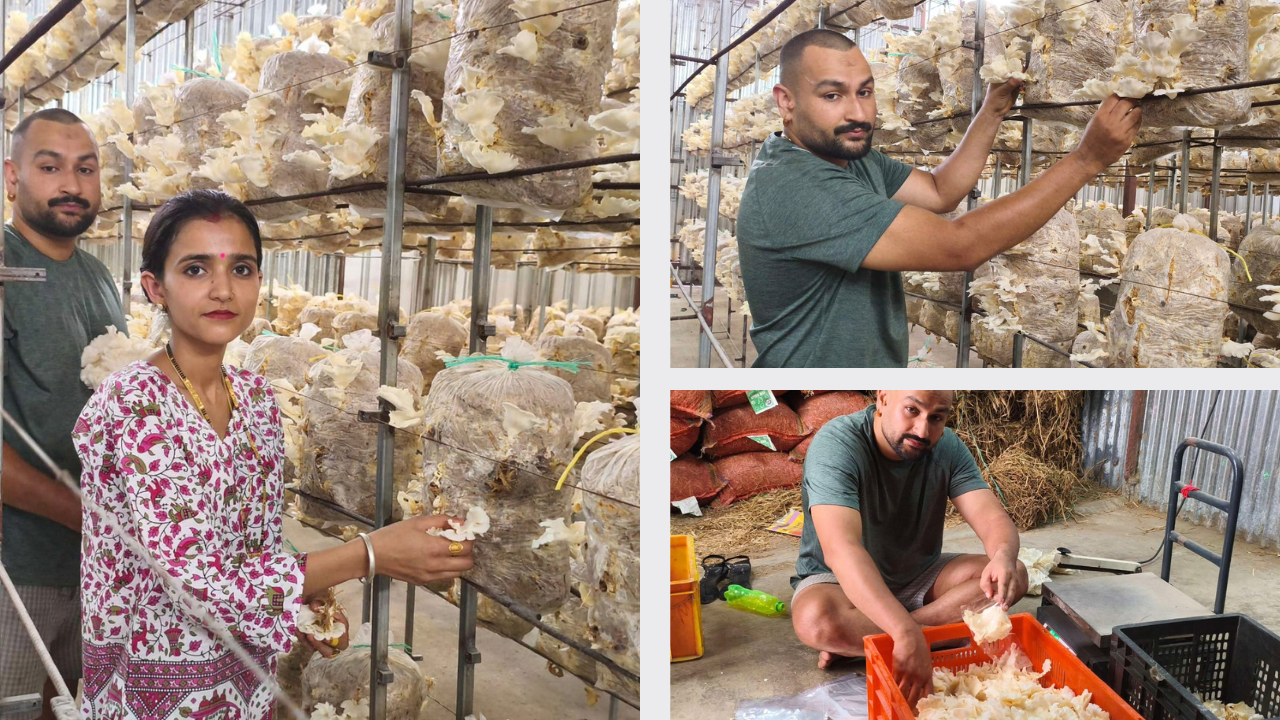
The enterprise gradually expanded. With experience came experimentation, and Ankit added oyster mushrooms to his production. He also adopted vertical farming to make maximum use of limited space.
Today, his mushroom unit covers around 80×80 feet, but the production is carried out across multiple levels, allowing him to generate substantially more output from a relatively small area. His monthly production has now reached around 20 quintals, which are supplied to vegetable markets.
After meeting the various production expenses, the enterprise provides him with an income of approximately ₹1.5 lakh a month.
The growth of the business also received support under the Himachal Khumb Vikas Yojana. In 2023-24, Ankit was sanctioned ₹50,000 for construction of a mushroom shed. The scheme also provides growers with training, financial assistance and technical guidance related to scientific mushroom cultivation, maintenance and disease control.
For Ankit, however, the business is no longer confined to Sundernagar.
As demand and experience grew, he expanded into neighbouring Punjab and established another mushroom unit near Bharatgarh. Production there is being carried out in bamboo huts, with the cultivation practices adapted to Punjab’s warmer climate. While mushroom varieties suited to the cooler conditions are grown in Sundernagar, a suitable variety for higher temperatures is being cultivated at the Punjab unit.
Ankit says he has also kept his production process natural and free from chemical pesticides, insecticides and fungicides. During periods of heavier workload, he takes the help of daily-wage workers, while his wife Charanjit Kaur is also involved in the enterprise.
What makes Ankit’s story significant is the scale of the transformation. A venture that began with 200 bags has evolved into a commercial operation with thousands of bags and a second production unit outside the state.
His journey also highlights the potential of mushroom cultivation for young people and small landholders looking for alternatives to conventional farming or salaried employment. Unlike many traditional agricultural activities, mushroom production can be undertaken on limited land, provided growers have the necessary technical knowledge and maintain proper production conditions.
Ankit believes young people should not look only towards government jobs for livelihood opportunities. Agriculture, horticulture and allied activities, he says, can also become viable businesses when approached with training, scientific methods and persistence.
From a 200-bag experiment in Sundernagar to a 7,000-bag enterprise with a new unit in Punjab, Ankit’s story is ultimately about starting small—and having the courage and patience to keep growing.