
S Gopal Puri
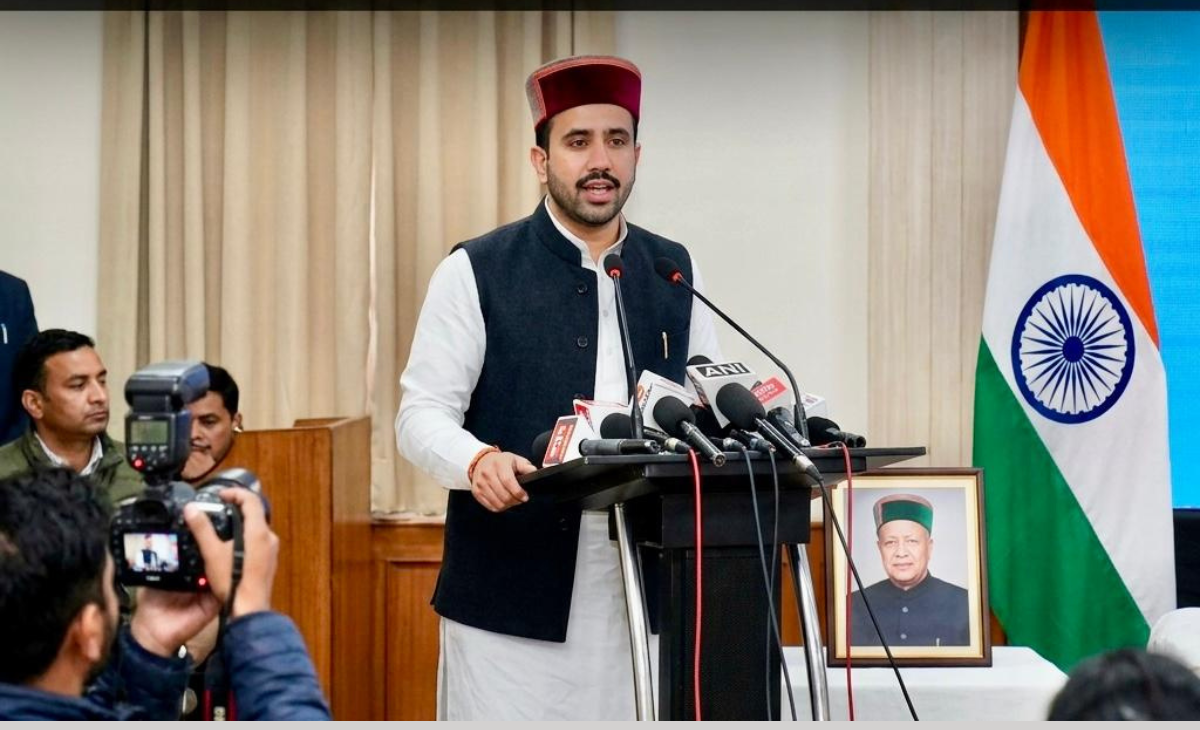
Shimla: In the high-stakes theater of Himachal Pradesh politics, where a single photograph can ignite a thousand rumors, Cabinet Minister Vikramaditya Singh has rebutted the narrative of “internal rebellion” when contacted by this correspondent.
Addressing the recent murmurs surrounding his cross-party engagements—specifically his cordial meeting with BJP’s Sarveen Chaudhary—Singh has reframed what critics call “Photo Diplomacy” as a masterclass in Result-Oriented Statesmanship.
The controversy, sparked by reports suggesting a rift between the Minister and Congress loyalists in the Shahpur belt, has been met with a sharp, intellectually grounded rebuttal.
For Singh, the goal isn’t just to preserve a legacy in amber, but to make it work for the 70 lakh citizens of the state.
The ₹7,000 Crore Dividend
Intelligence Over Ideology
Adding significant political weight to his defense, Singh revealed that his “habit” of maintaining open channels across the ideological spectrum is the primary engine behind a massive influx of central and state resources.
“In political life, a leader must meet everyone across the aisle,” Singh stated with the conviction of a seasoned administrator.
“It is precisely this habit of dialogue that has allowed me to secure approximately ₹7,000 crore in funding and infrastructure projects for Himachal. To deliver for the people, one must rise above partisan walls. This isn’t a betrayal; it is the most effective way to serve.”
For the intelligent observer, this isn’t just “Photo Diplomacy”—it is Developmental Diplomacy.
In a federal structure where state-central synergy is the key to unlocking budgets for roads, bridges, and urban rejuvenation, Singh’s ability to act as a pragmatic bridge is a rare and potent asset.
Deconstructing the “Shahpur Murmurs”
Addressing the specific ripples caused by his meeting with Sarveen Chaudhary—the primary rival of sitting Congress MLA Kewal Singh Pathania—the Minister offered a dose of reality that transcends the ballot box. He clarified that the meeting was rooted in the ancient Himachali value of social grace.
The Occasion
Chaudhary had visited him to extend a formal invitation for a family function. Routine photography by his office, shared as part of standard digital updates, was misinterpreted as a calculated “direct hit” on a colleague.
The Culture: Singh emphasized that in the hills, personal relationships have historically stood above political rivalries—a hallmark of the very “Holly Lodge” culture his critics claim he is abandoning.
An Unbroken Vow: The Path of the Lion
For those who comprise the “Virbhadra Club,” the Minister’s most resonant words were those of his unwavering commitment to his roots.
He made it clear that while his methods are modern and pragmatic, his heart remains anchored in the legacy of the late six-time Chief Minister.
“There is nothing like breaking a legacy or working against any loyalist,” Singh asserted.
“I am committed to following the footsteps of my father. For me, the people of Himachal are my family. My father taught me to lead with an open door and a clear heart.”
The Statesman of the New Era ?
By choosing to address the “murmurs” with transparency and a balance sheet of ₹7,000 crore, Vikramaditya Singh has reinforced his position as a leader of administrative gravity.
He is positioning himself as a politician who is secure enough in his own identity to engage with the opposition without fear of diminishing his brand.
While the “The Newz Radar” may focus on the friction of the moment, the broader political logic favors Singh’s approach. In an era of hyper-polarization, the “People’s Prince” is betting that the electorate will value a bridge built through diplomacy over a rivalry maintained through silence.
He isn’t just carrying a name; he is ensuring that the Virbhadra Legacy remains the most powerful force for progress in Himachal’s future.
“I am following and I will follow my father’s path until my last breath. My people are my family.” — Vikramaditya Singh.