
Eminent scholars and academicians deliberate on Sardar Vallabhbhai Patel’s historic contribution to national integration and its relevance to building a developed India
Munish Sood
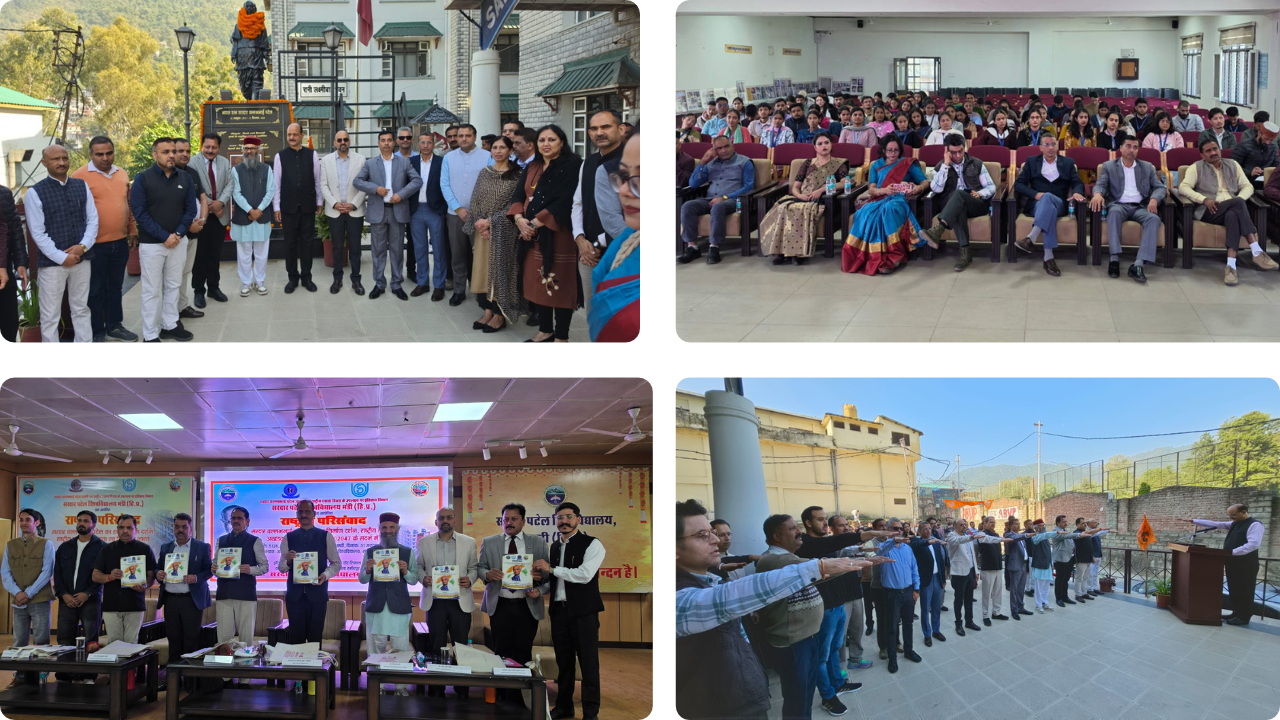
MANDI: The vision of Sardar Vallabhbhai Patel in uniting India after Independence and his enduring contribution to nation-building came under academic focus at a national seminar organised by Sardar Patel University, Mandi, to mark the birth anniversary of the Iron Man of India and National Unity Day.
Titled “Sardar Vallabhbhai Patel’s Vision of Nation-Building: National Unity, Integrity and in the Context of Viksit Bharat@2047”, the seminar brought together eminent scholars, historians and academicians from across the country to deliberate on Patel’s contribution to India’s political integration and the continuing relevance of his ideals in the journey towards a developed nation.
Acharya Lalit Kumar Awasthi, Vice-Chancellor of Sardar Patel University, attended the programme as the chief guest, while Dr Chet Ram Garg, Director of Thakur Ram Singh History Research Institute, Neri (Hamirpur), presided over the event. Acharya Dharm Chand Chaubey, Professor in the Department of Greater India Studies at Indira Gandhi National Centre for the Arts, New Delhi, under the Ministry of Culture, Government of India, was the keynote speaker. Dr Jogendra Kumar Yadav, Regional Director of IGNOU Regional Centre, Shimla, attended as the special guest. Dean of Student Welfare Acharya Rajesh Kumar Sharma and Registrar Shashi Pal Negi were also present.
The programme began with floral tributes to the statue of Sardar Vallabhbhai Patel on the university campus, followed by the administration of the National Unity Pledge by the Vice-Chancellor. The dignitaries also visited an exhibition organised on the occasion. The formal proceedings commenced with the lighting of the ceremonial lamp and the rendition of Vande Mataram. A souvenir published in connection with the seminar was also released.
Addressing the gathering, Vice-Chancellor Acharya Lalit Kumar Awasthi described Sardar Vallabhbhai Patel as one of the greatest architects of modern India, whose farsighted leadership and firm determination played a decisive role in consolidating the country after Independence.
He highlighted Patel’s historic achievement in integrating the princely states into the Indian Union, stating that his diplomatic skills, organisational ability and unwavering resolve ensured India’s political and geographical unity at a crucial juncture in its history.
Awasthi emphasised that national unity extended beyond the protection of geographical boundaries and also involved mutual respect among different languages, cultures and traditions, social harmony and a strong commitment to constitutional values.
He said the goal of Viksit Bharat@2047 would require a comprehensive approach encompassing economic progress, quality education, scientific research, innovation, women’s empowerment, social inclusion and active participation of young people.
Describing universities and higher educational institutions as important pillars of nation-building, he urged students to draw inspiration from Patel’s determination, organisational strength and dedication to national service. He added that the most meaningful tribute to Patel would be to incorporate his ideals into personal conduct, professional work culture and social life.
In his keynote address, Acharya Dharm Chand Chaubey elaborated on Patel’s personality, contribution to the freedom movement and historic role in the integration of princely states. He observed that Patel’s farsightedness, strong willpower, organisational capabilities and commitment to the nation provided a lasting foundation for India’s unity and integrity. His ideas, he said, continued to offer valuable guidance in understanding contemporary national challenges and achieving the vision of a developed India.
Presiding over the seminar, Dr Chet Ram Garg highlighted the importance of Indian history, cultural consciousness and national unity. He said a strong nation could be built only by preserving its historical heritage, cultural values and spirit of social harmony. He also encouraged students and research scholars to undertake serious and evidence-based research on different aspects of Indian history.
Earlier, Dean of Student Welfare Acharya Rajesh Kumar Sharma welcomed the dignitaries and introduced the guests. Dr Rakesh Kumar Sharma, Head of the Department of History and coordinator of the seminar, outlined its theme, objectives and significance, observing that Patel’s nation-building philosophy remained highly relevant to strengthening national unity and integrity.
Registrar Shashi Pal Negi proposed the vote of thanks, expressing gratitude to the guests, participating institutions, scholars, research scholars, faculty members and students for their contribution to the successful organisation of the seminar.