

Munish Sood
Mandi
In a calibrated administrative move aimed at reinforcing institutional discipline in the digital age, the Himachal Pradesh government under Chief Minister Sukhvinder Singh Sukhu has notified a detailed set of social media guidelines for its employees and officers. The directive comes amid heightened scrutiny over the online conduct of public servants, following a recent controversy that had triggered debate across political and bureaucratic circles.
Issued by Joint Secretary Neeraj Kumar, the order mandates that all government employees must uphold the highest standards of propriety, restraint, and responsibility—not only in official capacities but also across personal social media platforms and public forums.

Strict Boundaries on Digital Conduct
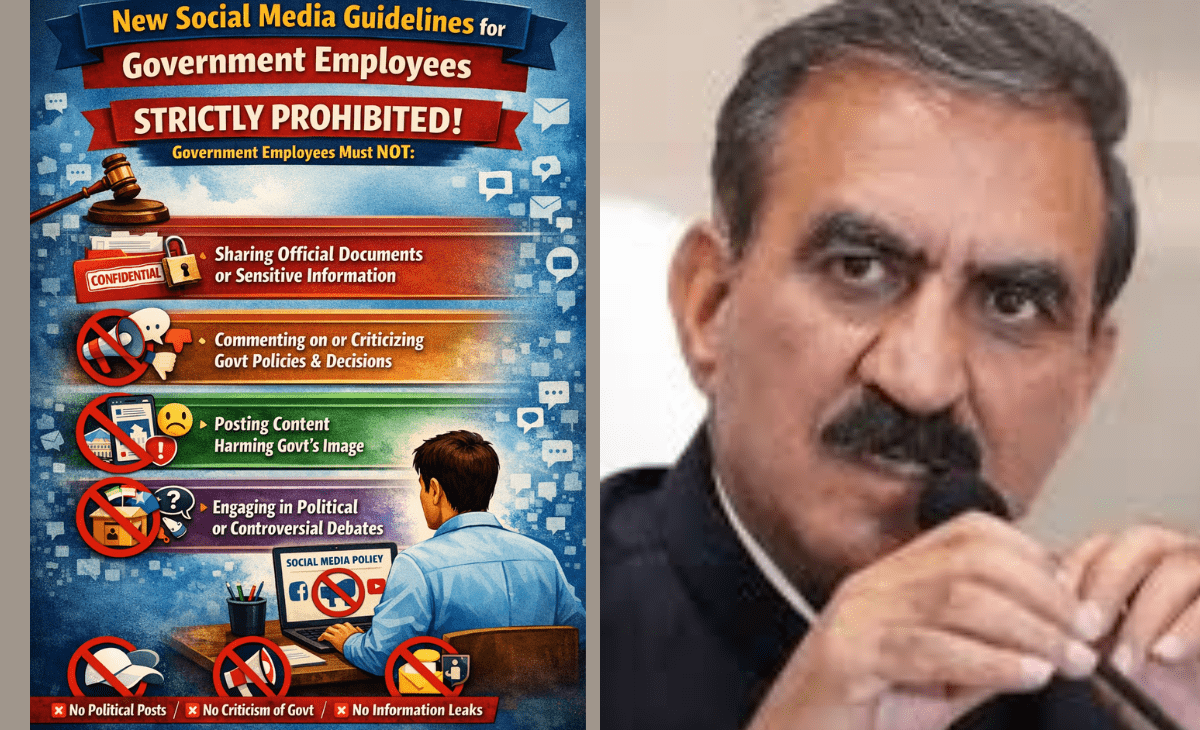
The guidelines lay down a clear framework regulating online behavior. Government employees have been expressly barred from:
• Sharing any official documents or sensitive government-related information without prior authorization
• Publicly commenting on, endorsing, or criticising government policies, decisions, or schemes
• Posting or amplifying content that could adversely impact the image or credibility of the government
• Engaging in political or controversial discourse that may compromise administrative neutrality
Importantly, the order also stipulates that any opinion expressed by an employee in a personal capacity must carry a clear disclaimer that it does not reflect the views of the government.
Discipline Extends Beyond the Workplace
In a notable assertion, the government has underlined that the code of conduct for public servants is not confined to office premises. The order emphasises that discipline, accountability, and ethical standards must extend into employees’ private lives, particularly in their digital engagements.
Officials say the move is intended to safeguard the integrity of governance and ensure that the conduct of public servants remains beyond reproach in an era where social media amplification can quickly escalate local issues into state-wide controversies.
A Triggering Controversy
While the notification does not cite any specific case, it follows closely after a widely discussed episode involving an SDM-level officer whose social media activity—particularly a promotional post—had drawn criticism and raised concerns over conflict of interest and propriety. The incident had gained traction due to the officer’s substantial digital following, crossing 900,000 users across platforms.
The episode eventually led to the removal of the content and deactivation of associated social media accounts, but not before it prompted serious introspection within the administration.
Governance in the Age of Social Media
The development reflects a growing trend among state administrations to formalise digital conduct norms for government personnel. As public officials increasingly occupy influential spaces online, the need to delineate personal expression from official responsibility has become more pressing.
While the government views the guidelines as essential to preserving administrative neutrality and public trust, some observers caution that the implementation will require a careful balance to avoid infringing upon individual freedoms.
A Policy Signal with Wider Implications
With this directive, the Sukhu government has effectively drawn a clear line on the digital engagement of its workforce. The message is unambiguous: in a hyper-connected ecosystem, personal online activity carries professional consequences—especially for those in public service.
The coming months will determine how these guidelines are enforced on the ground, and whether Himachal Pradesh sets a precedent for other states grappling with similar challenges in regulating the online conduct of their officials.