
CM projects agreement as Himachal’s victory; Union Minister says long-pending project is the result of Centre’s intervention and six-state consensus
Munish Sood
Mandi
The signing of the long-awaited agreement on the Kishau Multipurpose Project has triggered a fresh political confrontation in Himachal Pradesh, with Chief Minister Sukhvinder Singh Sukhu and Union Minister Anurag Thakur offering sharply different narratives over who deserves credit for taking the decades-old project forward.
The political exchange began after Sukhu described the agreement as an “historic day” for Himachal Pradesh and claimed that his government had secured a framework protecting the state’s financial interests.
In a post addressed to the people of Himachal Pradesh, Sukhu said his government had consistently opposed an arrangement that, according to him, would have imposed a substantial financial burden on the state for its share of the project. He claimed the revised agreement would enable Himachal Pradesh to derive an annual income of around ₹1,200–1,500 crore without making a corresponding investment.
Sukhu also sought to draw a distinction between the present arrangement and the one inherited by his government, arguing that his administration had refused to accept what it considered an unfair financial structure.
But the Chief Minister’s claim of credit was swiftly challenged by Anurag Thakur, who took to Facebook to question the extent to which the development could be attributed to the Himachal government alone.
“Credit-taking has its limits,” was the thrust of Thakur’s response as he argued that the Kishau project was the outcome of a much longer institutional and inter-state process.
Thakur pointed out that the project had remained stalled for several decades and said the Narendra Modi-led Central Government had brought Himachal Pradesh and Uttarakhand together in 2014 to revive the process. He also highlighted the formation of the Kishau Corporation in 2017 as an important step in taking the project forward.
According to Thakur, the present agreement is fundamentally a product of cooperative federalism, involving the Centre and all six participating governments rather than being the achievement of any single state government.
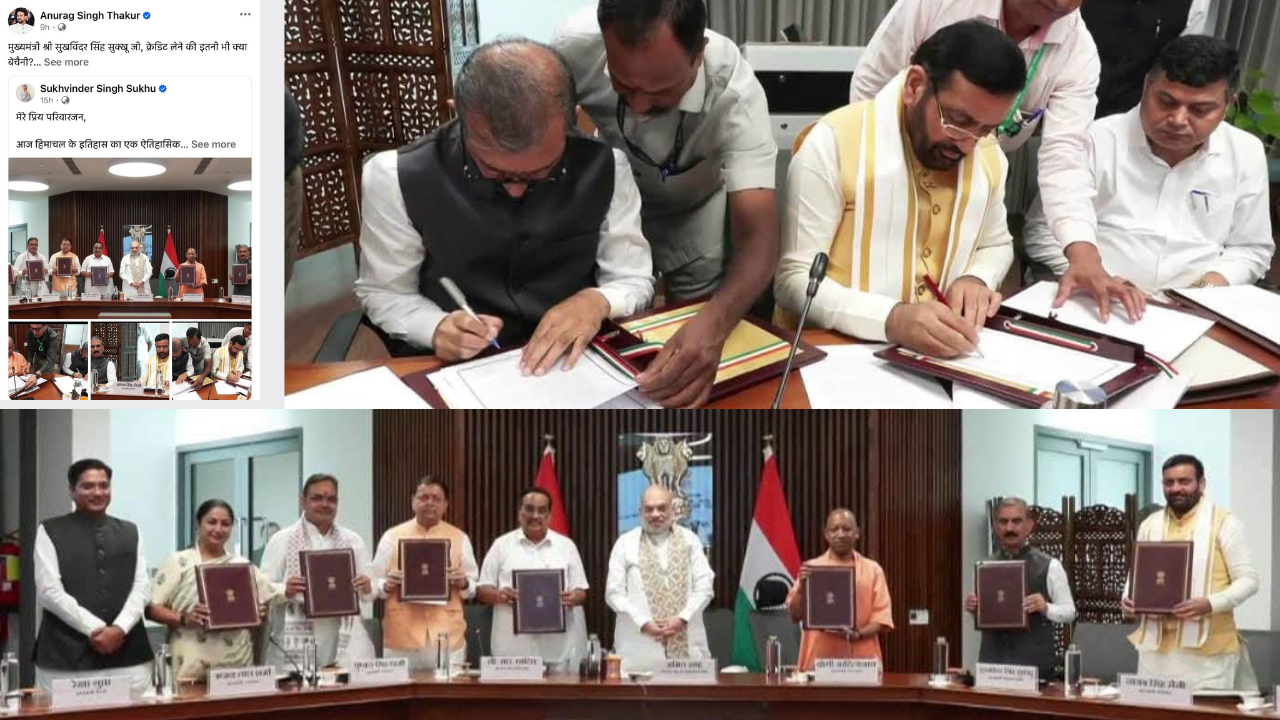
The Kishau agreement was signed on Tuesday by Himachal Pradesh, Uttarakhand, Uttar Pradesh, Haryana, Rajasthan and Delhi in the presence of Union Home Minister Amit Shah and Union Jal Shakti Minister C.R. Patil. The agreement seeks to resolve long-standing differences over water sharing, project financing and the distribution of benefits from the proposed project.
The Kishau project, planned on the Tons river, envisages a major multipurpose reservoir with benefits relating to water storage, drinking water supply, irrigation and power generation. The project is expected to generate about 1,379 million units of electricity annually.
A significant feature of the latest arrangement is the financing structure relating to Himachal Pradesh. Under the agreement, Delhi and Rajasthan will bear Himachal’s share of the project cost in a 75:25 ratio, corresponding to the water benefits accruing to the two states. Himachal, in turn, will receive financial compensation for the power generated from its share of the project.
The Centre is also providing substantial financial support for the water component of the project.
Jai Ram Thakur adds another political layer
Former Chief Minister and Leader of Opposition Jai Ram Thakur has also joined the debate, welcoming the agreement while emphasising the role of the Central Government and the participating states in resolving the long-standing issue.
His intervention has added another dimension to the political contest, particularly because the Kishau project has passed through several stages of negotiations under successive governments.
The BJP’s argument is that the project cannot be viewed exclusively through the prism of the present Himachal government, given the Centre’s role in bringing the states together and facilitating the final consensus.
The Congress government, on the other hand, has maintained that the crucial achievement for Himachal is the alteration of the financial arrangement and protection of the state’s interests.
Beyond the credit battle
The political dispute over Kishau is therefore emerging as much as a battle over the narrative of credit as over the project itself.
For the Sukhu government, the agreement represents the outcome of its insistence that Himachal should not shoulder an inequitable financial burden for a project whose water and power benefits extend beyond the state.
For the BJP, the agreement demonstrates the Centre’s role in resolving a long-standing inter-state issue through negotiations and consensus among six governments.
What remains beyond political claims is the larger significance of the agreement: after years of delays and disagreements, the six participating governments have now formally committed themselves to a common framework for taking the Kishau project forward.
The project’s next phase will involve translating the agreement into actual implementation, including financial arrangements, statutory clearances and construction-related processes.
For Himachal Pradesh, however, the immediate political question is already clear — whether Kishau will be remembered primarily as a victory of the state government’s negotiations or as the culmination of a wider Centre-led, multi-state process.
And with both sides now staking their claim, the Kishau project has acquired a new political life even before construction begins.