
Munish Sood
Mandi
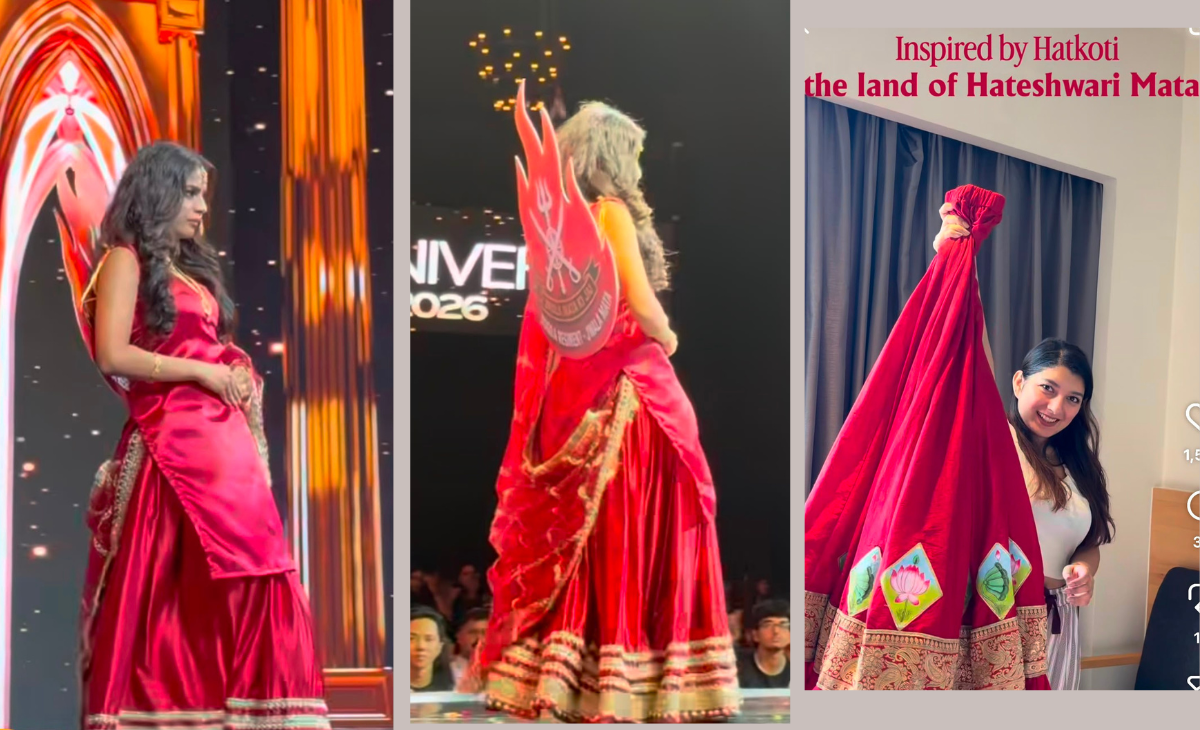
Himachal Pradesh’s traditional fashion stepped into the national spotlight at the Miss Universe India 2026 pageant in Jaipur, with the state’s iconic Kangra ghaghri making a striking appearance as part of the traditional attire showcased by Himachali contestants. The presentation brought the distinctive clothing heritage of the hills into one of the country’s most watched beauty platforms, placing a traditional garment rooted in Himachal’s cultural life alongside contemporary pageant fashion.
The appearance was particularly significant because the outfit was not presented simply as a generic “Pahari” costume. It drew upon the traditional ghaghri associated with Himachal’s regional dress traditions, including the cultural identity of Kangra, while the state’s representation also carried a strong connection with Hatkoti in Jubbal, Shimla district.
Sezer Pathania, one of the contestants representing Himachal Pradesh at Miss Universe India 2026, appeared in a traditional Himachali ghaghri, bringing the garment from the cultural landscape of the hills to the national pageant stage. The presentation gave contemporary visibility to a form of traditional women’s attire that has been part of Himachal’s social and cultural fabric for generations.
The Himachali ghaghri is more than an item of clothing. Traditionally worn with other regional elements of women’s attire, it reflects the diversity of the state’s textile traditions and the way clothing has evolved according to local customs, climate and craftsmanship. Across Himachal, traditional dress varies from one region to another, with Kangra, Shimla, Kullu, Mandi, Chamba and the tribal belts each having distinctive styles, fabrics, patterns and accessories.
The Kangra connection adds particular cultural significance to the pageant appearance. Kangra has a long and distinctive tradition of textiles, embroidery and women’s clothing, with the ghaghri forming part of the region’s traditional dress vocabulary. Bringing such an element into a national beauty contest represents a contemporary interpretation of that heritage rather than merely a costume presentation.
The Himachali presence at the pageant also had a strong connection with Hatkoti, an important cultural and religious centre in the Jubbal area of Shimla district. Snehal Rawat, who represented Himachal Pradesh in the national competition, hails from Hatkoti, linking the state’s pageant representation with the cultural traditions of the upper Shimla region.
Hatkoti, situated in the Pabbar valley, is renowned for its ancient temple complex and distinctive local traditions. The region has retained a strong cultural identity despite the changing social and economic landscape of the hills. Its association with a contestant on a national beauty platform consequently adds another dimension to Himachal’s representation.
Himachal Pradesh had three contestants — Sezer Pathania, Snehal Rawat and Swati Nadiyal — in the Miss Universe India 2026 field. Their participation provided the state with visibility at a national platform, but the incorporation of traditional Himachali attire gave that representation a distinctly cultural dimension.
What makes the moment noteworthy is the manner in which tradition and contemporary fashion came together. Instead of leaving traditional clothing confined to festivals, cultural functions or ceremonial occasions, the pageant provided an opportunity to reinterpret it for a modern audience while retaining its essential identity.
The development also comes at a time when India’s regional textiles, handlooms and indigenous fashion traditions are increasingly being incorporated into contemporary design. For Himachal, such platforms can help introduce younger audiences to traditional garments that might otherwise gradually disappear from everyday use.
The appearance of the Himachali ghaghri at Miss Universe India 2026, therefore, was not merely about pageant fashion. It was a moment in which Kangra’s traditional dress heritage, the cultural identity of Hatkoti and the contemporary aspirations of Himachal’s young women converged on a national stage.
From the homes and cultural traditions of the Himalayan hills to the spotlight of a national beauty pageant, the ghaghri has travelled a remarkable distance — carrying with it a distinctly Himachali story of identity, craftsmanship and tradition.