

Munish Sood
Mandi
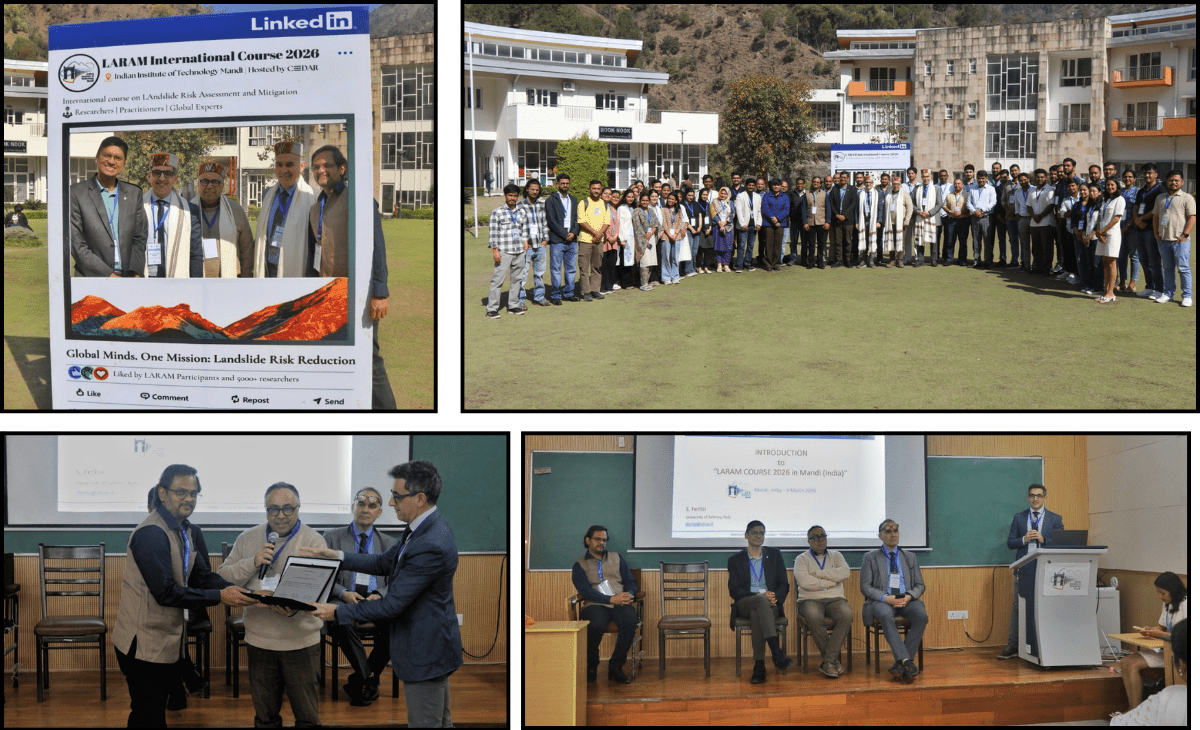
The Indian Institute of Technology (IIT) Mandi has launched the LARAM Course 2026 (Landslide Risk Assessment and Mitigation), a prestigious six-day international training programme aimed at enhancing global expertise and practical solutions for landslide disaster risk reduction. The programme marks the second time the internationally acclaimed LARAM School, Italy is being hosted in India in physical mode, bringing together leading scientists, researchers and professionals working in the field of disaster management and geotechnical engineering.
The LARAM School was established in 2005 by the Geotechnical Engineering Group of the University of Salerno, Italy, and has since evolved into a globally respected training platform for PhD scholars, young researchers, and professionals from fields such as civil engineering, environmental engineering, geology and earth sciences. Over the years, the programme has been conducted in several international locations including Italy, China and Switzerland, contributing significantly to the global exchange of knowledge on landslide risk assessment, forecasting and mitigation strategies.
The current edition of the course at IIT Mandi has attracted 10 internationally recognised experts from Switzerland, Italy, Norway and India, who will deliver lectures and specialised training sessions. Around 40 participants, including research scholars and professionals from different parts of India as well as a few international delegates, are taking part in the programme.
Experts noted that the course curriculum has been carefully designed keeping in view the unique geological and environmental challenges of the Himalayan region, where landslides frequently threaten human settlements, road networks and critical infrastructure. The training programme aims to equip participants with advanced scientific tools and interdisciplinary approaches that can help in better assessment, forecasting and mitigation of landslide risks in mountainous terrains.
The programme is being organised by the Centre for Climate Change and Disaster Management (C3DAR) at IIT Mandi with support from Tata Trusts, the National Disaster Management Authority (NDMA) and the Anusandhan National Research Foundation (ANRF). The six-day programme includes scientific lectures, interactive technical discussions and field exposure, enabling participants to study landslide-prone locations and understand real-world mitigation strategies.
Speaking on the occasion, Prof. Settimio Ferlisi, President of the LARAM School and faculty member at the University of Salerno, highlighted the importance of hosting the programme in the Himalayan region. He said the LARAM School has always aimed to build a strong international community of young researchers dedicated to reducing landslide risks. According to him, conducting the programme in the Himalayas provides participants with a unique opportunity to engage directly with one of the world’s most landslide-prone regions, thereby enriching both the scientific and practical dimensions of the training.
Dr. Kala Venkata Uday, Coordinator of LARAM Course 2026 and Chairperson of C3DAR at IIT Mandi, emphasized the need for stronger international collaboration to tackle disaster risks in mountain ecosystems. He pointed out that the Himalayan region faces complex landslide challenges due to fragile geological conditions, rapid infrastructure development and the growing impact of climate change. Platforms like the LARAM Course, he said, allow global experts and young researchers to exchange knowledge and develop strategies that can help build safer and more resilient mountain communities.
Hosting the LARAM Course 2026 at IIT Mandi highlights India’s expanding role in advancing research, training and international collaboration in landslide disaster risk reduction, particularly for the Himalayan region. Experts believe the programme will generate valuable insights for researchers, policymakers and disaster management authorities working towards sustainable and resilient development in mountainous environments.