
Munish Sood
Mandi
Hindi Diwas was observed with literary, creative and cultural activities at educational institutions across Mandi on Monday, with students showcasing their talent while speakers underlined the growing relevance of Hindi in education, journalism, digital media and the rapidly evolving world of artificial intelligence.
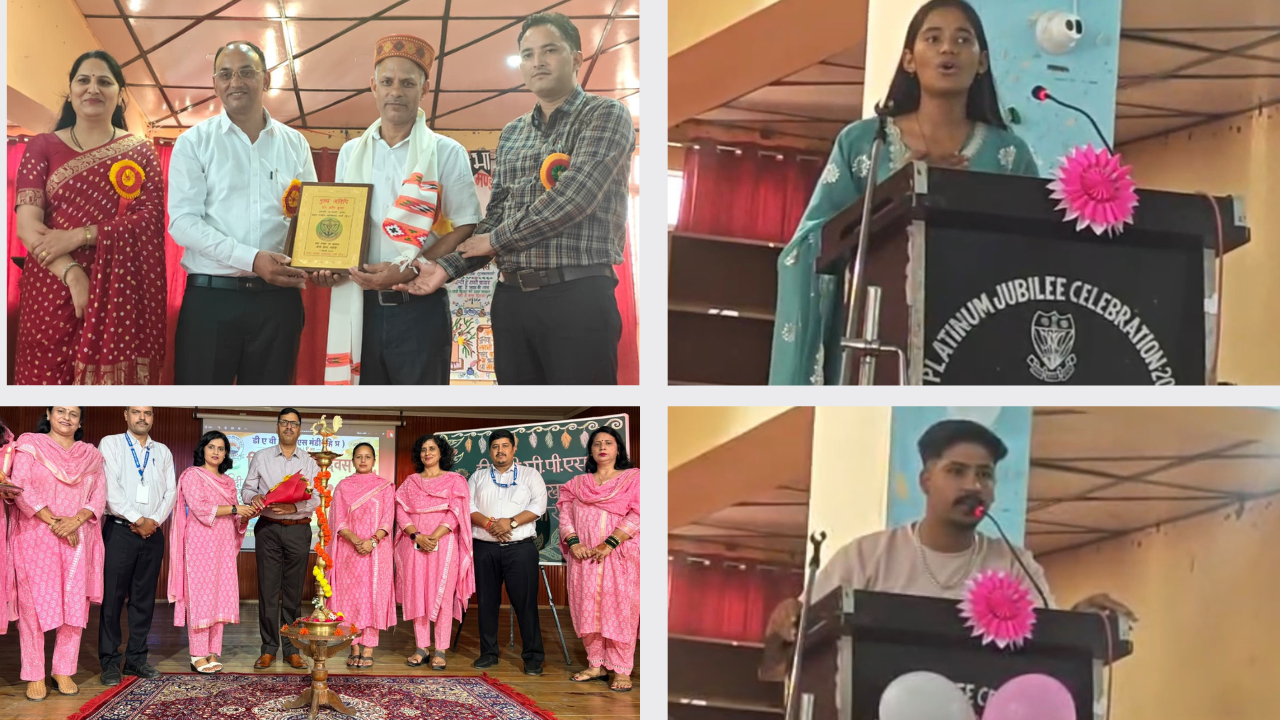
At Vallabh Government College, Mandi, the Hindi Department organised a series of competitions and cultural programmes to mark the occasion. The programme was presided over by acting Principal and Head of the Department of Geography, Dr Pradeep Kumar.
Addressing students, Dr Kumar said Hindi was not merely a medium of communication but an important carrier of Indian culture, literature, sensitivity and national unity. He encouraged students to develop a sense of pride in the language and promote its use in academic work, research, creative expression and everyday communication. He also pointed to the opportunities offered by the digital age, saying young people could play a major role in taking Hindi to a global audience through technology.
Head of the Hindi Department, Dr Dayak Ram, said Hindi had played an important role in preserving India’s rich literary and cultural heritage and strengthening social and national consciousness. He stressed that Hindi Diwas should not remain a one-day observance but should serve as a reminder of the need to continuously promote and expand the use of the language.
The college organised speech, essay writing, slogan writing, poetry recitation, quiz and cultural competitions. Students participated enthusiastically, displaying their literary skills, creativity and confidence.
In the speech competition, Yamini Sharma secured first position with 36.5 marks, followed by Lekh Raj with 34.5 marks and Dushyant with 33.5 marks. Heena stood fourth with 33 marks. In essay writing, Anchal won first place, Neha Devi second and Ankur/Ajuradha third. Karishma topped the slogan-writing competition, followed by Isha Chauhan and Anchal.
Anu Kumari won the poetry recitation competition, while Sheetal and Vijay Kumar secured second and third positions respectively. In the quiz, Group 3 comprising Tomesh, Sarika and Diya secured first position, while Group 1 comprising Kanika, Sukriti and Kusum Thakur stood second. Group 2 comprising Priya Bharti and Isha Chauhan was placed third.
The college’s Department of Journalism and Mass Communication also highlighted the changing role of Hindi in the media landscape. Department head Flying Officer Dr Chaman said Hindi journalism had contributed significantly to public awareness, social consciousness and democratic values. He said the expansion of digital and social media had taken Hindi beyond geographical boundaries, while AI and other emerging technologies were creating new opportunities for Hindi content in education, journalism, knowledge and creative fields.
Dr Chaman said Hindi cinema, literature, music and modern digital platforms had given the language a wider national and international presence. He described the younger generation as an important force in taking Hindi further onto the global stage.
The winners of various competitions were presented prizes and certificates by Dr Pradeep Kumar. The programme was supported by faculty members of the Hindi Department, including Dr Anju Sharma and Sarita.
Meanwhile, DAV Centenary Public School, Jawahar Nagar, Mandi, marked Hindi Diwas with the inauguration of a Hindi Fortnight, which will continue from September 14 to September 28.
Principal K.S. Guleria inaugurated the fortnight by lighting the ceremonial lamp and called upon all departments to increase the use of Hindi in the school’s academic and administrative activities. He also directed that the day’s proceedings, beginning with the morning prayer assembly, should encourage greater use of the official language.
According to Hindi Department head Sharmila, a range of activities have been planned during the fortnight to encourage students’ interest in Hindi and develop their creativity. These include word-tree activities for Class VI, slogan writing, synonym-based crossword puzzles, idiom comics, a ‘Meri Hindi Mera Samachar’ activity for Class VIII and a Hindi literature timeline competition for Class IX. Speech competitions, Hindi Antakshari and poetry recitation will also provide students with opportunities to showcase their talent.
The celebrations at both institutions reflected a common message—that Hindi’s relevance is no longer confined to classrooms and literature. From traditional cultural expression to journalism, social media, digital communication and artificial intelligence, the language continues to find new spaces and new audiences.