
Sunil Chadha
DHARAMSHALA:
In a small, mountainous state constrained by geography and often accused of political inertia, governments have long experimented with symbolic measures to keep various regions emotionally invested in the power structure.
Himachal Pradesh discovered its own version of a dual-capital model — something reminiscent of Jammu and Kashmir’s erstwhile Darbar Move. Instead of shifting capitals, the state crafted a unique arrangement: two functioning seats of the Assembly, one active in summer in Shimla and another operational in winter at Dharamshala, nearly 260 km away.
This unusual practice, which continues even today, can be traced back to former Chief Minister Virbhadra Singh, who found himself confronting persistent accusations of “stepmotherly treatment” toward Kangra, the state’s largest and politically most significant district.
Political heat pushes a new legislative geography
Through the 1990s, Kangra’s elected representatives frequently alleged that governance decisions were skewed towards upper Himachal.
In response, Virbhadra Singh began what was then an innovative outreach exercise: a winter sojourn introduced in 1994. For nearly a fortnight every year, he and his ministers would camp in Kangra, Chamba and Hamirpur, listening to grievances and reviewing development projects on the ground.
But the criticism didn’t entirely fade. By the early 2000s, the demand for stronger political presence in lower Himachal was louder. In 2005, Virbhadra took a decisive step: the first-ever Assembly session was convened in Dharamshala, breaking away from the long-standing tradition of keeping all sessions confined to Shimla. The move was both strategic and symbolic, an attempt to bridge the growing perception of regional imbalance.
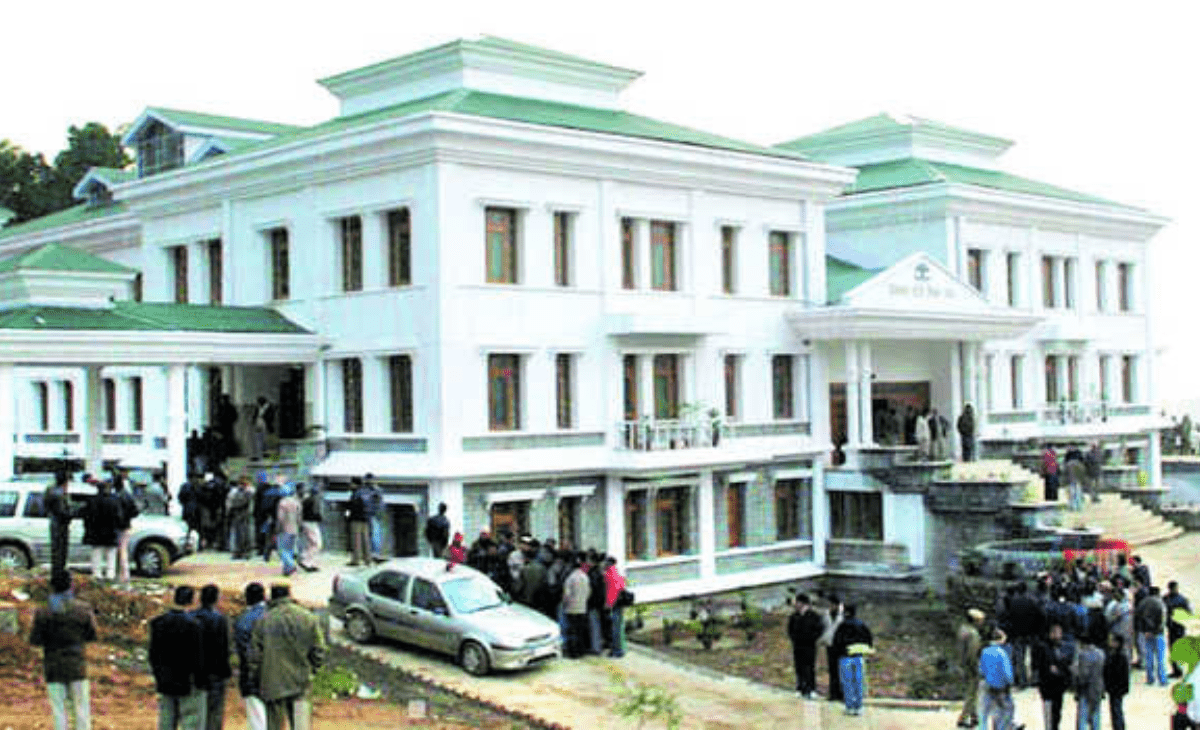
A year later, he went a step further. In 2006, the state government approved the construction of a dedicated Vidhan Sabha complex in Tapovan on Dharamshala’s outskirts, a location that opens to panoramic views of the Dhauladhar range. The building was completed by late 2008 at a cost of nearly Rs 12 crore.
The state government incurs crores of rupees every winter to transport the Assembly paraphernalia, ministers, bureaucrats, media teams and support staff to Dharamshala. The Speaker’s office, the Chief Minister’s Secretariat, ministers’ offices and even the Assembly administration temporarily shift base to the hill town.
Former Speaker BBL Butail had once remarked that the vast complex remained under-utilised and could be put to better use in the months when the House is not in session. But Virbhadra Singh always maintained that no monetary cost outweighs the emotional and administrative integration of lower Himachal.
His political logic was rooted in demographics: Kangra alone accounts for 15 Assembly seats, roughly a quarter of the state’s House strength. Its electoral behaviour is unpredictable as voters alternate between Congress and BJP every election cycle. A winter session in Dharamshala was meant to demonstrate the government’s commitment to the region and improve its political connect.
Leaders admit to heavy cost of exercise
Even though many leaders in both the Congress and the BJP admit privately that shifting the entire government machinery for a few days is inefficient and expensive, no party has dared scrap the tradition. The political risk of alienating Kangra, a district that can tilt electoral outcomes, makes the practice untouchable.
The Dharamshala Vidhan Sabha complex, meanwhile, is maintained year-round by a small permanent staff. Proposals to develop the building into a National e-Vidhan Training Centre have surfaced but have yet to materialise, though Himachal is the country’s first state to fully implement e-Vidhan systems for papers, bills and questions.
Today, under the leadership of Assembly Speaker Kuldeep Singh Pathania, the Dharamshala winter session continues to be an integral part of the state’s legislative calendar. The seasonal shift may not have delivered the electoral windfall once hoped for, but it has undeniably given lower Himachal a stronger sense of political presence, and cemented Dharamshala’s status as Himachal’s unofficial winter legislative seat.