
Shrey Awasthi
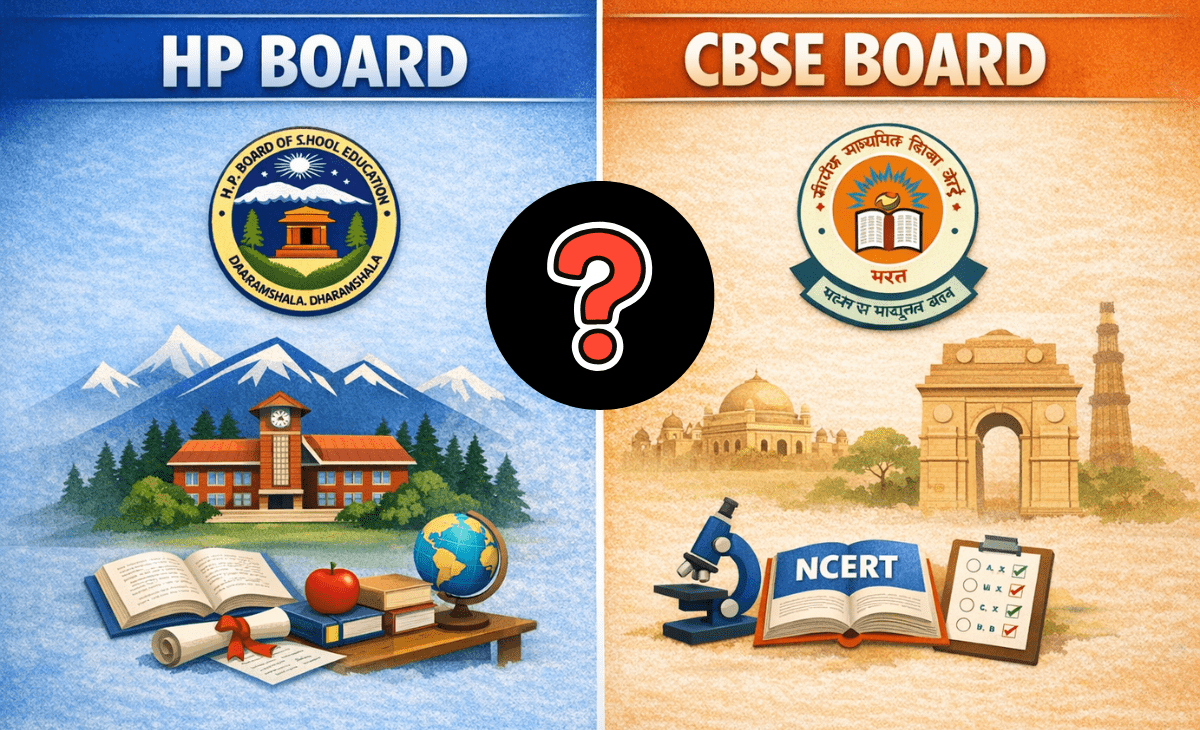
The Himachal Pradesh government’s recent decision to convert several government schools affiliated with the Himachal Pradesh Board of School Education (HPBOSE) into schools affiliated with the Central Board of Secondary Education (CBSE) has triggered a serious debate across the state.
The government has presented the move as an effort to improve academic standards and align school education with national benchmarks. However, the policy has also raised important questions about institutional credibility, teacher confidence and the long-term direction of public education in Himachal Pradesh.
Educational reforms must always be guided by careful planning, consultation with stakeholders and evidence-based policymaking. Unfortunately, the
decision to convert state board schools to CBSE appears to have been introduced without a comprehensive roadmap addressing the structural challenges within the education system.
The Government’s Proposal
According to official announcements, the state government plans to introduce the CBSE curriculum in a large number of government schools across Himachal Pradesh. In the first phase, around 145 government senior secondary schools are expected to be affiliated with CBSE starting from the 2026 academic session.
Reports also suggest that the reform may expand further, with approximately 140 additional schools being considered for CBSE affiliation in the next academic year. Earlier discussions within the education department indicated that as many as 200 schools could eventually adopt the CBSE curriculum, with some reports mentioning around 229 schools shortlisted for possible conversion.
The stated objective behind this decision is to improve academic competitiveness and help
students perform better in national-level competitive examinations.
While these goals are understandable, the key question remains: does changing the board affiliation truly address the core challenges faced by government schools in Himachal Pradesh?
Weakening the State Board
One of the most significant concerns raised by educationists is the message this policy sends about the credibility of the Himachal Pradesh Board of School Education.
For decades, HPBOSE has been the backbone of school education in the state. Thousands of teachers have built their careers within this system and generations of students have graduated under its framework.
Instead of strengthening the state board through curriculum reforms, teacher training and modern evaluation systems, the government now appears to be bypassing it.
When a government begins shifting its own institutions away from the state board, it indirectly signals that the board itself is inadequate. Such a perception can gradually weaken public confidence
in HPBOSE and create an unhealthy hierarchy in which CBSE schools are seen as superior to state board schools.
Over time, this could lead to increasing pressure from parents to convert all government schools to CBSE, effectively marginalising the state board altogether.
Reform Without Structural Improvement
Another major criticism of the policy is that it focuses on board affiliation rather than structural reform.
The real challenges facing government schools in Himachal Pradesh are well known:
- shortage of teachers in several subjects
- outdated infrastructure in many rural schools
- lack of laboratories and digital facilities
- increasing administrative burdens on teachers
Changing the examination board does not automatically resolve any of these problems.
Even government reviews have indicated that only around 86 schools initially met the infrastructure requirements for CBSE affiliation, while many others require significant upgrades before they can meet
CBSE norms.
If schools lack the necessary infrastructure, laboratories and digital facilities, the conversion risks becoming symbolic rather than substantive.
The Financial Cost
Another aspect that has received relatively little attention is the financial burden of converting government schools to CBSE.
The affiliation process itself involves substantial expenditure. Reports indicate that CBSE registration, inspection and affiliation procedures can cost around ₹70,000 per school, excluding the additional expenses required to upgrade infrastructure according to CBSE standards.
When multiplied across dozens or even hundreds of schools, this cost becomes considerable. Further expenditure will also be required for:
- teacher training programmes
- new textbooks and curriculum materials
- laboratory development
- digital classrooms
- administrative restructuring
At a time when many government schools still struggle with basic facilities, critics argue that these
resources might have been better invested in strengthening existing institutions.
Teachers and the Screening Test Controversy
Perhaps the most controversial aspect of the transition is the proposed screening test for teachers who wish to teach in the newly converted CBSE government schools.
According to reports, the Himachal Pradesh Board of School Education itself will conduct a screening examination, and only teachers who qualify this test will be allowed to teach in CBSE-affiliated schools.
This has created widespread anxiety among teachers across the state.
Many of these educators were recruited through rigorous competitive processes conducted by the Himachal Pradesh Public Service Commission (HPPSC) or the Himachal Pradesh Staff Selection Commission (HPSSC). They cleared written examinations, interviews and eligibility criteria before joining the government education system.
Requiring these same teachers to once again prove their competence through a screening examination raises serious questions about institutional trust.
The situation becomes even more concerning because the screening test is reportedly scheduled for March, leaving teachers with very little time to prepare or fully understand the implications of the new policy.
For teachers who have dedicated years of service within the HPBOSE framework, such a move appears less like educational reform and more like an administrative burden that may demoralise the teaching community.
Rural Education Realities
Himachal Pradesh has a unique educational landscape shaped by difficult terrain and scattered populations. Many government schools are located in remote hill regions where accessibility, teacher availability and student enrollment patterns differ significantly from urban areas.
Policies designed with metropolitan education systems in mind may not always be suitable for such contexts.
The government itself has acknowledged structural challenges in the state’s education system. Recent reviews revealed that 770 schools with zero enrollment were denotified, while 532 schools with fewer than five students were merged with nearby
institutions as part of broader reforms.
These figures suggest that the real issue in many areas is declining enrollment rather than curriculum quality.
Converting such schools to CBSE may not address the underlying causes of the problem.
Risk of a Two-Tier Government School System
Another unintended consequence of the policy could be the creation of a two-tier system within government education.
Once some government schools become CBSE-affiliated while others remain under HPBOSE, differences in perception and opportunity may emerge.
Students studying in CBSE schools may be perceived as receiving better education, while those in state board schools may feel disadvantaged.
This could lead to:
- unequal distribution of resources
- unhealthy competition between government schools
- migration of students between institutions
Such disparities could weaken the cohesion of the public education system.
Ignoring the Potential of HPBOSE
Ironically, while the government is shifting schools towards CBSE, the state board itself has been strengthening its capabilities.
HPBOSE recently received recognition from the National Council for Vocational Education and Training (NCVET), enabling it to design and certify vocational courses under the National Skills Qualification Framework (NSQF).
This recognition creates opportunities for skill-based education aligned with Himachal Pradesh’s local economy, including sectors such as horticulture, agriculture and tourism.
Instead of sidelining the state board, policymakers could have invested in strengthening these initiatives to make HPBOSE more innovative and relevant.
A Balanced Reform Strategy
Educational reform should not be reduced to a binary choice between CBSE and state boards. Both systems have their strengths.
CBSE offers national standardisation and alignment
with competitive examinations. State boards, on the other hand, are often better positioned to integrate regional history, geography and socio-economic realities into the curriculum.
For a diverse hill state like Himachal Pradesh, a balanced approach would involve:
- modernising the HPBOSE curriculum
- investing in school infrastructure
- strengthening teacher training systems
- expanding vocational education linked to local industries
Such reforms would strengthen the education ecosystem without undermining the institutions that have served the state for decades.
The government’s decision to convert HP Board schools into CBSE institutions may have been motivated by the desire to improve educational outcomes. However, meaningful reform requires more than simply changing the board affiliation.
Education policy must prioritise strengthening classrooms, empowering teachers and building institutional capacity.
Himachal Pradesh has long been recognised for its
achievements in school education and literacy. Preserving that legacy requires thoughtful and inclusive reforms — not policies that risk weakening the very institutions that built it.
If the goal is truly to improve the quality of education, the focus must remain on strengthening the system, not replacing it.
(Views are personal)
Shrey Awasthi
Social Media Co-Convenor, BJP Himachal Pradesh