

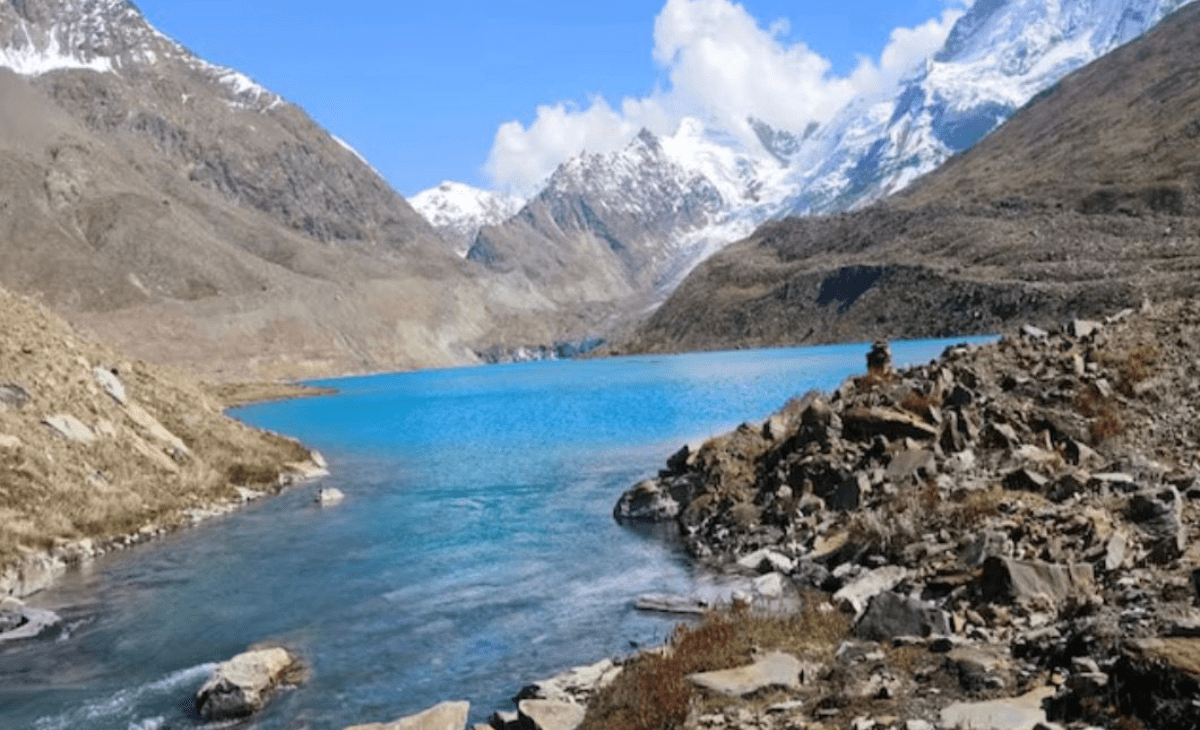
Rapid expansion of Ghepan Lake triggers alarm amid global warming
Munish Sood
MANDI: High in the Indian Himalayas, a remote glacial lake has become the latest symbol of the world’s escalating climate emergency. Ghepan Lake, perched at 13,583 feet above sea level in Himachal Pradesh’s Lahaul-Spiti district, has expanded by a staggering 173 per cent over the last three decades, raising fears of a potential glacial lake outburst flood (GLOF) that could endanger communities stretching from India’s Chenab Valley to parts of Jammu, Kashmir, and even Pakistan.
The National Remote Sensing Centre (NRSC) has classified Ghepan Lake as one of the most vulnerable glacial water bodies in the western Himalayas. The lake now spans over 101 hectares and holds nearly 35 million cubic metres of water, a volume large enough to trigger catastrophic flooding downstream if the natural embankments give way.
This alarming expansion, experts say, is a direct outcome of accelerated glacier melt caused by global warming. Rising temperatures and erratic precipitation have destabilized the region’s delicate cryosphere, with snowfall patterns shifting dramatically over the last decade.
Once known for its steady snowpack and dry climate, Lahaul Valley now witnesses frequent flash floods and unpredictable weather, signs of a fragile ecosystem under strain.
India moves toward technological preparedness
Responding to these findings, local authorities have initiated the installation of Himachal Pradesh’s first satellite-based early warning system (EWS) at Ghepan Lake. The system will provide real-time hazard alerts to the Meteorological Department and disaster management teams, enabling early evacuation measures in case of sudden lake instability.
Deputy Commissioner Kiran Badana confirmed that multidisciplinary teams comprising experts from the Forest Department, CSIR and other scientific institutions are also working to stabilise surrounding slopes and reduce soil erosion that could trigger further destabilisation.
“The early warning system will not only safeguard Lahaul Valley but also protect downstream regions along the Chenab River basin,” she said, calling the move “a milestone in proactive climate risk management”.
Scientific vigilance and global implications
The Centre for Development of Advanced Computing (C-DAC) and the Central Water Commission have been monitoring the lake for years through high-resolution satellite imaging. Their recent joint study confirms that the lake is now 2.46 km long and 625 meters wide, fed by glacial runoff that continues to intensify as the regional climate warms.
The NRSC’s latest report warns that if unchecked, Ghepan’s expansion could lead to “a chain reaction of glacial failures” across nearby valleys, amplifying the risk of floods and landslides. This pattern mirrors developments in the greater Himalayas — from Nepal to Bhutan — where hundreds of glacial lakes are swelling at unprecedented rates, threatening millions who depend on these mountain ecosystems for water and livelihood.
Global warming’s footprint in the Himalayas
Scientists consider the Ghepan Lake expansion a clear warning of how climate change is redrawing the geography of the Himalayas. The combination of rising surface temperatures, thinning glaciers, and shifting precipitation patterns is altering ancient hydrological balances that have sustained mountain civilizations for centuries.
Environmental experts argue that while early warning systems and slope stabilization offer short-term safety, the deeper solution lies in global climate action. “The Himalayas are warming nearly twice as fast as the global average,” noted one researcher involved in the study. “Ghepan Lake is not just a local hazard — it’s a mirror reflecting the urgency of our planet’s crisis.”
Balancing tourism and safety
Located a few hours beyond the Atal Tunnel, Ghepan Lake has recently gained popularity among adventure trekkers and photographers drawn to its pristine blue waters. However, authorities have now restricted unregulated trekking in the area until safety systems are fully operational.
The administration hopes to operationalise the early warning system within months, marking a new chapter in India’s preparedness against climate-driven disasters. Yet, as the ice melts faster than ever before, the challenge remains immense — the battle to protect life in the high Himalayas has become a frontline in the broader fight against global warming.