
S Gopal Puri
Shimla : In an era when political identities often dominate even the interiors of government offices, Himachal Pradesh’s Education Minister Rohit Thakur has quietly redefined what public representation can look like.
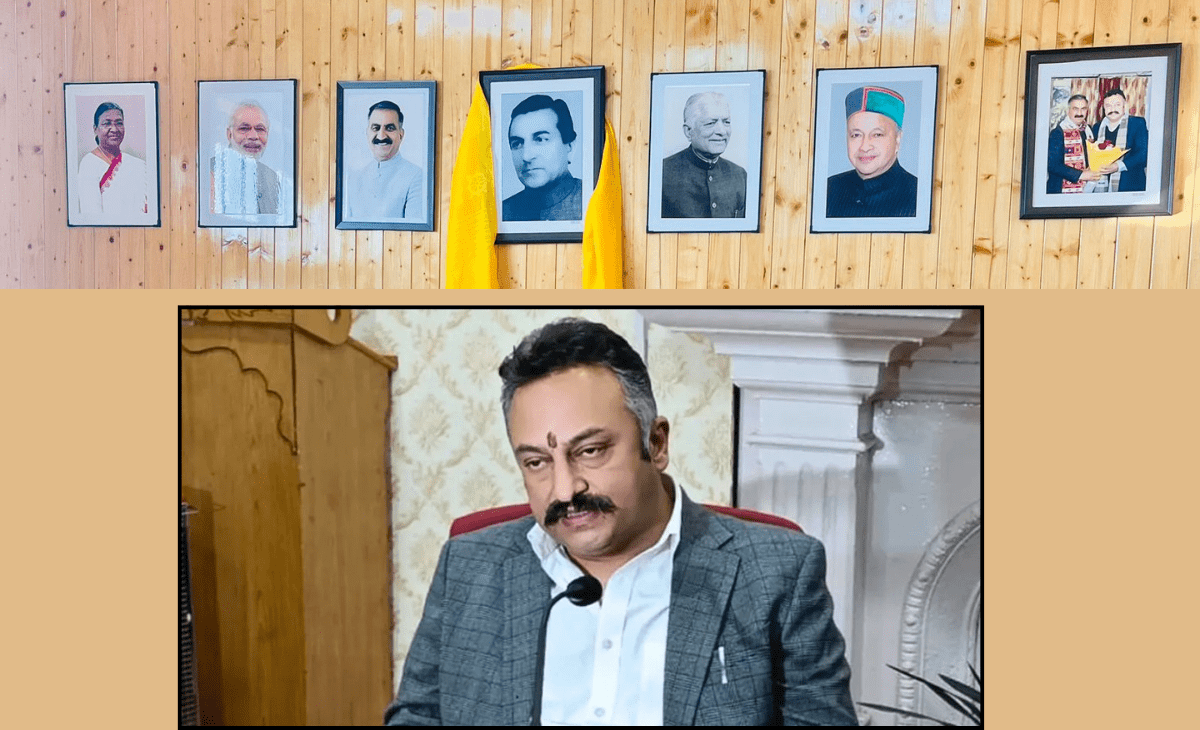
Walk into his wood-paneled office in Shimla, and one sight immediately stands out — a series of framed portraits adorning the wall behind his desk.
Among them are photographs of President Droupadi Murmu, Prime Minister Narendra Modi, former Chief Minister Virbhadra Singh, Chief Minister Sukhvinder Singh Sukhu, and Thakur’s late grandfather Thakur Ram Lal, himself a stalwart of Himachal politics.
This line-up is rare — even refreshing. In a political culture where most leaders display portraits only of figures aligned with their own party, Rohit Thakur’s office sends a very different message. It represents a silent but powerful tribute to India’s constitutional spirit — one that rises above party lines and honours the continuum of democratic leadership.
A Symbol Beyond Party Lines
For Rohit Thakur, this arrangement is not mere decoration. It’s a reflection of belief — that governance must be rooted in respect for institutions and leaders who represent the Republic, regardless of political differences.
In most ministerial offices, walls mirror partisan pride. Thakur’s, however, mirrors balance. The coexistence of portraits from different political ideologies underscores a conviction that service to people is larger than service to party.
For an education minister, that symbolism acquires deeper meaning. It offers a lesson — not from textbooks, but from visual values. The images behind his desk teach that respect for the Constitution is the highest political education.
A Legacy of Public Service
Rohit Thakur, a fourth-term legislator and grandson of former Chief Minister Thakur Ram Lal, represents the Jubbal–Kotkhai constituency in Himachal Pradesh. He has carried forward a family tradition of public life defined by accessibility and restraint. His political conduct often reflects his belief that humility and institutional respect are essential to good governance.
Action Beyond Symbolism
Since taking charge as Education Minister, Rohit Thakur has emphasized institutional rebuilding. From accelerating teacher recruitment to restoring monsoon-damaged schools, his focus has remained on strengthening systems rather than showcasing slogans.
He recently announced initiatives to introduce horticulture education in schools, expand Kendriya Vidyalayas, and fill thousands of vacant posts in government institutions — reforms that reflect his pragmatic, people-first approach.
What His Office Says
“These portraits remind us that leadership changes, but the Constitution remains,” says a senior official close to the minister.
“It’s not about politics—it’s about respect for institutions that hold the nation together.”
The Quiet Message
Rohit Thakur’s office, with its dignified arrangement of portraits, may seem a small detail — but in today’s climate of political polarization, such details matter.
The wooden walls of his room quietly narrate a story of inclusion, continuity, and constitutional commitment.
In their silence, they echo something powerful: that public service, at its best, belongs not to a party, but to the people.