
Munish Sood
Mandi
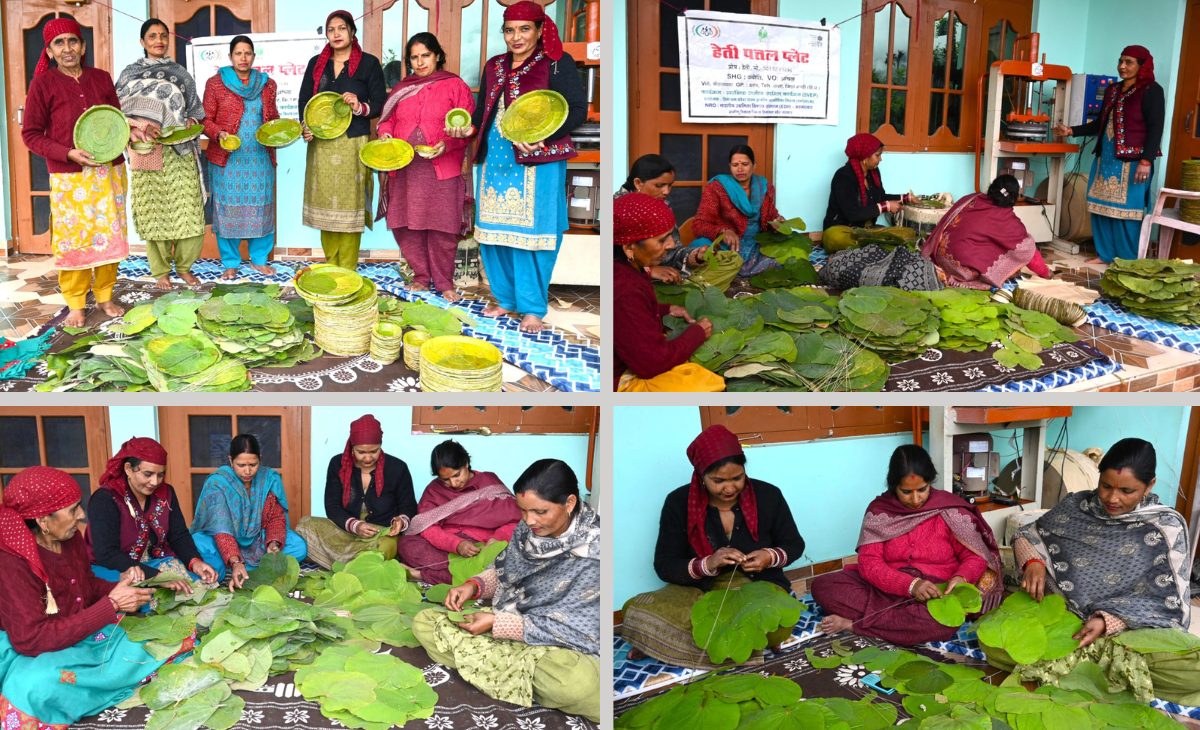
In a compelling example of rural entrepreneurship and women’s empowerment, members of the Jyoti Self-Help Group in Bihandhar village near Mandi are achieving financial independence through the production of eco-friendly leaf plates.
Among them, Hety Devi has emerged as a success story, turning a traditional practice into a steady source of income. Associated with the group since 2018 and currently serving as its secretary, she manufactures biodegradable pattal (leaf plates) made from leaves of the Tour tree, widely used during weddings and community feasts across the region.
Initially, Hety Devi produced the plates manually, earning around ₹5,000 per month. However, her income saw a significant rise after 2023 when she received a plate-making machine from the local development block. With mechanised production, her monthly earnings have increased to approximately ₹10,000, depending on market demand. The Himachal Pradesh State Rural Livelihood Mission has played a key role in supporting such initiatives.
The group maintains a clear pricing structure, with handmade plates selling at ₹200 per hundred and machine-made plates at ₹400 per hundred. Similarly, handmade leaf bowls (doonas) are priced at ₹100 per hundred, while machine-made ones fetch ₹200 per hundred.
Adapting to changing times, the group has also adopted digital platforms to expand its reach. “We now receive orders through mobile phones, which has streamlined our business,” Hety Devi said, while expressing gratitude to Chief Minister Sukhvinder Singh Sukhu for supporting such livelihood initiatives.
Jyoti Self-Help Group President Tripta Devi informed that the group, formed in 2018, consists of six women and has been provided a revolving fund of ₹40,000 by the government. This has enabled internal lending among members and strengthened their economic base. She added that the group earns between ₹1 lakh and ₹1.5 lakh annually through the enterprise, helping sustain their households. The government has also facilitated access to machinery for scaling up production.
Deputy Commissioner Apurva Devgan said that self-help groups are playing a pivotal role in promoting women’s self-reliance at the grassroots level. He added that the district administration is taking all necessary steps to strengthen such groups in line with government directives.
The initiative highlights how convergence of government support, local skills and market linkage is driving sustainable livelihoods and empowering rural women in Himachal Pradesh.