
Sunil Chadha
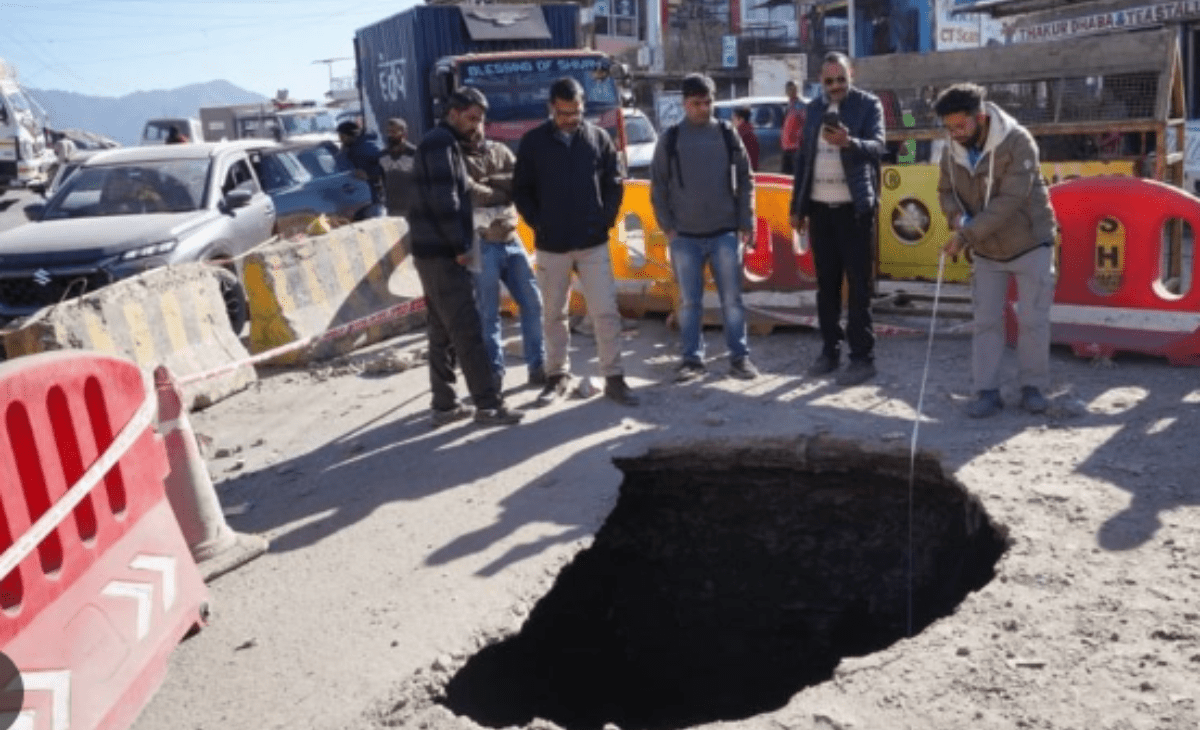
SHIMLA: A probe report submitted by the Geological Survey of India (GSI) has held four-lane tunnelling work and water pipeline leakage responsible for the sudden appearance of a large ditch on the Bhattakufar road on the outskirts of Shimla.
The report was handed over to Shimla Deputy Commissioner Anupam Kashyap on Tuesday (December 16, 2025), nearly three weeks after the incident that raised concerns over the safety of residents living near the project site. A girl had fell into the ditch as the rear tyre of the school bus she alighted from got stuck in it.
According to the GSI assessment, the cave-in occurred on November 22, 2025, and involved a cavity measuring about 2.2 metres in length, 1.5 metres in width and nearly 4 metres in depth along the roadside at Bhattakufar. The scientific body identified leakage from two underground water pipelines as the primary trigger, while categorising tunnelling-related vibrations and other construction activities as secondary, human-induced factors.
Blasting to be stopped, manual work allowed
The report has recommended an immediate halt to blasting activities linked to tunnel construction in the area. However, it has not objected to manual construction work continuing under close supervision. Officials said the vibrations caused by blasting may have aggravated subsurface instability, particularly in a zone already weakened by continuous water seepage.
Following the submission of the report, the Deputy Commissioner sought a detailed explanation from the company executing the tunnel project. The firm has been asked to provide all records related to surveys conducted when tunnelling work began in March 2024, along with documentation of correspondence exchanged with the district administration during the construction phase.
“The company has been directed to submit details of what preventive measures were suggested by authorities and when, and how and when those measures were implemented,” Kashyap said.
Safety of residents a priority, says DC
Emphasising that public safety remains the administration’s top priority, the Deputy Commissioner said cracks have already appeared in several houses located within the tunnel’s influence zone during four-lane construction. District officials have carried out field inspections to assess the extent of damage.
While the construction company will prepare a formal damage assessment report, the district administration has assured residents that it will extend all possible support to ensure compensation for affected households. “Protecting lives and property is non-negotiable,” Kashyap said.
Water pipes repaired, further mapping ordered
The GSI report noted that leakage from water pipelines significantly contributed to soil erosion beneath the road surface. Officials from the Jal Shakti department carried out immediate repairs after identifying a faulty reducer that had caused persistent leakage.
The deputy commissioner has now asked the department to submit a comprehensive report mapping all underground water pipelines in areas impacted by tunnelling work. The objective, officials said, is to prevent similar incidents by ensuring that construction agencies are fully aware of subsurface utility networks.
“The GSI has clearly pointed out that pipe leakage was the dominant factor,” Kashyap said, adding that corrective steps have already been initiated.
The review meeting was attended by additional district magistrate (protocol) Jyoti Rana, district revenue officer Sumedh Sharma and other senior officials. The administration is expected to take a call on further regulatory action once responses from the construction company and line departments are received.
The incident has once again brought focus on the environmental and structural risks associated with large infrastructure projects in the fragile Himalayan region, particularly in densely inhabited urban pockets like Shimla.