

Heritage landmark blending royal legacy and public service
Munish Sood
MANDI:
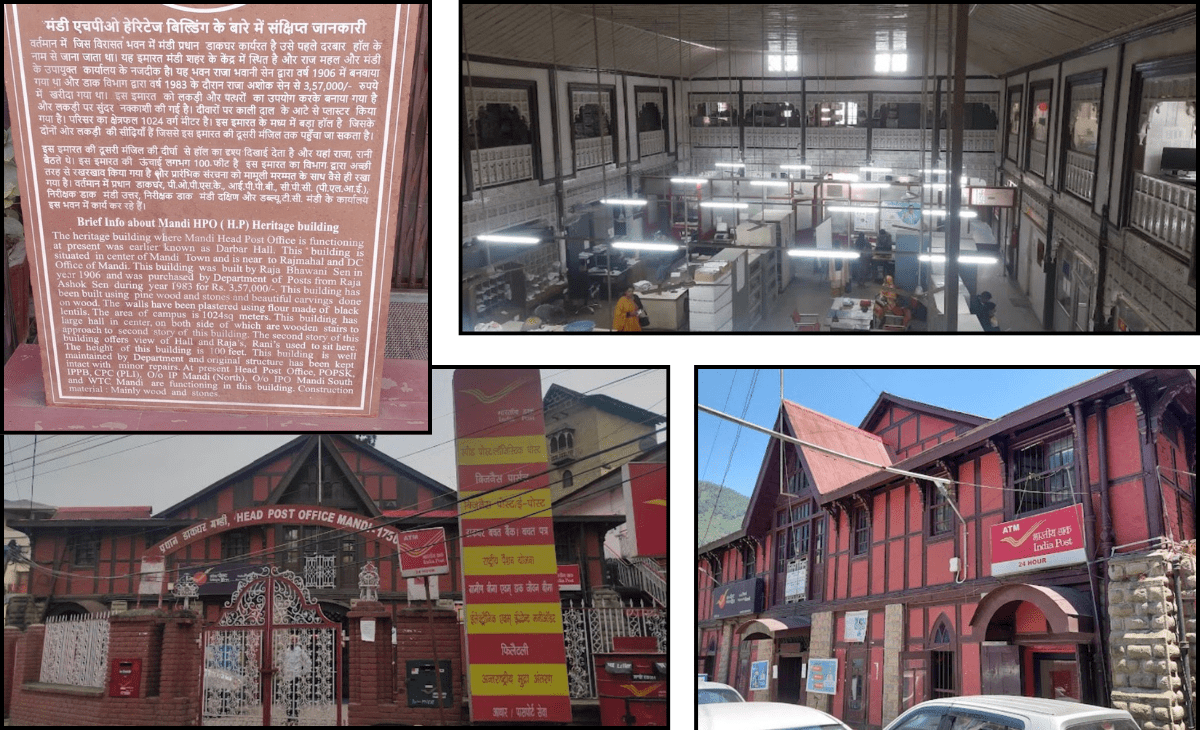
The iconic heritage building that today houses the Mandi Head Post Office (HPO) is not just a functional government facility but one of the town’s most treasured historical structures. Once known as the Darbar Hall of the Mandi royal family, the building stands at the heart of the city, close to the Raj Mahal and the office of the Deputy Commissioner.
Its walls, carved beams and traditional architecture continue to echo the royal past of the erstwhile princely state.
The current HPO building was constructed in 1906 by Raja Bhawani Sen. Its craftsmanship reflects the finest elements of Pahari hill architecture. Built using a blend of stone and intricately carved wood, the building features walls plastered with a traditional mixture involving black lentil flour, a method unique to the region.
The post office department purchased the building in 1983 from Raja Ashok Sen for Rs 3,57,000. Spanning an area of 1,024 square metres, the structure has been carefully maintained, with only minimal repairs over the years to preserve its original form.
Building 100 feet in height
At the heart of the building lies a grand hall, flanked by wooden staircases that lead to the second-floor gallery. This gallery once served as the viewing deck for the king and queen, offering a complete view of the ceremonial proceedings held below.
The building rises nearly 100 feet, giving it a majestic presence even today. Currently, the premises house several important wings of the postal system, including Mandi Head Post Office, POPSK, IPPB, CPC(PLIA), Inspector Post (Mandi North & Mandi South) and the WTC-Mandi.
Darbar Hall and its deep historical roots
Historically, the Darbar Hall was part of the larger Raj Mahal palace complex, an administrative and cultural centre of the Mandi State. Unlike Solan’s Darbar Hall, where the decision to form Himachal Pradesh was taken, the Mandi Darbar Hall primarily functioned as the royal court. It served as the venue where rulers held official meetings, dispensed justice, interacted with the public, and conducted important ceremonies.
The town of Mandi itself dates back to 1526 AD, founded by Raja Ajbar Sen. Over generations, successive rulers expanded the palace complex, creating an architectural legacy that British traveller Moorscraft described in the 19th century as a striking white structure with a distinctive blue slate roof.
Evolution of postal establishment
While the exact construction history of the present post office building is not fully documented, it is linked to the period of Raja Vijay Sen, known for ushering in several public services, including early postal facilities. Later, during the British rule, especially when Raja Joginder Sen was a minor, the state’s administration underwent significant restructuring. This phase likely saw the formal establishment or reorganisation of the head post office as part of wider modernisation efforts.
Today, the Darbar Hall-turned-Head Post Office stands as a rare example of heritage that is both preserved and actively used. Its architecture, history and continued relevance make it one of Mandi’s most compelling cultural landmarks.
For a town celebrated for its ancient temples, royal history and Himalayan charm, this heritage post office remains a proud symbol of the fusion between Mandi’s regal past and its modern public life.