
Youth-driven movement works wonders without help from govt
Munish Sood
MANDI:
Hidden for decades beneath dense forests and layers of soil, a centuries-old Shiva temple in Harabag village of Jogindernagar in Mandi district has been rediscovered, thanks to an extraordinary, youth-driven movement that has rekindled faith, history and collective consciousness in Devbhoomi Himachal Pradesh.
The Harabag Shiva Temple is more than a place of worship. Local belief, architectural features and oral traditions strongly suggest its origins date back to the Pandava era, making it a living testament to ancient Himalayan civilisation. Long erased from the physical landscape yet preserved in folklore, the temple’s rediscovery and revival in 2025 has emerged as one of the region’s most significant grassroots heritage movements.
Nestled deep inside forested slopes, the temple remained buried under debris and neglect for generations. Paths vanished, worship stopped and the structure slowly merged with the wilderness.
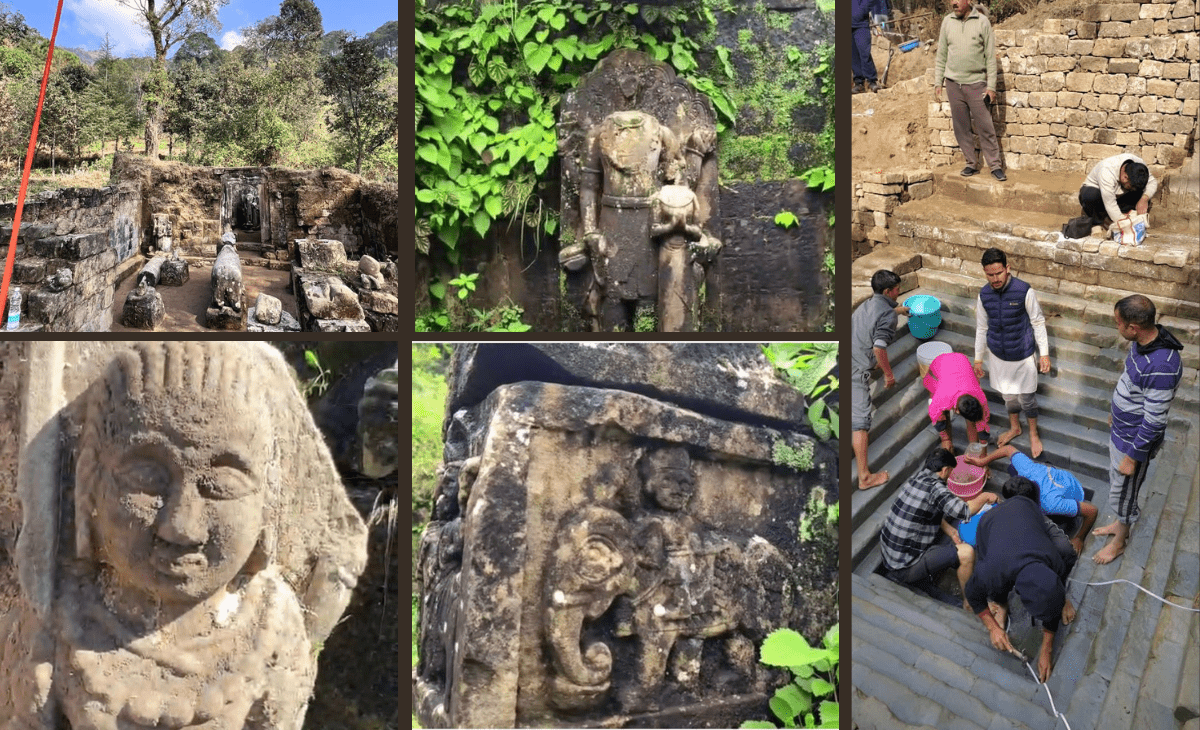
Yet, among elders and villagers, stories of the sacred site never faded. The temple’s stone craftsmanship, massive monolithic slabs, mortarless joints, broken Nandi idols and forest-based location mirror architectural traits seen in other Pandava-era temples across Himachal, including Baijnath and Mandi’s Panchvaktra Temple.

A natural water kund located before the shrine further enhances its historical and spiritual value. Locals believe the water holds medicinal and sacred properties, a belief still deeply respected.
Oral histories suggest the shrine once lay along an important route of the former Mandi princely state. It is believed that kings halted here for ritual bathing and Shiva worship before continuing their journeys. This indicates that the site functioned for centuries as a vibrant spiritual and social centre.
Destruction by invasions, earthquake
The temple bears scars of two major calamities. Mughal-era invasions in the 17th-18th centuries are believed to have damaged idols and structures, traces of which are visible even today.
Later, the devastating 1905 Kangra earthquake reportedly destroyed what remained, burying the temple completely under earth and forest growth. After that, worship ceased, access routes disappeared and the shrine survived only in legends.
Over time, fear and superstition surrounded the site. Proximity to cremation grounds, broken idols, wild animals and dense forest cover discouraged visits. For decades, the area remained abandoned until local youth chose to challenge the silence.
Efforts to unearth ancient treasure started in July 2025
On July 31, 2025, Jogindernagar zila parishad member Vijay Bhatia, along with local youth, formally approached the administration, writing to the SDM, the Chief Minister’s Office and the State Archaeology Department, seeking protection and revival of the ancient shrine. Despite repeated representations, no official survey or conservation effort followed for nearly three months.
Refusing to give up, the youth took the initiative themselves. Around the same time, Shiva devotee and social media influencer Shivansh Sharma reached the site. His videos revealed the temple’s actual condition to a national audience, triggering widespread attention and renewed local energy. For over one-and-a-half months, he stayed at the site, actively participating in voluntary service.
28 days of relentless voluntary service
What followed was an unprecedented 28-day shramdaan campaign. Volunteers carefully removed soil, bushes and debris, uncovered buried stones, studied the original layout and safeguarded each element. Gradually, the temple’s foundation, sanctum and sacred water kund re-emerged. People began arriving from distant areas to witness and support the effort.
On December 2, following a complaint, the district administration halted the activity, citing the land as government property. The youth clarified that no construction was underway, and that only cleaning, preservation and worship motivated by faith and service was being done.
In response, the volunteers took a dignified and symbolic step: broken idols were respectfully covered and regular worship of the ancient Shivling resumed. Morning and evening aartis began, priests were arranged and on December 15, a grand jagran and community feast saw participation from hundreds, becoming a powerful symbol of social unity.
Initiative receives massive public support
So far, over 1,000 people, including NCC and NSS volunteers, students, villagers, women and elders, have directly participated. Temporary waterproof shelters were installed to protect the structure from weather, all without altering the site or violating legal boundaries.
When the work was halted, the youth chose democratic engagement over confrontation. A signature campaign across Jogindernagar gathered over 3,000 signatures, cutting across age, gender and occupation, unanimously demanding official permission for the temple’s conservation and revival. Despite continued dialogue, the official stance remains unchanged.
The youth are now asking for only formal approval and guidance for the protection and revival of the ancient Pandava-era Harabag Shiva Temple.
This revival is not a social media trend but the result of sustained physical effort, sacrifice and coordination. Key contributors include Shivansh Sharma, Vijay Bhatia and local youth leaders Kuldeep Thakur, Gaurav Barwal, Manoj Labbu, Vikrant Bakshi, Prashant Bakshi, Aditya Singh, Ashish Awasthi, Vatsal, Shubham Walia, Rakesh Kumar and Nityanand Awasthi, along with Gram Sudhar Sabha Harabag, NCC/NSS volunteers, college students and village youth. Women of the area played a silent yet vital role through continuous service, food arrangements and ritual support.